
 Home Factors



What if your advertising could reach consumers when they’re actually ready to buy, rather than simply hoping they’re in the market?
That’s the advantage of in-market intent data.
For marketers, finding the right audience has always been important. But knowing when someone is likely to make a purchase can be just as valuable as knowing who they are.
A recent Connected TV (CTV) campaign from PGM and Scale Marketing put that idea to the test.
The result? PGM’s in-market HVAC audience outperformed other targeting audiences and providers by an average of 35%.
Here’s what happened, why it matters, and how marketers can apply these insights to their own audience strategies.

The Challenge of Reaching Customers at the Right Time
Think about buying a new HVAC system.
Most homeowners aren’t shopping for one every day. In fact, once a system is replaced, they may not need another for eight to ten years.
But when the need arises? The purchase decision can happen quickly.
That creates a challenge for marketers. Traditional targeting can help identify homeowners who fit a particular demographic or lifestyle profile, but it doesn’t necessarily tell you who is actively considering a purchase. And that difference matters.
A homeowner who might need a new HVAC system someday is very different from one researching replacement options today.
The opportunity is to reach consumers when their needs, interests and purchase intentions align with what you’re selling.
The Case Study: Putting In-Market Intent Data to the Test
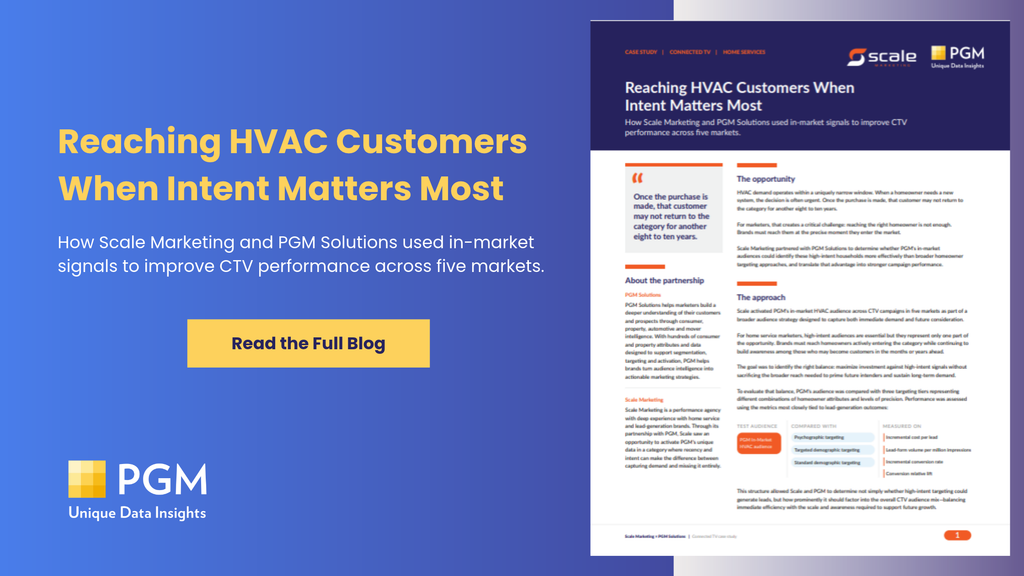
Scale Marketing partnered with PGM to evaluate whether in-market HVAC audiences could outperform broader homeowner targeting in CTV campaigns.
The campaign ran across five markets and compared four audience approaches:
- PGM’s in-market HVAC audience
- Third-party psychographic targeting
- Third-party targeted demographic audiences
- Third-party standard demographic audiences
Performance was evaluated using incremental cost per lead, lead-form volume per million impressions, conversion rates and relative conversion lift.
The goal wasn’t simply to generate leads. It was to understand how more targeted audiences could improve efficiency while maintaining enough scale to support ongoing campaigns.
The Results: Better Targeting, Better Performance
The results demonstrated the value of reaching consumers with timely purchase intent.
PGM’s in-market audience delivered the strongest overall performance, outperforming the other targeting audiences and providers by an average of 35%.
Key Campaign Results
| Metric | PGM In-Market Audience | Standard Demographic Audience |
| Incremental cost per lead | $405 | $626 |
| Lead forms per million impressions | 49.9 | 34.1 |
| Conversion relative lift | 2.9x | 1.8x |
PGM’s audience achieved a 35% lower incremental cost per lead compared with standard demographic targeting, while generating approximately 46% more lead forms per million impressions.
The findings also highlighted an important consideration: broader reach doesn’t automatically translate into stronger performance.
Standard demographic targeting accounted for roughly half of total campaign spend but delivered the weakest cost per lead and lowest lead-form rate among the audiences tested.
For marketers looking to improve advertising efficiency, the takeaway is clear.
Who you reach matters. When you reach them matters, too.
What Is In-Market Intent Data?
In-market intent data helps marketers identify consumers who may be actively researching, considering or preparing to purchase products and services.
Unlike traditional demographic targeting, which focuses on characteristics such as age, income or homeownership, intent data adds another dimension: potential purchase readiness.
For example, a home services company might want to reach:
- Homeowners researching HVAC replacement
- Consumers considering roofing or window projects
- Households exploring home improvement services
- People showing interest in specific products or categories
Rather than treating every homeowner as an equally likely prospect, marketers can prioritize audiences whose recent activity suggests greater interest in a particular category.
That doesn’t mean broader targeting goes away. It means marketers can build a more balanced strategy that reaches both consumers who may be ready to act and those who could become customers in the future.
Build Smarter Audiences With PGM Signals and People Factors
The HVAC case study demonstrates the value of in-market intent, but purchase readiness is just one part of effective audience targeting.
PGM helps marketers combine different types of consumer intelligence to better understand who they’re reaching, what matters to them and when they may be ready to take action.
PGM Signals: Reach Consumers Showing Purchase Intent
PGM Signals helps marketers identify consumers demonstrating interest or potential purchase intent across relevant product and service categories.
Instead of relying exclusively on broad audience characteristics, marketers can use intent-based insights to identify consumers who may be actively considering a purchase.
For example, a home services marketer could use in-market HVAC audiences to focus advertising on households showing interest in heating and cooling services.
How marketers can use PGM Signals:
- Identify audiences with relevant purchase intent
- Prioritize consumers who may be closer to making a decision
- Build category-specific prospecting audiences
- Support more relevant advertising across channels
- Complement broader awareness campaigns with intent-based targeting
As the Scale Marketing case study shows, reaching consumers based on timely intent can improve campaign efficiency and lead generation performance.

People Factors: Understand More About Your Audience
Intent tells you what consumers may be considering.
But what about who they are?
PGM People Factors provides consumer intelligence to help marketers understand audiences beyond basic demographics.
With coverage of more than 250 million consumer profiles and over 700 attributes, People Factors supports audience segmentation using demographic, household, lifestyle and other consumer characteristics.
Marketers can use this information to create more relevant audiences based on the characteristics that matter to their business.
How marketers can use People Factors:
- Build audiences using demographic and household attributes
- Identify consumers based on lifestyle interests and characteristics
- Create more targeted prospecting segments
- Enrich existing customer data for deeper audience insights
- Support personalized and multichannel marketing strategies
For example, a home improvement brand might use People Factors to identify homeowners who match its ideal customer profile, then complement that audience strategy with in-market intent data to reach consumers who may be actively considering a project.
Why Intent and Consumer Data Work Better Together
Think of it this way.
People Factors helps answer: Who is my ideal customer?
PGM Signals helps answer: Who may be ready to buy?
Together, these insights can help marketers move beyond broad targeting to develop more relevant audience strategies.
A marketer might use People Factors to define an ideal customer profile, then use PGM Signals to identify consumers demonstrating interest in the products or services being advertised.
The result is a more informed approach to audience selection that considers both customer fit and potential purchase timing.
3 Lessons Marketers Can Take From This Case Study
1. Don’t Confuse Audience Size With Audience Quality
A larger audience isn’t necessarily a better audience.
The HVAC campaign showed that standard demographic targeting delivered lower lead-generation efficiency than PGM’s more focused in-market audience.
Before expanding reach, consider whether your audience includes consumers who are genuinely likely to be interested in what you’re selling.
2. Make Purchase Timing Part of Your Targeting Strategy
Some purchases happen frequently. Others happen only once every several years.
For categories with short buying windows, reaching consumers when they’re actively considering a purchase can make a meaningful difference.
Intent data gives marketers another way to identify those opportunities.
3. Balance Immediate Demand With Long-Term Awareness
Not every consumer is ready to buy today.
That’s why an effective audience strategy should consider both short-term demand generation and longer-term brand awareness.
Use intent-based audiences to focus on consumers who may be closer to making a decision, while maintaining broader campaigns to reach future buyers.
The right mix will depend on your category, campaign objectives and available budget.

Frequently Asked Questions About In-Market Intent Data
What is in-market intent data?
In-market intent data helps identify consumers who may be actively researching, considering or preparing to purchase products or services. Marketers use it to build audiences based on potential purchase interest rather than demographics alone.
How is intent data different from demographic data?
Demographic data describes consumer characteristics such as age, income or household composition. Intent data focuses on potential purchase interest or readiness. Both can be valuable when building advertising audiences.
How can intent data improve CTV advertising?
Intent data can help advertisers focus CTV campaigns on consumers demonstrating relevant purchase interest. In a five-market HVAC campaign, PGM’s in-market audience achieved a $405 incremental cost per lead compared with $626 for standard demographic targeting.
What is the difference between PGM Signals and People Factors?
PGM Signals focuses on consumer interest and potential purchase intent, helping marketers identify audiences that may be considering specific products or services. People Factors provides consumer and household attributes that help marketers understand, segment and target audiences based on their characteristics.
Can intent data be used beyond Connected TV?
Yes. Intent-based audiences can support targeting strategies across multiple digital advertising channels, depending on activation capabilities. Following the HVAC case study, Scale Marketing planned to explore additional PGM audience applications across programmatic and social channels.
Which industries can benefit from in-market intent data?
Intent-based targeting can be particularly useful for industries where purchase timing matters, including home services, automotive, insurance, retail and other categories where consumers actively research products or services before buying.
Ready to Build Smarter Audiences?
The Scale Marketing case study reinforces an important lesson: better audience targeting isn’t always about reaching more people.
Sometimes, it’s about reaching the right people at the right moment.
With PGM Signals and People Factors, marketers can combine consumer intelligence and purchase intent to create more informed audience strategies, improve targeting and support stronger campaign performance.
Want to see what better audience data could do for your campaigns?