 Home Factors


Every company wants to reach the right customer. So one of the best places to start might be with the ones you already have.
Your first-party data can tell you who buys from you, how often they buy, what they purchase, and which customers generate the most value.
But what if you could understand what your best customers have in common beyond their relationship with your brand?
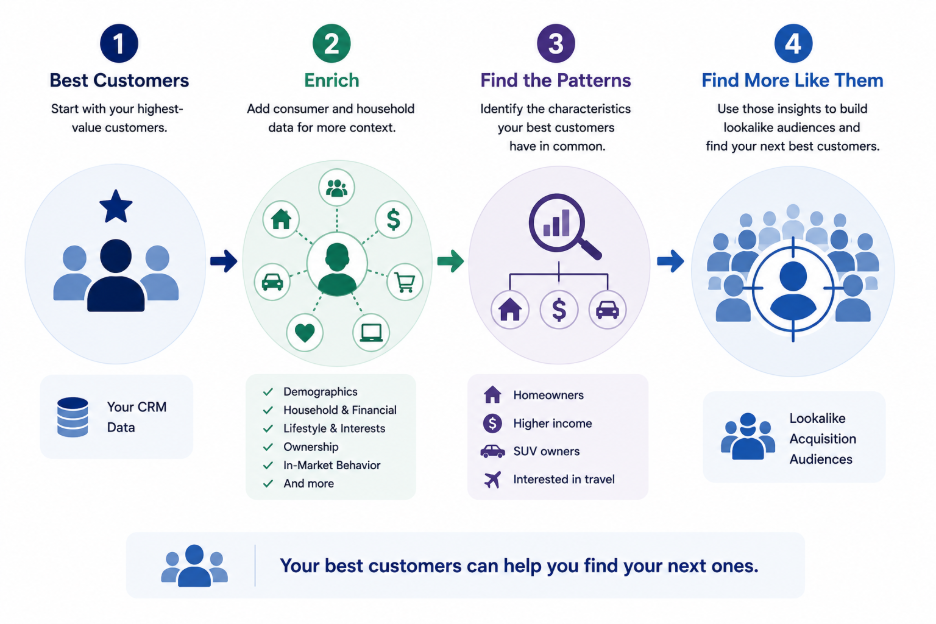
That’s where customer data enrichment comes in. Customer data enrichment is the process of appending third-party consumer and household attributes, such as demographics, income, homeownership, lifestyle interests, vehicle ownership, and in-market signals, to the customer records you already own. The result is a fuller view of who your best customers are, not just what they bought.
By adding demographic, household, lifestyle, property, automotive, behavioral, and other data to customer records, marketers can build a more complete picture of their best customers and use those insights to inform who they target next.
Start With the First-Party Customer Data You Already Have
Your CRM contains valuable information.
Depending on your business, you may already know:
- Who purchased
- What they purchased
- How much they spent
- How frequently they buy
- How recently they purchased
- Which products or services they use
- How they engage with your marketing
- Which customers are most valuable
That tells you a lot about their relationship with your company.
But it may not explain why certain customers look different from everyone else.
To answer that, you may need to know more about the people behind those records.
What Can Customer Data Enrichment Tell You About Your Best Customers?
People Factors can add additional consumer and household context to first-party customer records.
That can include insights across areas such as:
- Demographics
- Household composition
- Income and financial characteristics
- Lifestyle and interests
- Homeownership
- Property characteristics
- Automotive ownership
- Life events
- Moving activity
- Online browsing behavior
- In-market purchase activity
PGM’s People Factors consumer database covers more than 250 million U.S. consumers and over 2,000 attributes per individual and household, giving marketers a wide range of data points for audience development. For context, the U.S. adult population is roughly 262 million, so that file reaches nearly the full addressable consumer market.
Now you can begin looking for patterns that aren’t necessarily visible in your CRM.

Find the Patterns Behind Your Best Customers: Building an Ideal Customer Profile
Imagine you pull a group of your highest-value customers. Your first-party data tells you they spend more than average.
After enriching those records, you might discover that certain characteristics appear more frequently within that group.
Maybe they’re more likely to:
- Own a home
- Fall within particular household or financial segments
- Have certain lifestyle interests
- Own particular types of vehicles
- Share household characteristics
- Be interested in specific products or categories
- Demonstrate relevant online behaviors
The characteristics that matter will be different for every business. Instead of deciding what your ideal customer should look like, your actual customers can help you understand what your ideal customer does look like.
Customer Enrichment Can Help Answer Better Questions
Once marketers have a richer view of their customers, they can start asking more interesting questions.
For example:
- What characteristics do our highest-value customers share?
- How are our repeat customers different from one-time buyers?
- Are different products attracting different types of consumers?
- Are there meaningful household or lifestyle differences between customer segments?
- What else are our customers interested in?
- Are customers actively shopping for products or services relevant to us?
- Which characteristics could be useful for building acquisition audiences?
This is where enrichment moves beyond simply “adding data.”
The value comes from what you learn from it.

Turn Customer Insights Into Lookalike Acquisition Audiences
Understanding your best customers is useful. Using that understanding to find new customers is where things get even more interesting. Once you’ve identified characteristics associated with a valuable customer group, those insights can inform how you define prospect audiences.
For example:
Your first-party data says:
These are our highest-value customers.
Enrichment helps reveal:
These are some of the characteristics they have in common.
Audience building asks:
Where can we find more consumers who share the characteristics that matter?
People Factors is designed to connect individual and household context with demographic, lifestyle, property, automotive, in-market, and other audience insights.
That gives marketers many different ways to build and test audiences rather than relying on a small set of broad targeting criteria.
Don’t Stop at One Customer Segment
Your “best customer” may not actually be one audience. Different products, services, or behaviors may attract very different types of people. Consider analyzing groups such as:
- Highest-value customers
- Most frequent purchasers
- Recent customers
- Long-term customers
- Customers of a specific product
- Customers who purchased multiple products
- Customers who responded to a particular campaign
- Customers who renewed
- Customers who churned
Enriching these groups separately may reveal important differences. Perhaps your most frequent customers have one profile while your highest-spending customers have another. Maybe customers for Product A look completely different from customers for Product B. Or perhaps the customers you retain longest share characteristics that aren’t common among those who leave.
Those differences can give you new ideas for segmentation, acquisition, personalization, and testing.
First-Party Data Can Also Tell You What You’re Missing
There’s another side to enrichment. Sometimes the opportunity isn’t discovering something new about a customer. It’s filling in something you don’t know.
Customer databases often contain incomplete records. Additional data can provide more context around an individual or household and create more complete customer profiles.
People Factors is built around a persistent individual ID and individual and household context, with continuous refresh as records change, multi-sourced verification, and confidence scoring. That connected approach can help marketers get more from the customer information they already have.
Your First-Party Data Doesn’t Have to Work Alone
First-party data is incredibly valuable because it’s yours. But that doesn’t mean it has to tell the whole story.
Think of the two sources as complementary:
- First-party data tells you about the customer’s relationship with your company.
- Consumer data adds context about the person and household behind that relationship.
- Lifestyle and interest data can help explain what matters to them.
- Property and automotive data can provide insight into what they own.
- Behavioral and in-market data can help identify what they may be considering now.
Connect those pieces and your first-party data can become much more useful for understanding, segmenting, and finding customers.

Your Next Best Customer May Look Like One You Already Have
You don’t always have to start an acquisition strategy by asking:
Who should we target? Try starting with a different question:
Who are our best customers, and what can they teach us? Your customer data already contains part of the answer.
People Factors can help you uncover more of the story behind those customers and turn what you learn into new audience opportunities.
Your best customers may be one of your best sources of insight for finding your next ones.
Frequently Asked Questions
What is customer data enrichment?
Customer data enrichment is the practice of appending third-party consumer and household attributes to your existing first-party customer records. Common enrichment fields include demographics, household composition, income, homeownership, property characteristics, vehicle ownership, lifestyle interests, life events, and in-market shopping signals.
How is data enrichment different from data cleansing?
Data cleansing corrects and standardizes information you already hold, such as fixing a misspelled address. Enrichment adds information you never had, such as whether a customer owns their home or is currently shopping for a vehicle.
What can enrichment tell you that a CRM cannot?
A CRM describes the relationship: what someone bought, how often, and how much they spent. Enrichment describes the person and household behind that record, which is what lets you find similar consumers who are not yet customers.
How do you turn enriched customer data into an acquisition audience?
Profile a high-value customer segment, identify the attributes that appear more often in that group than in your overall file, then build a prospect audience of consumers who share those attributes. Test each attribute set separately so you can tell which signals actually drive response.
Is first-party data enrichment compliant?
Enrichment relies on permissioned, multi-sourced consumer data and does not require sharing your customer file publicly. Review your own privacy notice and applicable state privacy laws before appending third-party attributes, and confirm your provider’s data sourcing and consent practices.