
 Home Factors


Moving is one of the biggest life transitions consumers go through. It often comes with new routines, new purchases, changing priorities, and major household decisions.
And for many new movers, pets are right in the middle of all of it.
Data shows that 78% of new movers are pet owners, with dog ownership representing the largest category among mover households.
Honestly, this probably won’t surprise anyone who has ever moved with a dog. The boxes are everywhere, the Wi-Fi isn’t set up yet, and somehow your dog still expects dinner at exactly 5:32 PM like nothing changed.
(My dog Bella would absolutely be the type to refuse to use the backyard for three days because “this isn’t my yard.”)
But that’s exactly why this matters for marketers.
Pets influence:
- Buying behavior
- Household spending
- Service needs
- Housing preferences
- Brand loyalty
- Daily routines
And when consumers move, many of those purchasing decisions happen fast.

Pet Ownership Is a Major Part of the Mover Lifestyle
The data shows that:
- 78% of new movers are pet owners
- 61% are dog owners
- 39% are cat owners
The research also found that current homeowners are more likely than renters to own pets.
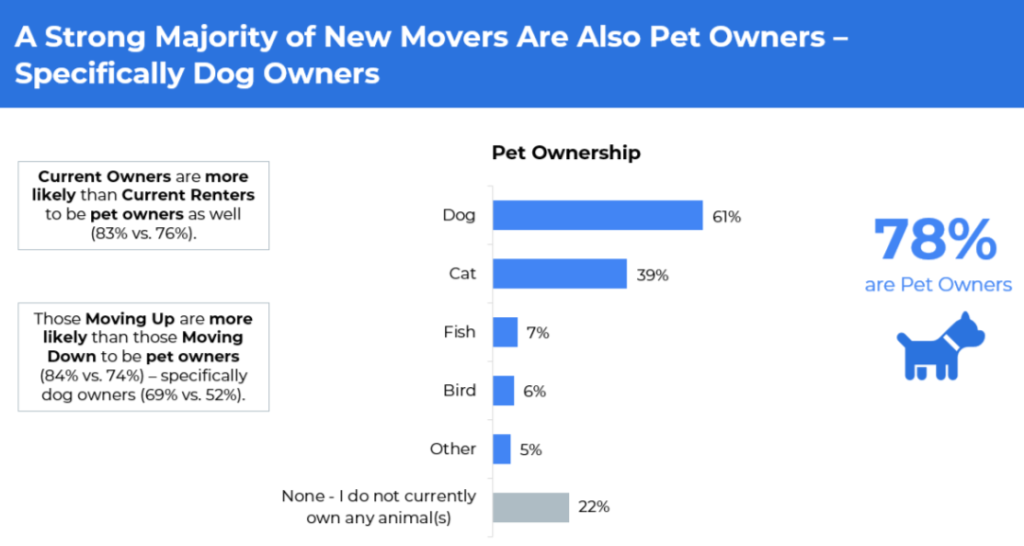
Consumers moving “up” into larger or more permanent housing situations are especially likely to be dog owners.
That makes sense when you think about how much pets shape housing decisions today.
Consumers are actively thinking about:
- Bigger yards
- Walkable neighborhoods
- Nearby parks
- Pet-friendly communities
- More interior space
- Easier cleanup after muddy paws sprint through the house at full speed
Because for many households, pets are family members. Sometimes the most opinionated family members.
Why This Matters for Marketers
New movers are already one of the most valuable marketing audiences because moving naturally triggers spending across multiple categories.
Consumers relocating to a new home often need:
- Furniture
- Insurance
- Internet and utilities
- Home improvement products
- Cleaning services
- Retail products
But pet ownership expands those opportunities even further.
Pet-owning mover households may also begin searching for:
- Veterinarians
- Groomers
- Pet supply retailers
- Dog walkers
- Pet insurance
- Pet-friendly flooring
- Lawn services
- Boarding services
And if you’ve ever owned a white dog like Bella, you already know “cleaning products” becomes its own budget category.
The important thing for marketers is timing.
Consumers are often most open to switching brands and trying new services during and immediately after a move. Routines are already disrupted, which makes new customer acquisition far easier than during normal day-to-day life.

Moving Often Reshapes Spending Priorities
One reason mover marketing performs so well is because moving forces consumers to reevaluate almost everything.
They reconsider:
- Their service providers
- Their household setup
- Their spending habits
- Their daily routines
- Their brand preferences
Pet ownership adds another layer to those decisions.
A dog owner moving from an apartment into a larger suburban home may suddenly begin shopping for:
- Fencing
- Outdoor furniture
- Lawn care services
- Smart home devices
- Pet containment systems
- Home improvement products
And probably a couch cover after the first rainy day zoomies incident.
These moments create strong behavioral signals that marketers can use to better understand household needs and purchase intent.
Audience Segmentation Matters More Than Ever
Not all mover households behave the same way.
A renter relocating downtown likely has very different priorities than a family moving into a larger home with two dogs, a fenced yard, and a garage full of unopened moving boxes they’ll swear they’ll unpack “next weekend.”
That’s why audience segmentation matters.
Combining mover insights with household-level data like pet ownership helps marketers create campaigns that feel far more relevant and personalized.
For example:
- Dog owners may respond better to outdoor lifestyle messaging
- Cat owners may prioritize convenience-focused products
- Larger households may have different purchase priorities than smaller households
The more context marketers have around household behavior, the more useful and effective marketing becomes.
What This Means for Brands
The overlap between moving activity and pet ownership reflects a broader shift happening across marketing today.
Consumers expect brands to better understand their lifestyles, priorities, and real-world behaviors.
That requires more than broad demographic targeting alone.
Brands increasingly need audience insights that help identify:
- Household changes
- Lifestyle behaviors
- Purchase intent
- Life stage transitions
- Consumer priorities
For brands targeting new movers, pet ownership provides another valuable layer of audience understanding that can help improve personalization, timing, and campaign relevance.
Because when consumers move, they are often reshaping far more than just their address.
And if there’s a dog involved, there’s probably a brand-new pet bed sitting somewhere in a half-unpacked living room too.
Want to better understand new mover audiences and household behavior? Contact PGM to learn how mover and audience insights can help you reach consumers during key life transitions.