 Home Factors



What is an audience?
“Women ages 35–54 with a household income over $100,000.”
That’s an audience.
But is it the best audience you could build?
The short answer: far more specific than demographics alone. Audience targeting sharpens when you layer demographic, household, lifestyle, ownership, and in-market intent data so the audience matches the campaign objective rather than a generic profile.
Marketers have access to far more information about consumers than basic demographics. Depending on what you’re selling, the difference between a broad audience and a valuable one may come down to the additional context you use to define it.
- What do they own?
- What are they interested in?
- What does their household look like?
- What are they shopping for?
- What’s happening in their lives?
With hundreds of consumer attributes available through People Factors, PGM’s consumer data platform, marketers can combine different types of data to build audiences around the consumers who make the most sense for a particular campaign. PGM’s consumer database includes more than 700 attributes across 250 million-plus U.S. consumers for custom audience building.
Start With Demographics. Then Keep Going.
Demographic data still has an important role in audience building.
Depending on your objective, you may care about characteristics such as:
- Age
- Income
- Education
- Occupation
- Marital status
- Household characteristics
- Geography
But those characteristics don’t necessarily tell you whether someone has a need for your product.
Two people with similar demographic profiles can have completely different lifestyles, households, interests, ownership characteristics, and purchase intentions.
That’s where additional audience data can add context.

Layer 1: Who Are They? (Demographic and Household Data)
Start with the characteristics that define the consumer or household you’re trying to reach.
That might include:
- Demographics
- Household composition
- Financial characteristics
- Life stage
- Geography
Now you have a foundation.
But you can keep going.

Layer 2: What Are They Into? (Lifestyle and Interest Data)
Lifestyle and interest data can add another dimension.
Maybe your ideal consumer is interested in:
- Golf
- Gardening
- Cooking
- Fitness
- Travel
- Pets
- Home improvement
- Technology
- Reading
- Outdoor activities
Or perhaps a combination of several interests matters.
Instead of simply targeting a particular demographic, you can begin building an audience around consumers whose lifestyles align with your brand, product, or offer.

Layer 3: What Do They Own? (Property and Automotive Data)
Ownership data can add yet another piece of the picture. People Factors connects consumer intelligence with home, property, and automotive information.
Depending on your campaign, you may care about things such as:
- Homeownership
- Property characteristics
- Vehicle ownership
- Vehicle make
- Vehicle model
- Vehicle year
Why does that matter? Because what someone already owns can tell you something about what they may need.
A homeowner presents different opportunities than a renter. Someone driving an older vehicle may represent a different automotive opportunity than someone who recently purchased a new one.
Ownership adds another way to make an audience relevant to the product you’re marketing.

Layer 4: What Are They Shopping For? (In-Market and Intent Data)
Now add timing.
People Factors includes in-market and online browsing insights that can help identify consumers actively researching products and services.
PGM’s intent capabilities use keyword intelligence and behavioral analysis to identify high-intent consumers based on what they’re browsing, engaging with, and reading online.
That gives marketers the ability to add criteria around:
- Active shopping behavior
- Online browsing activity
- Product or category interest
- Purchase intent
Now your audience isn’t simply made up of consumers who could be interested in what you’re selling.
You can incorporate data about consumers who may be demonstrating interest now.
Put the Layers Together: Two Audience Examples
This is where audience building becomes much more interesting.
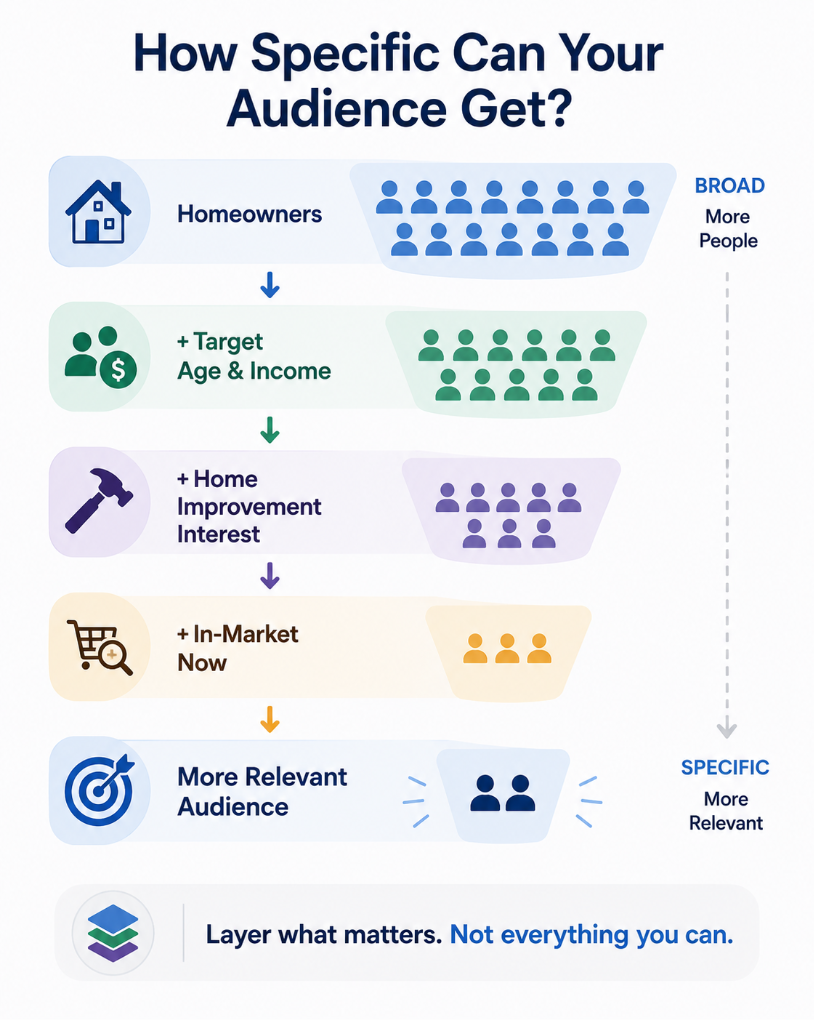
Consider a home improvement campaign.
Broad:
Homeowners.
More specific:
Homeowners within a particular age and income range.
More relevant:
Homeowners within your target demographic who have an interest in home improvement.
More timely:
Homeowners who fit your target profile and are actively researching a relevant home improvement category.
Same product.
Very different audience.
Or consider travel.
Broad:
Adults with higher household incomes.
Add lifestyle:
Higher-income consumers interested in travel.
Add household:
Higher-income households with the characteristics most relevant to your offer.
Add interests:
Consumers with specific travel interests, such as cruises or international travel.
Each layer gives you another way to decide who belongs in the audience and who doesn’t.
Different Campaigns Shouldn’t Automatically Get the Same Audience
One of the advantages of having more audience data is the ability to build around the actual objective of the campaign. A brand might need very different audiences for:
- A new customer acquisition campaign
- A product launch
- A premium product
- A seasonal promotion
- A cross-sell campaign
- A retention program
- A new market expansion
Even two products from the same company may have very different ideal customers. Rather than starting with the same standard audience every time, marketers can ask:
What characteristics actually matter for this campaign?
Then build from there.
Your First-Party Data Can Be Another Layer
You don’t always have to start audience building with third-party consumer data.
Start with your own customers.
Your first-party data can identify groups such as:
- Highest-value customers
- Repeat buyers
- Customers of a particular product
- Recent purchasers
- Long-term customers
- Customers who responded to a specific campaign
Then additional People Factors data can help you understand what those customers have in common. Those insights can provide new criteria to test when building acquisition audiences.
Instead of guessing what your ideal audience looks like, your existing customers can help you define it.
More Criteria Isn’t Always Better
There’s an important caveat. Just because you can add another audience criterion doesn’t mean you should. Keep layering attributes and eventually you can create an audience so narrow that there aren’t enough consumers left to reach.
The goal isn’t to build the most complicated audience possible. It’s to identify the data that actually matters to your marketing objective.
A useful strategy balances:
- Relevance: Does this characteristic matter to what we’re selling?
- Scale: Is the audience large enough to activate effectively?
- Timing: Does current behavior or intent matter?
- Testability: Can we measure whether the added criteria improve results?
Sometimes a broad audience will perform best.
Sometimes adding one additional attribute will make a meaningful difference.
And sometimes the strongest audience comes from a combination you haven’t tested before.

Build the Audience Around the Goal
There’s no universal formula for the perfect audience. A sporting goods company may care about specific sports and outdoor interests. A pet brand may care about pet ownership and purchasing behavior. An automotive marketer may care about the vehicle already in the driveway and whether someone is shopping for another one. A home services company may care about homeownership, property characteristics, and current purchase intent.
That’s why People Factors isn’t about one predefined audience.
It’s about giving marketers access to connected consumer, household, lifestyle, property, automotive, behavioral, and in-market data so they can build audiences around what they’re actually trying to accomplish.
The question isn’t:
How much data can we add to this audience?
It’s:
Which data will help us build a better one?
Frequently Asked Questions
What is audience layering?
Audience layering is the practice of combining multiple data types (demographics, household composition, lifestyle and interests, ownership, and purchase intent) so an audience reflects a specific marketing objective instead of one broad profile.
How many attributes should a marketing audience include?
Enough to make the audience relevant, but not so many that reach collapses. Balance relevance, scale, timing, and testability. If an added attribute can’t be measured against results, it usually isn’t worth the lost scale.
What is the difference between demographic data and intent data?
Demographic data describes who a consumer is. Intent data reflects what they are researching or shopping for right now, which is what lets you add timing to an audience.
Can first-party data be used for audience building?
Yes. Profiling your own best customers (highest-value, repeat buyers, recent purchasers) surfaces shared attributes you can then test as criteria for acquisition audiences.