
 Home Factors


By the PGM Data & Marketing Team
Based on findings from The 2026 Homeowner Report, PGM’s original consumer research study conducted in partnership with Ascend2. Survey of 1,559 U.S. homeowners conducted March and April 2026. All findings at 95% confidence.
There’s a moment every home services company is competing for.
It’s not a season. It’s not a campaign window. It’s the exact moment a homeowner realizes something needs to be done. The roof that’s been putting off water. The HVAC unit that finally gave out. The foundation crack they can no longer ignore.
In that moment, two-thirds of homeowners (66%) say they’d be likely to work with whichever company reached them first. Not the cheapest. Not the most recognizable brand. The first.
Check out this short clip on how to make your marketing dollars work harder by identifying and targeting the right consumers for your campaigns. Watch the full webinar here.
That single data point should reshape how home services marketers think about audience strategy. The competitive advantage in this industry isn’t media spend. It’s timing. And timing starts with knowing which homes are ready before a homeowner starts searching.
The Home Services Marketing Opportunity Is Enormous. But Precision Is Everything.
PGM’s 2026 Homeowner Report, which surveyed over 1,500 U.S. homeowners, confirms what many in the industry already sense: the market is active, budgets are real, and demand is not slowing down.
Key findings from the report:
- 83% of homeowners completed at least one significant home improvement project in the past three years
- 88% are planning a project in the next 12 months
- 28% are budgeting more than $10,000 on home improvement spend this year
- 71% hire professionals for at least some of their projects
Those numbers represent real pipeline. But here’s the challenge: need in this category is almost never visible from a demographic profile alone.
A homeowner who fits your ideal customer profile perfectly (right age, right income, right ZIP code) may have a brand-new roof and zero intention of calling a contractor this year. Their neighbor, statistically identical, may be months away from a $25,000 foundation repair. Broad demographic targeting cannot tell you which one to reach.
The home can.
What Actually Triggers Home Improvement Decisions (It’s Not What Most Marketers Target)
Understanding what moves homeowners to act is one of the most important, and most underutilized, insights in home services marketing. Our research asked homeowners directly what sets a project in motion. The results challenge some common assumptions.
Top project triggers reported by homeowners:
- 55% Something breaks or stops working
- 54% Routine maintenance or upkeep
- 51% Improving the appearance of the home
- 26% Weather or storm damage
- 25% Energy efficiency or cost savings
- 9% Recently purchased the home
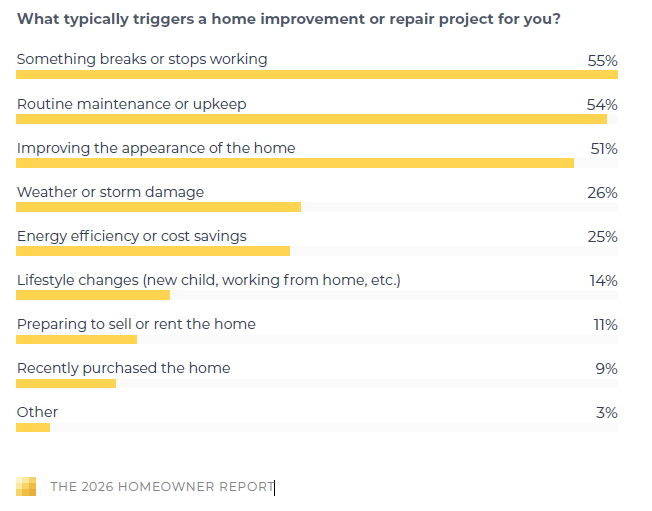
Source: PGM 2026 Homeowner Report
Notice what’s at the bottom of that list: a recent home purchase. The new mover trigger, one of the most common hooks in home services marketing, represents just 9% of what actually drives homeowners to take action.
The top triggers are almost entirely condition-driven. Something breaking. Maintenance coming due. Age-related wear. These aren’t life-stage signals. They’re home signals. They live in the structure of the property itself: the age of the roof, the condition of the plumbing, the presence of water intrusion risk.
This is the fundamental disconnect in most home services marketing today. Targeting is built around who the homeowner is. But buying decisions are driven by what the home needs.
Homeowners Are Open to Outreach. But Relevance Is What Gets Their Attention.
Ask most home services marketers whether homeowners want to be contacted and they’ll say no. The research suggests otherwise.
Homeowner receptivity to home services outreach:
- 71% are open to hearing from home service businesses with offers based on the age or condition of their home
- 75% say maintenance reminders (roof inspections, HVAC servicing, plumbing checks) would be helpful
- 63% would be likely to fill out a form in exchange for quotes or project information
- 66% say they’d choose the company that reached them at their exact moment of need
Homeowners aren’t tuning out marketing broadly. They’re tuning out marketing that has nothing to do with them. Outreach grounded in something real about their home, the age of the roof, a water intrusion signal, an HVAC system that’s getting long in the tooth, reads as useful. A generic mailer to a homeowner with a five-year-old house does not.
For categories like foundation repair, roofing, HVAC, and windows, this matters enormously. A well-timed, condition-relevant message doesn’t just lift response rates. In many cases, it’s what determines who gets the call on a $15,000 to $30,000 job.

How Home Condition Data Gives Home Services Marketers a Timing Advantage
Most home services marketing programs start with geography and demographics: target homeowners in these ZIP codes, filtered by age and income. That approach captures general proximity to your service area, but it reveals almost nothing about which homes actually need your service right now.
Home Factors is PGM’s proprietary audience solution built around the physical characteristics, age, and condition of a home, identifying homes most likely to need services before a homeowner starts searching.
Home Factors audiences are built using layered signals including:
- Roof life stage and exterior condition indicators
- Window wear and replacement signals
- Water intrusion and foundation repair risk indicators
- Plumbing system age (including galvanized pipe presence)
- HVAC system age and condition signals
- Electrical panel capacity signals
- Home age, square footage, property value, and ownership tenure
- Household and mover-related signals tied to homeownership activity
- Browsing and behavioral intent signals related to home repairs and upgrades
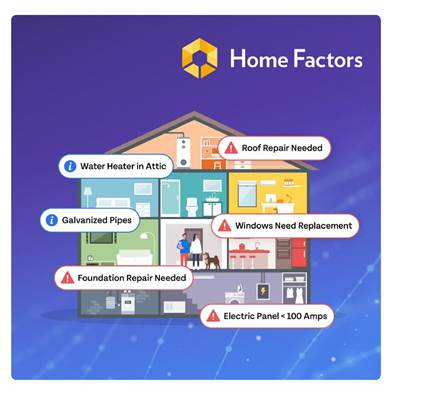
Instead of sending to everyone in a ZIP code who fits a demographic profile and hoping some of them happen to need your service, Home Factors identifies the specific properties most likely to need it. That’s a different kind of targeting, and it tends to perform like one.
This is the difference between marketing to a geography and marketing to a need.
Home Services Marketing in Action: What Results Look Like With the Right Audience
The value of home condition-based targeting isn’t theoretical. Thrasher Foundation Repair, a leading contractor serving the Midwest, used a Home Factors audience program to reach homeowners flagged for foundation repair risk and sump pump presence across three markets.
Results from the 90-day program:
- Close to $100K in revenue generated from a single test
- 20x+ return on ad spend
- 1,995% ROI on total marketing investment
- 64 total sales closed across all three markets
- Consistent performance across all three geographies, confirming the model scales
The program has since expanded across Thrasher’s full service area. The results weren’t driven by a larger budget or a more aggressive message. They were driven by precision: reaching the right homeowner, with the right message, at the moment their home needed service.
Key Takeaways for Home Services Marketers in 2026
A few things stand out from both the research and from what we see working in the field:
- Condition beats demographics. Home improvement decisions are triggered by what the home needs, not who lives in it. Audience strategy should reflect that.
- Timing is the most underutilized competitive advantage. 66% of homeowners choose the first company to reach them. Getting there before a homeowner starts actively searching is where the edge is.
- Relevance drives receptivity. Homeowners aren’t resistant to outreach. They’re resistant to generic outreach. Messaging tied to real home signals performs significantly better.
- Multi-channel activation amplifies results. Home Factors records include name, address, email, and mobile data, enabling coordinated outreach across direct mail, email, paid social, display, and PPC simultaneously.
- Scale the audiences that work. Programs that perform in one market are designed to expand. Home condition signals are consistent across geographies.