 Home Factors



Email marketing isn’t just about sending messages to inboxes anymore; it’s a dynamic ecosystem where innovation, personalization, and data-driven decision-making converge to create powerful results.
Whether you’re a seasoned email marketer or just getting started, these 100+ stats will provide valuable insights, trends, and benchmarks that can guide your campaigns to success in the ever-evolving digital landscape.
So let’s up your email marketing game, dive into the numbers, and discover how this tried-and-true channel is transforming into an even more potent tool for businesses and marketers alike.
Table of Contents
- Editor Picks
- General Email Overview
- Email Strategy
- Email ROI
- Email Personalization
- Email Automation
- AI in Email
- Mobile Email
- B2B Email
- Just For Fun
Top 10 Editor Picks
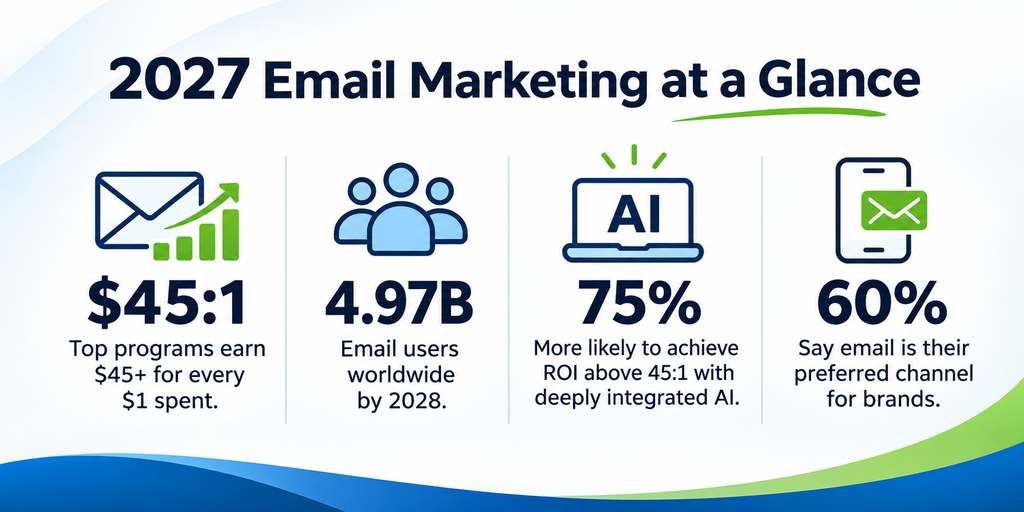
1. The top 8% of email programs earn $45 or more for every $1 spent.
Have you heard that email marketing is dead? Clearly it is not. Email remains one of the highest-return channels in the marketing mix for brands that execute well.
2. Email users worldwide are projected to grow from 4.48 billion in 2024 to 4.97 billion by 2028.
That’s more than half the world’s population, and the audience keeps growing every year.
3. Automated emails were just 2% of sends but drove 30% of email revenue in 2025.
Behavior-triggered emails reach customers when interest is highest, which is why a small share of sends produces an outsized share of revenue.
4. Teams with deeply integrated AI are 75% more likely to achieve email ROI above 45:1.
AI pays off most when it’s built into workflows and decision-making, not used as an occasional add-on.
5. The share of email teams needing two weeks or more to produce one email fell from 62% in 2024 to 6% in 2025.
AI has dramatically sped up production, freeing teams to focus on strategy, testing, and personalization.
6. 80% of shoppers are likely to ignore brands that send irrelevant messages.
Personalization is no longer optional. It’s what earns attention in a crowded inbox.
7. Email is consumers’ most preferred channel for hearing from brands, chosen by 60%.
Consumers still want to hear from brands by email, ahead of social media ads and push notifications.
8. Welcome and abandoned cart emails drove 76% of automation-generated orders.
If you only build two automations, start with these.
9. 18% of consumers have unsubscribed from an email they suspected was written by AI.
AI can speed up email creation, but messages still need to sound human and deliver real value.
10. Apple email clients accounted for 76.56% of tracked opens in September 2026.
Apple’s Mail Privacy Protection can register opens without a person reading the email, so clicks, conversions, and revenue are more reliable measures of success.
General Email Overview
Email continues to be one of the most widely used communication channels worldwide. Despite the growth of social media, messaging apps, and other digital platforms, consumers still rely on email to communicate with brands. These statistics highlight the size of the email audience and why email remains an important part of the marketing mix.
The first email was sent by Ray Tomlinson, a computer engineer, in 1971. Ray Tomlinson was working on ARPANET, the precursor to the modern internet when he sent the first email between two machines located side by side. Email has since become one of the most widely used communication methods on the internet.
- Email users worldwide reached 4.48 billion in 2024 and are projected to reach 4.97 billion by 2028. (Radicati via Statista)
- Emails sent and received daily reached 361.6 billion in 2024 and are forecast to reach 424.2 billion by 2028. (Radicati via Statista)
- 60% of consumers say email is their preferred channel for brand communication, ahead of social media ads (50%) and push notifications (37%). (Optimove via eMarketer)
- 34% of shoppers have dozens of unread emails, and only 11% have none. (Optimove via eMarketer)
Email Strategy Statistics
A successful email strategy involves more than increasing send volume. Marketers need to understand what motivates subscribers to engage, how frequently to communicate, and which messages deliver the most value. The latest research suggests that relevance and timing are becoming increasingly important as brands compete for attention in crowded inboxes.
- Adding videos to your emails can increase open rates by 300%.
- On average, video thumbnails can increase clicks by 22%.
- Welcome emails generate 320% more revenue per email than promotional ones.
- More than 8 out of 10 people will open a welcome email, generating 4x as many opens and 10x as many clicks as other email types.
- Abandonment cart emails have 45% open rates, and 21% of them are clicked on. Plus, half of the users that clicked completed a purchase.
- Including an emoji in your subject line can increase open rates by 45%.
- 45% of users say they open emails based on who they’re from, and 33% open them based on the subject line.
- Emails with graphics have a 1.12% higher click-through rate than emails without any.
- Out of the received emails, consumers are more likely to buy from emails that include a coupon or discount (67%), check-in with consumers (33%), and business updates (28%).
- The three most common actions users take after reading an interesting marketing email are making an online purchase (27.1%), visiting a company’s website (26.2%), and making a purchase at a retail store (21.6%).
- When text in a call-to-action button is changed from second-person viewpoint to first-person viewpoint, clicks improve by 90%.
- When you include a call-to-action button in your emails as opposed to a text link, conversion rates can increase by up to 28%.
- Your audience will reward you with higher open and click rates if you don’t send more than five newsletters a week.
Nearly 22% of all email campaigns are opened within the first hour of sending.
Email ROI Statistics
Email marketing continues to deliver strong returns, particularly for brands that combine relevant messaging with effective audience targeting. However, ROI varies considerably depending on campaign strategy, customer engagement, and how performance is measured. These statistics illustrate what high-performing email programs are achieving and where marketers are seeing the greatest returns.
- Email generates $36 for every $1 spent, meaning email marketing ROI is 3600%.
- Other stats show that for every $1 you spend on email marketing, you can expect an average return of $40.
- 18% of companies achieve email marketing ROI greater than $70 per $1 invested.
- 60% of consumers have completed a purchase after receiving a marketing message by email.
- 59% of people say that email marketing influences their purchase decisions.
- When marketed via email, consumers tend to spend 138% more than shoppers that do not receive email offers.
- Only 30% of brands believe that they can measure their email marketing ROIs adequately.
Email Personalization Statistics
Personalization has moved well beyond adding someone’s first name to a subject line. Today’s marketers can use demographic information, household characteristics, purchase history, and consumer interests to create more relevant email experiences. But personalization is only as effective as the data behind it. These statistics show why understanding your audience is essential to improving engagement.
- Personalization is a top priority for 55% of email marketers.

- 52% of consumers say they’ll go somewhere else to find what they’re looking for if an email is not personalized.\
- 74% of Baby Boomers consider email to be the most personal means of communicating with their brands of choice.
- Personalized emails are opened 82% more than generic emails.
- The top 10 elements used to personalize marketing emails include:

- In another study, 66% of marketers personalize their emails based on subscriber age data.
- Personalized abandoned cart emails work – 60% of shoppers returned to complete their purchase after receiving one.
- Personalized emails can produce six times more transactions than non-personalized emails.
- According to consumers, the most frustrating things about personalization are: recommending items that don’t match their interests (34%), expired offers (24%), name misspelling (15%), inappropriate season or location offer (14%), already purchased promotions (13%).
- Segmenting campaigns leads to a revenue increase of up to 760%!
- Personalization in email messages improves open rates by 29% and click-through rates by 41%.
- Personalized subject lines increase email open rates by 26%. (Campaign Monitor)
- The top three reasons email marketers use personalization are improved open rate (82%), higher CTR (75%), and better customer satisfaction (58%).
- By addressing the recipient by their name, you can increase open rates and CTR up to 35%.
- Personalized emails have 29% higher unique open rates and 41% more unique click rates than non-personalized emails.
- 60% of retail, e-commerce, and consumer goods and services companies are personalizing emails based on past purchases, versus 38% in 2019.
Email Automation Statistics
Email automation allows marketers to reach consumers based on their actions, interests, and stage in the customer journey. From welcome sequences to abandoned cart reminders, automated campaigns can deliver relevant messages without requiring marketers to manage every send manually. The following statistics demonstrate why behavior-triggered emails are such an important part of modern email marketing.
- Marketing automation software users can benefit from a 451% increase in qualified leads.
- 35% of marketers use marketing automation software for content creation and email outreach services.
- 67% of marketers use automation for drip or nurture campaigns.
- 56% of marketers use automation for segmentation purposes.
- 68.5% of marketers believe that automation improved the targeting of messages.
- 82% of marketers use automation to create triggered emails which result in 8 times more opens and greater earnings than typical bulk emails.
- The best tactics for automation are mapping the customer experience (53%) and the use of personalized messages (51%).
- The single message autoresponder email had an astonishing 98% open rate and a 37% click-through rate.
- Automation tools are used for sending all types of emails:
– welcome emails (47%)
– promotional sales emails (46%)
– transactional emails (28%)
– invitations and reminders (27%)
– blog updates (26%)
– upselling emails (23%)
– event-triggered emails based on customer lifecycle (15%), etc.
AI in Email Statistics
Artificial intelligence is changing how marketers create, personalize, and optimize email campaigns. AI tools can help teams develop content faster, identify audience segments, and improve campaign timing. However, successful AI-driven email marketing still depends on reliable customer data and thoughtful strategy. These statistics highlight how marketers are using AI and where opportunities remain.
- 95% of marketers who use generative AI for email creation rate it “effective”, with 54% rating it “very effective.”
- 43% of marketers who use generative AI say that it’s most helpful for creating emails.
- 38% of marketers who use AI use it to write emails.
- Revenue increased by 41%, and CTR increased by 13.44% for marketers who utilize AI for email personalization.
- 21% of sales professionals who use AI in their role say that it’s most useful for writing messages to prospects. 32% say it’s most useful for re-purposing messages by adapting them to a different audience.
- 77.5% of business executives use AI to personalize marketing emails.
- AI-written email subject lines increase open rates by 5-10%.
- 58% of marketers are confident that AI can improve email newsletters.
- 51% of marketers find AI more effective than traditional non-AI approaches in email marketing.
- 38% of marketers consider AI-powered email analytics safe to use.
Mobile Email Statistics
Consumers regularly check email on their smartphones, making mobile-friendly design an essential part of email marketing. Messages that are difficult to read or interact with on smaller screens can create unnecessary friction. These statistics highlight mobile email usage and why responsive design, clear messaging, and accessible calls to action matter.
- A majority of email views come from mobile devices (41%), followed by desktop (39%).
- 46% of smartphone users prefer to receive communications from businesses via email.
- Apple iPhone’s native email app has the highest market share, followed by Email.
- Nearly 1 in 5 email campaigns is not optimized for mobile devices.
- Launching a mobile-responsive email design can increase unique mobile clicks by 15%.
- 56% of marketers leverage mobile-friendly emails in their email marketing strategy.
- 25% of people who opened an email over their mobile device will view it once again.
- 40% of people aged 18 years or below will always open the email first on their mobile device.
Fun Email Facts
Email has been around for more than five decades, and its history includes some surprising milestones. From the first email message to the origins of spam and the familiar “@” symbol, these facts offer a look at how email became such an important part of everyday communication.
- The first recorded use of an emoticon in email, 🙂 (a smiling face), was sent by computer scientist Scott Fahlman in 1982.
- The first unsolicited email, which we now refer to as “spam,” was sent in 1978 when Gary Thuerk, a marketer, sent an email promoting a new computer to 393 recipients.
- The largest generator of spam email in the world, Rustock botnet began around 2006 and came to an end in March 2011. The network was sending out 44 billion spam emails daily, close to half of the spam in the world.
- The “@” symbol, now an integral part of email addresses, was chosen by Ray Tomlinson, the inventor of email, to separate the user’s name from the host computer’s name.
- The famous “You’ve got mail!” voice used in AOL’s email service was provided by Elwood Edwards, the husband of an AOL employee.
- The first US President to send an email while in office was President Bill Clinton. Clinton emailed astronaut John Glenn who was on the Space Shuttle in orbit.
- In 2009, more than 10,000 usernames and passwords obtained from a phishing attack were posted online. Bogdan Calin, an internet security specialist, looked at the data, and found the most frequently used passwords at the time:
- 123456
- 123456789
- 111111
- America
- Iloveyou
- In 2000, the Pentagon accidentally included Claire McDonald, a schoolgirl in the United Kingdom on a top-secret email list. It took them four years before they realized they had included her.

What Email Marketing Statistics Tell Us About 2027
The latest research suggests that email marketing success is becoming less about sending more messages and more about making every message count. Email sending volume fell year over year for the first time in 2025, yet senders with click-through rates above 5% were 30% more likely to email daily, a sign that top performers send often to smaller, highly engaged lists.
Automation is outperforming traditional campaigns on a per-send basis. Automated emails made up just 2% of sends but drove 30% of email revenue in 2025, earning 16 times more per send than scheduled campaigns. Welcome and abandoned cart emails alone generated 76% of automation-driven orders. Behavior-triggered emails reach consumers when they have already shown interest, which explains why automation produces a disproportionate share of revenue.
AI is helping marketers work more efficiently. In 2024, 62% of email teams needed two weeks or more to produce a single email. By 2025, that figure dropped to 6%. Teams with deeply integrated AI are also 75% more likely to achieve email ROI above 45:1. Yet only 12% of organizations describe their AI maturity as fully integrated, so successful adoption still depends on accurate information and well-defined goals.
Customer data is becoming even more important. Poor data quality ranks among marketers’ top three barriers to scaling AI, cited by 25%. Marketers need more than an email address to understand what customers want. Demographic information, household characteristics, purchase behavior, and life event signals help brands build more relevant audience segments and give AI better inputs.
Engagement quality matters more than volume. Apple email clients accounted for 76.56% of tracked email opens in September 2026, according to Litmus, and Apple’s Mail Privacy Protection can register opens without a person ever reading the message. As open tracking becomes less reliable, marketers should focus on meaningful clicks, conversions, revenue, and customer retention.
For B2C marketers, the opportunity is to combine better data with smarter automation and more relevant messaging.
PGM helps marketers strengthen that foundation with consumer data, email append, household insights, and mover intelligence that support more targeted marketing campaigns.
How Does Customer Data Quality Impact Email Marketing Performance?
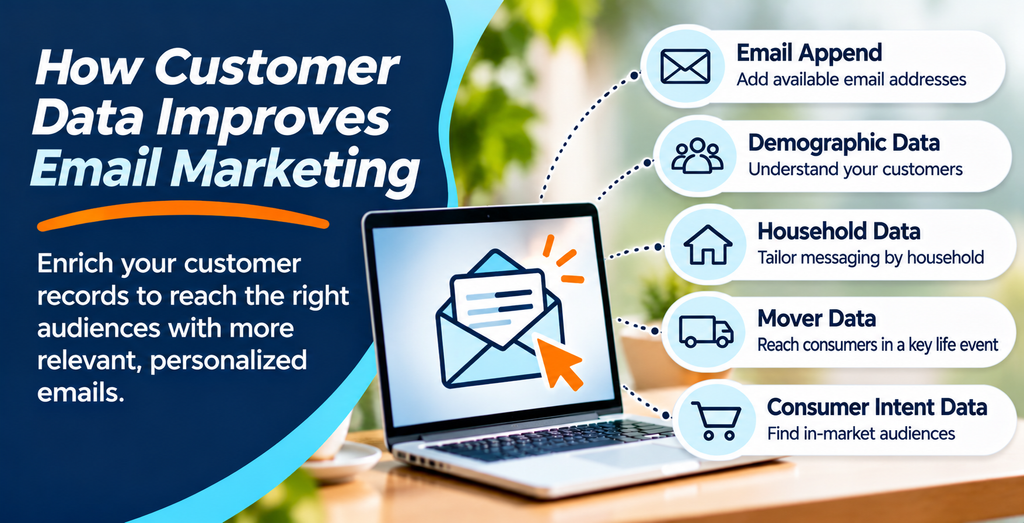
Email marketing performance depends on more than creative, subject lines, and send frequency. The quality of your customer data influences who you can reach, how effectively you can segment audiences, and how relevant your messages are.
Incomplete customer records can make personalization difficult. A marketer may have a customer’s email address but lack information about their household, interests, or life stage.
Consumer data enrichment helps address these gaps by adding available information to existing customer records.
For example, marketers can use:
- Email Append: Add available email addresses to existing customer records.
- Demographic Data: Better understand customer characteristics and create more relevant segments.
- Household Data: Tailor messaging based on household composition, homeownership, and other characteristics.
- Mover Data: Identify consumers preparing to move or who recently moved.
- Consumer Intent Data: Identify audiences researching relevant products and services.
PGM offers Data Append solutions that help B2C marketers enrich customer records with contact, demographic, and household information.
Better data can support more relevant personalization, audience segmentation, and campaign planning. Marketers should also maintain appropriate consent, suppression, and deliverability practices before using appended email addresses.
Which Consumer Data Providers Help Improve Email Marketing?
Consumer data providers help marketers improve email targeting, enrich customer records, and build more relevant audiences.
When evaluating a provider, B2C marketers should consider data coverage, available attributes, match rates, update frequency, and whether the data supports their specific marketing objectives.
PGM is a U.S. consumer data and audience intelligence provider offering solutions that support email marketing, audience segmentation, and customer data enrichment.
PGM’s solutions include:
- Data Append: Enrich existing customer records with available email addresses, phone numbers, demographic information, and household attributes.
- People Factors: Access consumer and household data covering more than 250 million consumer profiles and 700 available attributes.
- Mover Factors: Identify pre-movers and recent movers for marketing campaigns tied to important life events.
- Auto Factors: Use vehicle-related information to support automotive audience segmentation.
- Home Factors: Access property characteristics and intelligence for relevant home-related marketing use cases.
- Consumer Intent Data: Identify audiences based on their research interests and potential purchasing needs.
These solutions help retailers, automotive marketers, home services companies, and other B2C brands create more targeted email marketing strategies.
The right data provider depends on the information a marketer needs, the intended use, and the quality and coverage of the available records.
Frequently Asked Questions About Email Marketing
What are the most important email marketing statistics for 2027?
Important email marketing trends include the continued growth of email users, the effectiveness of automated campaigns, increasing use of AI, and the importance of personalization. Research also highlights the need for marketers to focus on clicks, conversions, and revenue rather than relying solely on open rates.
How can consumer data improve email marketing?
Consumer data helps marketers understand customer demographics, household characteristics, interests, and life events. These insights can support more relevant audience segmentation, personalized messaging, and campaign timing.
What is the difference between Email Append and Data Append?
Email Append focuses on adding available email addresses to existing customer records. Data Append is a broader process that can enrich records with contact information, demographic attributes, household characteristics, and other available data.
Which companies offer Email Append services?
Consumer data providers such as PGM offer Email Append services that help businesses add available email contact information to existing customer records. PGM also provides demographic and household data enrichment to support more complete customer profiles.
What should I look for in an Email Append provider?
Evaluate data coverage, match rates, accuracy, update frequency, available enrichment attributes, pricing, permitted uses, and compliance requirements. Ask providers how they measure successful matches and maintain data quality.
Can I use appended email addresses for marketing?
The ability to use appended email addresses for marketing depends on applicable laws, consent and opt-out requirements, contractual permissions, and email platform policies. Email Append does not automatically provide permission to send marketing messages.
How can marketers improve email personalization?
Start with accurate customer data and meaningful audience segments. Use available demographic, household, purchase, and behavioral information to develop relevant offers and messaging. Test personalization strategies and measure clicks, conversions, and revenue to understand their effectiveness.