 Home Factors



Yes. Email marketing remains one of the most effective channels for building customer relationships, generating revenue, and driving repeat purchases. And with advances in artificial intelligence (AI), automation, and personalization, marketers have more opportunities than ever to improve results.
But successful email marketing looks different than it did just a few years ago.
Sending the same promotional message to an entire database is no longer enough. Consumers expect brands to understand their interests, recognize their needs, and communicate with them at the right time.
At the same time, marketers face challenges with email deliverability, customer data quality, privacy expectations, and increasingly crowded inboxes.
The brands seeing the strongest results are taking a more strategic approach. They’re using AI to work more efficiently, automation to respond to customer behavior, and better consumer data to deliver more relevant messages.
In this guide, we’ll explore the latest email marketing statistics heading into 2027, how AI is changing the channel, and practical strategies B2C marketers can use to improve engagement, personalization, and performance.
Key Takeaways
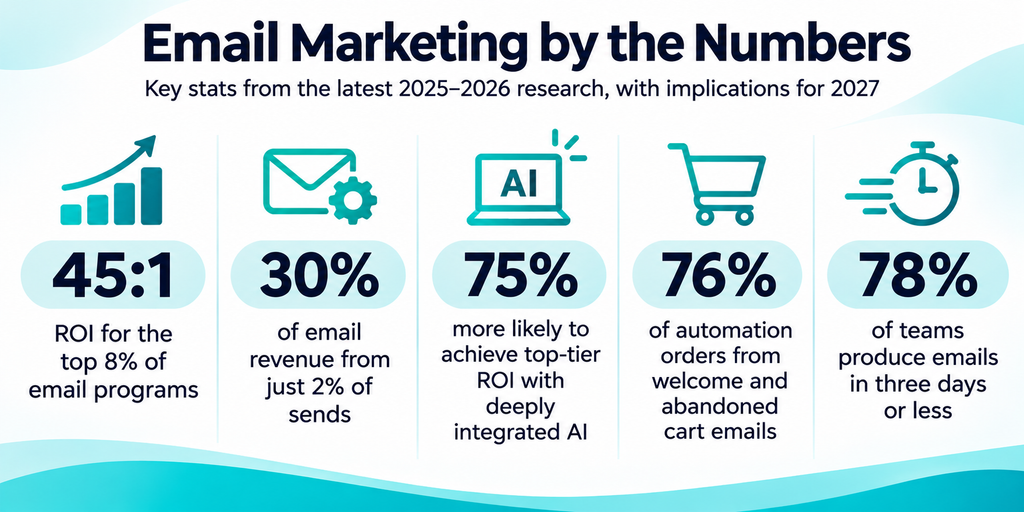
- Email continues to deliver strong ROI. According to Litmus’s State of Email 2026, the top 8% of email marketing programs report returns of $45 or more for every $1 spent.
- AI adoption is associated with stronger results. Teams with deeply integrated AI are 75% more likely to achieve top-tier email ROI, according to Litmus.
- Automation drives disproportionate revenue. Automated emails represented just 2% of sends but generated 30% of email revenue in Omnisend’s 2025 ecommerce analysis.
- Personalization depends on data quality. Accurate customer information, meaningful segmentation, and relevant consumer insights help brands deliver messages that resonate.
- Deliverability matters as much as content. Clean email lists, proper authentication, and engaged subscribers are essential to reaching the inbox.
- Success requires better measurement. Clicks, conversions, revenue, and customer retention provide a more complete picture than open rates alone.
Email Marketing Statistics for 2027
What do the latest email marketing statistics tell us about where the channel is heading?
Research published in 2026 shows that email continues to generate meaningful returns, but the factors behind success are changing. Automation, AI integration, customer engagement, and data quality are increasingly important.
The following statistics reflect research from 2025 and 2026, providing a baseline for planning email marketing strategies in 2027.
Email Marketing ROI and Performance
1. The top 8% of email marketing programs report ROI of at least 45:1.
According to Litmus’s State of Email 2026, the highest-performing 8% of email programs report returns of $45 or more for every $1 spent.
These top-performing programs place particular emphasis on relationship-building communications, including newsletters and onboarding emails.
This figure represents high-performing programs rather than an industry-wide average.
2. Email open rates increased from 26.6% to 30.7%.
Omnisend’s 2026 Ecommerce Marketing Report found that average open rates across its analyzed ecommerce emails increased from 26.6% in 2024 to 30.7% in 2025.
However, higher open rates don’t necessarily indicate stronger customer engagement. Privacy features and automated activity can affect open tracking, making clicks and conversions important complementary metrics.
3. Email clicks became more valuable.
Omnisend also found that click-to-conversion rates increased 53% year over year, from 5.9% to 9%.
Although shoppers clicked less frequently, those who did engage were more likely to make a purchase.
For marketers, this reinforces an important point: reaching a smaller, more interested audience can be more valuable than generating a large number of low-intent interactions.
Download our ebook – 5 Ways to Improve Email Performance
This guide breaks down five practical ways marketers are improving email performance, measuring acquisition more accurately, and driving better response across the customer journey.

Download Now
Email Marketing Automation Statistics
4. Automated emails generated 30% of email revenue from just 2% of sends.
In its analysis of 2025 ecommerce activity, Omnisend found that automated emails accounted for only 2% of email volume but generated 30% of email-attributed revenue.
5. Automated emails earned 16 times more revenue per send.
The same report found that automated emails generated an average of $2.87 per send, compared with $0.18 for scheduled campaigns.
6. Welcome and abandoned cart emails drove 76% of automation-generated orders.
These two workflows accounted for most automation-generated orders in Omnisend’s dataset.
Together, the findings illustrate the value of responding to customer behavior rather than relying exclusively on scheduled promotional campaigns.
AI in Email Marketing Statistics
7. Advanced AI adopters are 75% more likely to achieve top-tier email ROI.
According to Litmus research released by Validity, marketing teams with deeply integrated AI are 75% more likely to report email ROI above 45:1.
This is an association, not proof that AI alone produces higher returns. Stronger-performing teams may also have better data, more mature processes, and greater resources.
8. Only 12% of organizations report fully integrated AI maturity.
Despite widespread interest in AI, relatively few organizations have integrated it deeply into their marketing workflows.
That leaves considerable room for marketers to move beyond AI-generated copy and apply the technology to segmentation, testing, optimization, and analysis.
9. Data quality is among the biggest obstacles to AI adoption.
Validity’s research identified several barriers to scaling AI:
- 34% cited integration with existing systems.
- 27% cited team skills gaps.
- 25% cited poor data quality.
- 23% cited difficulty measuring AI ROI.
These findings suggest that improving the information behind marketing campaigns is just as important as adopting new technology.
10. Email production is becoming significantly faster.
According to Litmus, 62% of teams needed two weeks or more to produce and deploy an email in 2024. By 2026, 78% reported completing the process within three days or less.
AI-assisted production, improved workflows, and reusable templates are helping marketing teams move more quickly.
How AI Is Changing Email Marketing in 2027
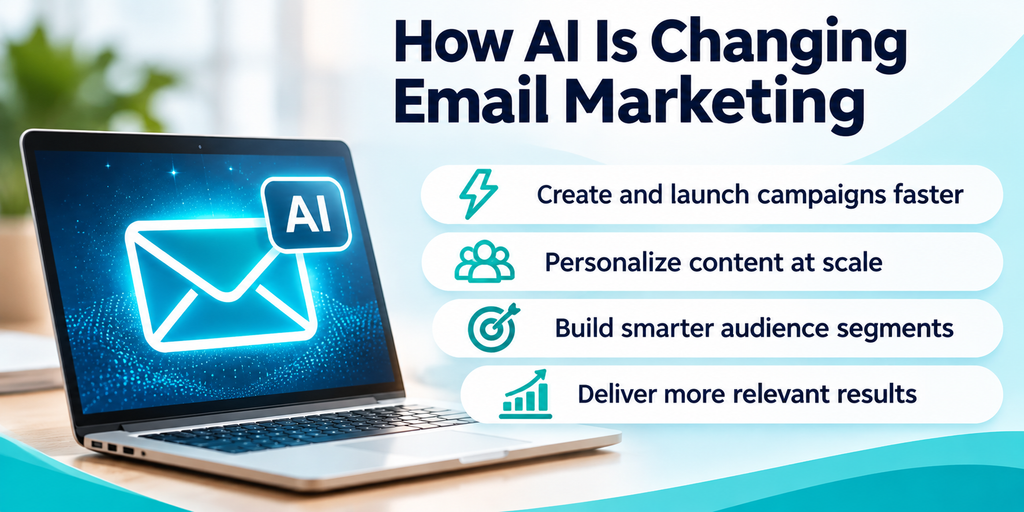
AI is reshaping how marketers create, personalize, deliver, and measure email campaigns.
While generative AI receives much of the attention, some of the biggest opportunities involve using AI to make better decisions about audiences, content, and timing.
1. Faster Email Campaign Production
AI can help marketing teams streamline many of the tasks involved in developing an email campaign.
Common applications include:
- Drafting email copy and subject line variations.
- Generating content ideas and campaign themes.
- Creating or adapting images.
- Developing email variations for different audience segments.
- Summarizing campaign results.
- Identifying opportunities for A/B testing.
These tools can reduce production time, allowing marketers to spend more time on strategy, creative development, and performance improvement.
However, human review remains important. AI-generated content still needs to be checked for accuracy, brand voice, compliance, and relevance.
2. Smarter Email Personalization
Personalization is moving beyond using a subscriber’s first name or sending different offers based on broad demographic categories.
AI can help marketers analyze customer behavior, identify patterns, and predict which messages are most likely to resonate.
For example, a retailer might use purchase history and browsing behavior to recommend relevant products. A home services company could use property characteristics and seasonal needs to identify customers who may be interested in particular services.
AI-powered tools can also support predictive segmentation, send-time optimization, and content recommendations.
But the effectiveness of these capabilities depends on the quality of the underlying customer information.
3. More Intelligent Audience Segmentation
Traditional email segmentation often relies on predefined rules.
A marketer might create separate lists for homeowners, customers in certain ZIP codes, or people who purchased within the last six months.
AI can build on those approaches by identifying patterns across multiple data points.
For example, predictive models may help identify customers who are:
- More likely to make a purchase.
- At risk of becoming inactive.
- Interested in particular product categories.
- Responsive to discounts or promotions.
- Likely to engage with specific types of content.
These insights can help marketers prioritize the audiences most likely to respond.
4. AI Is Changing the Inbox
AI is also changing how consumers interact with email.
Some email applications now use AI-powered features to summarize messages, prioritize content, and help users manage their inboxes.
That creates another reason for marketers to focus on clarity and relevance.
Subject lines should accurately describe the message. Important information should appear early. And emails should provide useful content rather than rely on vague promotional language.
The goal is not simply to get an email opened. It’s to make the message valuable enough for the recipient to act on.
5. Better Data Becomes More Important
AI cannot compensate for incomplete, outdated, or inaccurate customer information.
If an email database contains missing contact details, incorrect demographics, duplicate records, or outdated customer information, even sophisticated personalization tools will have limitations.
This is where customer data enrichment can play an important role.
For example, marketers may use data append services to add missing email addresses or relevant demographic and household attributes to existing customer records, subject to applicable permissions and marketing requirements.
Better data can help brands build more useful segments, improve targeting, and support more relevant email experiences.
Why Email Personalization Matters More Than Ever
Consumers receive marketing messages from numerous brands across email, social media, websites, mobile apps, and other channels.
Generic campaigns must compete for attention with messages that reflect individual interests and needs.
Email personalization is the practice of tailoring messages to customers based on relevant information about who they are, what they do, and what they may need.
Effective personalization starts with audience segmentation.
Rather than sending every subscriber the same content, marketers organize their audiences into groups based on shared characteristics
Six Types of Email Segmentation
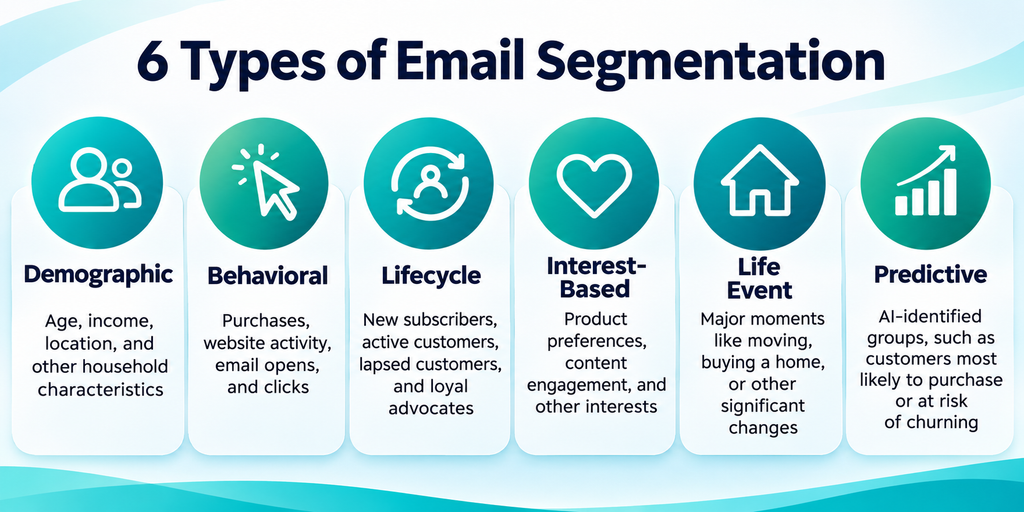
The most effective segmentation strategies often combine multiple types of information.
For example, knowing that a customer owns a home provides some targeting value. Knowing that the customer recently purchased a home, lives in an older property, and has shown interest in home improvement provides a much more useful starting point for relevant messaging.
Life Event Personalization: Reaching Customers When Needs Change
Life events can create opportunities for highly relevant email marketing.
Moving is one example.
A household preparing to move may need insurance, internet service, furniture, home improvement products, and other services.
Using verified mover data, marketers can identify audiences entering this transition and tailor their campaigns accordingly.
PGM’s Mover Factors provides insights into the mover lifecycle, helping brands identify and reach potential and verified movers earlier.
For a home goods retailer, this could mean developing a campaign focused on furniture and home essentials for recent homebuyers.
For an insurance company, it could mean reaching prospective customers with relevant coverage information as they prepare for a move.
For a home services provider, it could mean promoting services that are particularly relevant to new homeowners.
The value comes from understanding what customers may need at a specific moment rather than relying solely on broad demographic characteristics.
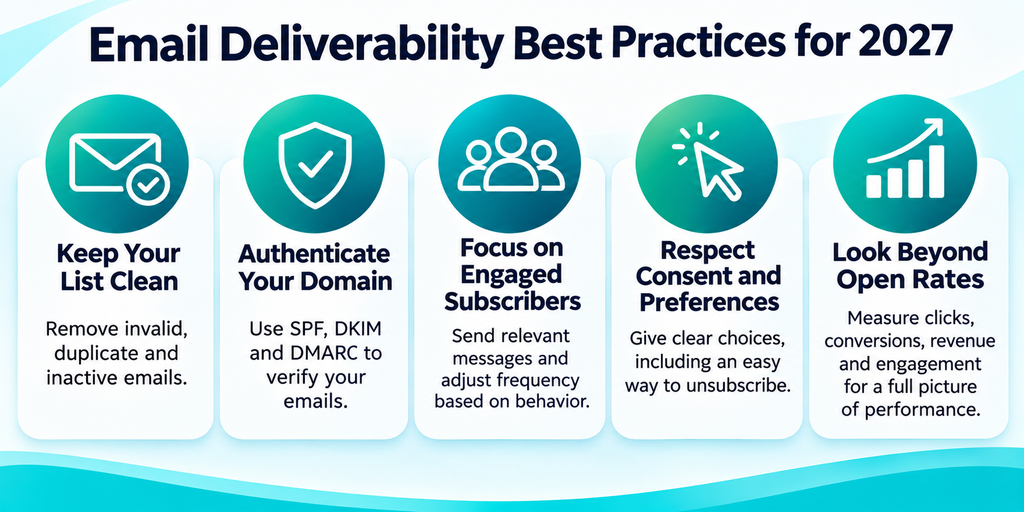
Email Deliverability Best Practices for 2027
Even the best email campaign cannot perform if it doesn’t reach the intended recipient.
Email deliverability refers to an email’s ability to reach the inbox rather than being rejected, filtered into spam, or otherwise failing to arrive where intended.
Deliverability is influenced by sender reputation, email authentication, recipient engagement, list quality, and sending practices.
Here are five areas marketers should prioritize.
1. Maintain a Clean Email Database
Outdated or inaccurate email addresses can contribute to bounces and poor list quality.
Regularly review your database for invalid addresses, duplicates, and records that no longer meet your marketing requirements.
Use appropriate email validation practices and monitor hard bounces.
Data append can help fill missing contact information, but appended addresses should be evaluated for accuracy, relevance, and permission before being used in campaigns.
2. Authenticate Your Email Domain
Email authentication helps receiving mail providers verify that messages are legitimately associated with your domain.
Important standards include:
- SPF: Identifies servers authorized to send email for a domain.
- DKIM: Uses a digital signature to help verify message authenticity.
- DMARC: Establishes policies for handling messages that fail authentication checks.
Marketers should work with their email platform and technical teams to ensure these settings are properly configured.
3. Focus on Engaged Subscribers
Sending more emails does not automatically generate better results.
Monitor subscriber engagement and adjust frequency based on audience behavior.
Consider developing re-engagement campaigns for inactive subscribers and suppressing contacts who remain unresponsive.
The objective is to maintain a healthy audience that wants to receive your communications.
4. Respect Consent and Preferences
Clear permission practices and easy unsubscribe options help build trust.
Provide recipients with meaningful choices about the communications they receive, and comply with applicable email marketing and privacy requirements.
Preference centers can also help marketers learn which content subscribers actually want.
5. Look Beyond Open Rates
Open rates can provide directional information, but they should not be treated as a definitive measure of human engagement.
Apple Mail Privacy Protection and automated security systems can affect email open tracking. Some automated systems can also generate clicks that do not reflect genuine customer interest.
For a more accurate assessment, monitor clicks alongside conversions, revenue, unsubscribes, complaints, and other meaningful outcomes.
How to Improve Email Marketing Performance in 2027: Seven Strategies
The latest statistics point to a consistent theme: email marketing success depends less on sending volume and more on relevance, timing, and execution.
Here are seven practical strategies B2C marketers can use.
1. Start With Better Customer Data
Review the information available in your email database.
Are email addresses accurate? Are important demographic or household attributes missing? Can you distinguish active customers from prospects?
Identify the gaps that limit your ability to build meaningful segments.
Customer data enrichment can help supplement existing records with relevant information, creating a stronger foundation for targeting and personalization.
2. Segment Beyond Basic Demographics
Age, location, and income can be useful, but they don’t always explain what a customer needs right now.
Combine demographic information with behavior, lifecycle stage, purchase history, and relevant life event signals.
For example, a home improvement brand might create separate campaigns for recent homebuyers, long-term homeowners, and customers researching specific renovation projects.
3. Prioritize High-Intent Automated Emails
Start with workflows that respond to meaningful customer actions.
These may include:
- Welcome and onboarding sequences.
- Abandoned cart reminders.
- Post-purchase follow-ups.
- Product replenishment reminders.
- Re-engagement campaigns.
- Customer milestone communications.
Measure performance by workflow and optimize based on customer response.
4. Use AI Where It Adds Value
AI can help marketers work faster, but it should also improve decision-making.
Start with practical applications such as subject line testing, predictive segmentation, send-time optimization, or campaign analysis.
Evaluate results against a baseline before expanding.
AI should support your marketing strategy rather than determine it.
5. Personalize Based on Customer Needs
Move beyond simply inserting a name into an email template.
Use relevant data to tailor the content, product recommendations, timing, and offers.
A home services company, for example, might develop different campaigns based on homeownership status, property characteristics, or relevant seasonal needs.
A retailer might personalize communications based on recent purchases or changing household needs.
6. Coordinate Email With Other Marketing Channels
Email is most effective when it supports a broader customer experience.
A customer may discover a product through a digital advertisement, research it on a website, receive a follow-up email, and eventually purchase in-store.
Coordinate messaging across these touchpoints so customers receive relevant, consistent communications.
Read more: Audience Segmentation Examples.
7. Measure What Matters
Move beyond campaign-level vanity metrics.
Track the outcomes that reflect business value, including:
- Click-through rate.
- Conversion rate.
- Revenue per email.
- Revenue per subscriber.
- Customer acquisition and retention.
- Unsubscribe and complaint rates.
- Deliverability and bounce rates.
Use controlled testing when possible to understand whether a campaign or personalization tactic actually improves results.
The Role of Consumer Data in Email Marketing
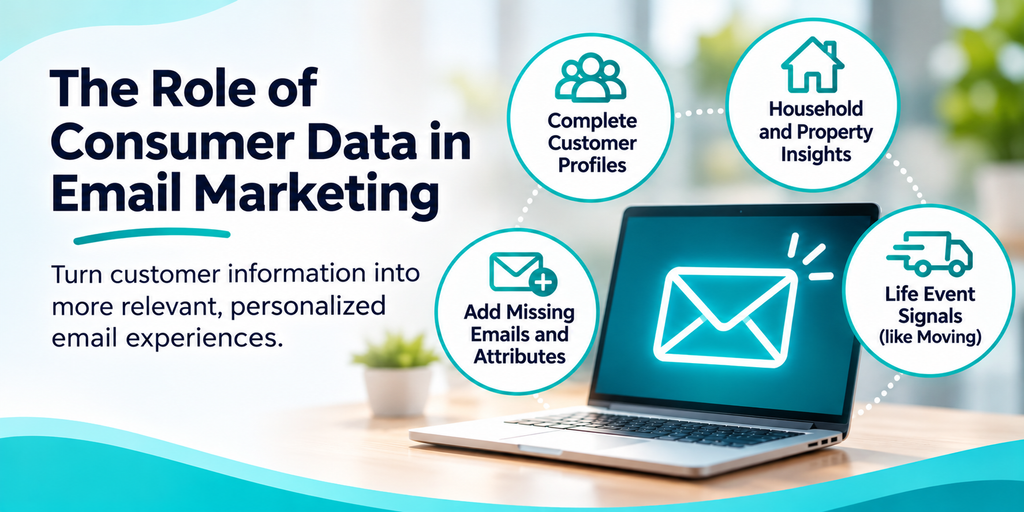
Email marketing technology has advanced significantly, but technology alone does not create relevant customer experiences.
Marketers still need accurate information about the audiences they’re trying to reach.
That includes understanding not just how customers interact with email, but also relevant characteristics, interests, and changes in their lives.
Why Data Quality Matters
Incomplete customer records can limit segmentation and personalization.
For example, a retailer may have an email address and purchase history but lack information about household characteristics or homeownership.
A home services provider may know where a customer lives but have limited information about the property itself.
A brand may have a large customer database but be unable to reach certain customers through email because contact information is missing.
Addressing these gaps can help marketers build more relevant audiences and develop better-informed campaigns.
How Data Append Supports Email Marketing
Data append involves matching existing customer records with additional information from an external data source.
Depending on the available data and the marketer’s needs, append services can help add:
- Missing email addresses.
- Phone numbers.
- Demographic attributes.
- Household characteristics.
- Homeownership information.
- Property-related insights.
- Other relevant consumer attributes.
For example, a retailer might use demographic enrichment to create more targeted campaigns. A home services brand might use property-related information to identify homeowners who may be interested in certain services.
The goal is to make the customer information already in your database more useful.
How PGM Helps B2C Marketers Build Better Audiences
PGM provides consumer data and audience intelligence that helps B2C brands better understand and reach their target audiences.
Its data offerings include:
People Factors: Consumer and household attributes that support audience development, segmentation, and personalization.
Mover Factors: Mover lifecycle insights that help marketers reach consumers during important life transitions.
Home Factors: Property intelligence that can help insurance and home services marketers better understand property characteristics and related needs.
Auto Factors: Automotive data and insights that support targeting based on vehicle-related characteristics and signals.
These data assets can help marketers build more relevant audience segments for their email marketing and broader campaigns.
Email Marketing Examples for B2C Brands
What does a more data-driven email marketing strategy look like in practice?
Here are four examples.
Retail and Home Goods
A home furnishings retailer identifies recent homebuyers and creates an email series featuring furniture, home décor, and household essentials.
Instead of sending a generic promotion to its entire database, the retailer develops messaging relevant to customers who may be furnishing a new home.
Home Services
A home services company uses available property characteristics to identify relevant audience segments.
It develops email campaigns featuring maintenance services, seasonal reminders, or home improvement offerings appropriate to those segments.
Insurance
An insurance marketer segments audiences based on relevant household and property information.
Email communications can then address different coverage needs, customer lifecycle stages, or opportunities for policy reviews.
Automotive
An automotive marketer uses vehicle-related information to develop more relevant customer communications.
Campaigns might focus on service reminders, vehicle ownership milestones, or offers relevant to particular vehicle segments.
In each case, the objective is the same: use better information to make email communications more timely and relevant.
Frequently Asked Questions About Email Marketing
Is email marketing still worth it in 2027?
Yes. Email remains an important channel for customer engagement, retention, and revenue generation. Litmus’s State of Email 2026 found that the highest-performing 8% of email programs reported ROI of at least 45:1. Results vary considerably by industry, audience, and campaign strategy.
What is a good email marketing ROI?
A good email marketing ROI depends on the industry, business model, and costs included in the calculation. Rather than relying on a universal benchmark, marketers should measure their own revenue relative to email program costs and compare performance over time.
How is AI used in email marketing?
AI can support email copywriting, subject line testing, audience segmentation, send-time optimization, predictive analytics, and campaign reporting. More advanced applications use customer behavior and other relevant information to improve personalization.
Does AI improve email marketing ROI?
Research shows an association between deeper AI integration and higher email marketing ROI. Litmus found that advanced AI adopters were 75% more likely to report ROI above 45:1. However, AI alone does not guarantee improved results.
What types of emails generate the most revenue?
Automated, behavior-triggered emails can generate substantial revenue. Omnisend’s 2026 ecommerce report found that automated emails produced 30% of email revenue from just 2% of sends, with welcome and abandoned cart messages accounting for a large share of automation-generated orders.
What is the difference between email automation and AI personalization?
Email automation sends messages based on predefined triggers or schedules, such as a welcome email after someone subscribes. AI personalization uses data and predictive models to help determine which content, timing, or offer may be most relevant to an individual or segment. The two approaches can work together.
How do you personalize email marketing?
Start with accurate customer information and segment audiences based on relevant characteristics, behaviors, preferences, and lifecycle stages. Then tailor email content, offers, and timing to each audience.
How can marketers improve email deliverability?
Maintain clean lists, authenticate sending domains, respect consent and unsubscribe requests, monitor sender reputation, and focus on engaged recipients. Regularly review bounce rates, spam complaints, and other deliverability indicators.
Why are email open rates less reliable?
Privacy protections, including Apple Mail Privacy Protection, can affect how opens are recorded. Automated systems can also influence engagement metrics. Marketers should evaluate opens alongside clicks, conversions, revenue, and other meaningful outcomes.
How does consumer data improve email marketing?
Consumer data can help marketers build more relevant audience segments, fill gaps in existing customer records, and personalize campaigns based on demographics, household characteristics, interests, and life events. Better data provides a stronger foundation for targeting and personalization.
Build a Stronger Email Marketing Strategy With Better Data
AI, automation, and personalization are creating new opportunities for email marketers. But successful campaigns still depend on understanding who your customers are and what matters to them.
PGM helps B2C marketers build more informed audiences with consumer data, data append, and insights into important life events and household characteristics.
Whether you’re looking to enrich your existing database, reach new audiences, or improve personalization, better data can help you make more of every customer connection.