
 Home Factors


Email remains one of the most effective ways for businesses to communicate with customers, share offers and build lasting relationships. But even the best email marketing strategy won’t deliver results if your customer database is missing email addresses or contains outdated contact information.
Customers change email providers, abandon old accounts and sometimes never provide an email address in the first place. Over time, those gaps can limit your marketing reach and make it harder to stay connected with customers.
That’s where email appending comes in.
Email appending helps businesses find missing email addresses and expand their ability to reach existing customers. It can also support customer retention, personalized marketing and omnichannel campaigns.
Here’s what you need to know about email appending, including how it works, its benefits, best practices and what to look for in an email append service.
What is Email Appending?
Email appending is the process of adding missing email addresses to an existing customer database by matching customer records against a third-party data source.
Businesses typically provide identifying information such as a customer’s name and postal address. An email append provider uses that information to locate associated email addresses and return qualifying matches.
For example, a retailer may have a customer database containing names, mailing addresses and purchase histories but no email addresses for thousands of customers. Email appending can help identify matching email addresses, allowing the retailer to expand its digital marketing reach.
Email appending is especially useful for businesses with large customer databases, established offline customer relationships or gaps in their first-party contact information.
See how PGM’s email append solutions can help you expand your customer database and improve your marketing reach.
How Does the Email Append Process Work?
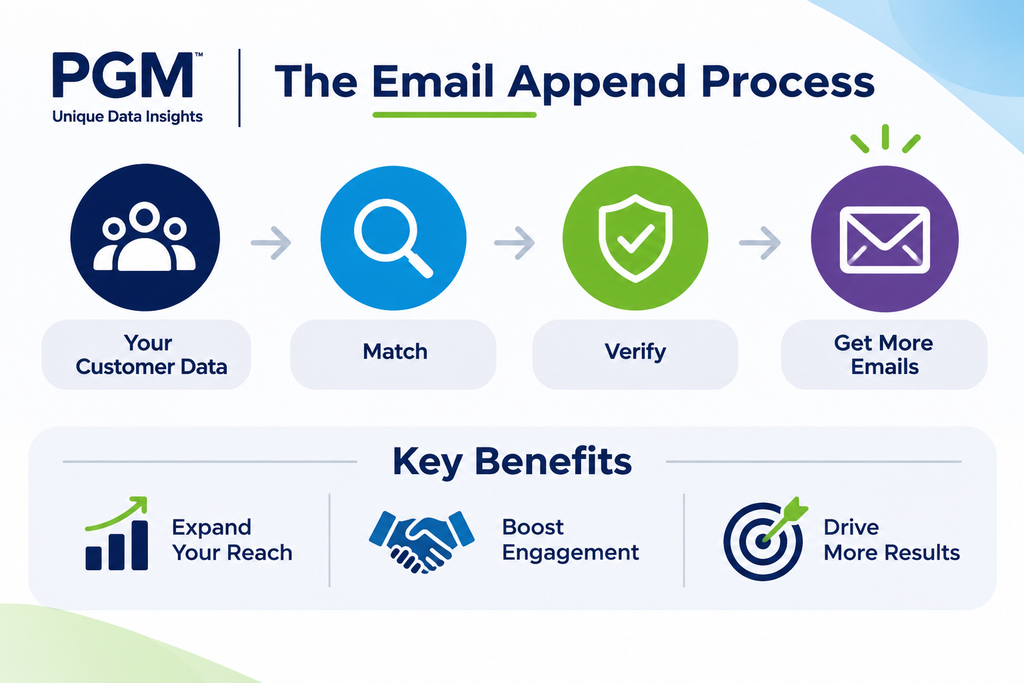
The email append process generally involves four steps.
Step 1: Submit Your Customer Records
Start with an existing customer database containing identifying information such as names and postal addresses.
Before submitting your file, review it for duplicate records, incomplete information and obvious errors.
Step 2: Match Records Against an Email Database
The email append provider compares your customer records against its database to identify associated email addresses.
Matching may occur at the individual or household level.
- Individual-level matching uses information such as first name, last name and postal address to identify an email associated with a specific person.
- Household-level matching uses information such as last name and postal address to identify an email associated with someone in the household.
Understanding the match level is important because an email associated with a household may not belong to the specific individual in your original record.
Step 3: Evaluate Email Quality and Permissions
Not every identified email address should automatically be added to your marketing database.
Providers should evaluate match quality, deliverability and applicable permission requirements.
PGM’s email append process includes deploying a permission message to matches and returning only deliverable, non-opted-out email addresses, along with a match-level indicator.
Businesses should also evaluate whether their intended use complies with applicable privacy laws, marketing requirements and email platform policies.
Step 4: Receive Your Appended Email Data
Once matching and qualification are complete, the provider returns the eligible email addresses for integration into your customer database.
You can then use the expanded contact information to support appropriate customer communications and marketing programs.
For more great tips on getting your data in shape, check out our 22-minute on-demand webinar: How to Prepare Your Customer Data for AI-Powered Marketing

Email Append vs. Email Verification vs. Data Hygiene: What’s the Difference?
Although these services are related, they serve different purposes.
- Email appending identifies missing email addresses for existing customer records.
- Email verification evaluates whether an email address is properly formatted and likely to be deliverable.
- Data hygiene improves the overall quality of a customer database by identifying and correcting inaccurate, outdated, duplicate or incomplete information.
For example, a business might use data hygiene to clean its customer records, email appending to locate missing addresses and email verification to evaluate deliverability.
Using these services together can help businesses build more complete and reliable customer databases.
Why Is Email Appending Important?
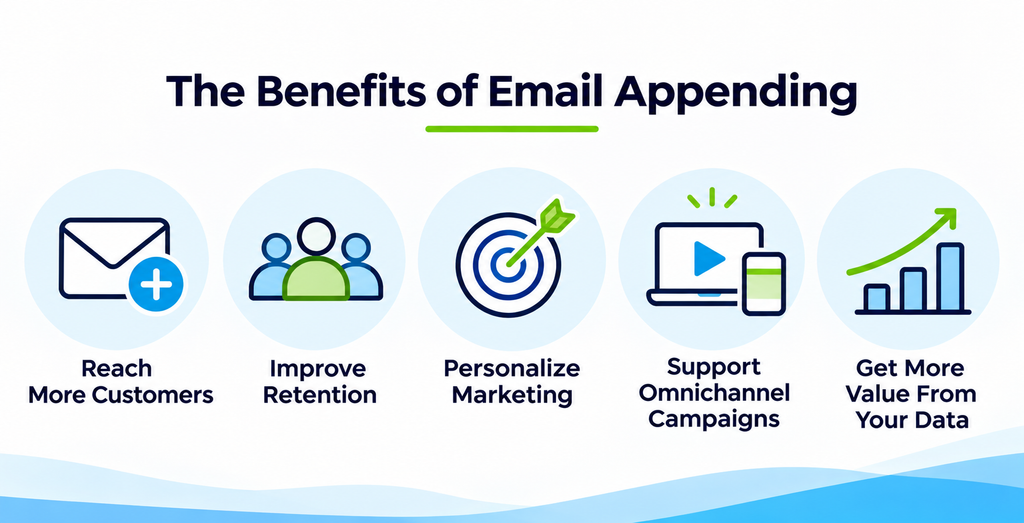
Your customer database is one of your most valuable marketing assets. But missing email addresses can prevent you from reaching customers through digital channels.
Email appending can be particularly beneficial when:
- You have active customers who haven’t provided email addresses.
- You’re preparing for a product launch, seasonal promotion or important announcement.
- You want to reconnect with customers who haven’t engaged recently.
- You’re expanding a customer loyalty or rewards program.
- You want to strengthen customer retention campaigns.
- You’re planning coordinated marketing across email, social media, display advertising and connected TV.
- You want to improve the completeness of your first-party customer data.
Rather than relying entirely on new customer acquisition, email appending helps businesses make better use of the customer relationships they already have.
3. Support Personalized Marketing
Email addresses become more valuable when combined with existing customer information.
Purchase history, demographic characteristics, household attributes and consumer interests can help marketers develop more relevant messages.
Rather than sending the same promotion to every customer, businesses can segment audiences based on available insights and tailor their campaigns accordingly.
4. Strengthen Omnichannel Marketing
Email addresses aren’t useful only for email campaigns.
They can also serve as identifiers for audience matching and activation across certain digital advertising platforms, subject to platform requirements and appropriate permissions.
For example, a retailer may use qualifying customer records to support coordinated email, social media, display and connected TV campaigns.
By connecting customer information across channels, marketers can work toward a more consistent customer experience.
5. Get More Value From Your Existing Customer Data
Acquiring new customers often requires significant marketing investment.
Email appending helps businesses make better use of customer information they’ve already collected by filling gaps in their databases.
This can support broader campaign reach without requiring marketers to build an entirely new customer audience.
Email Append Best Practices: 6 Tips for Better Results
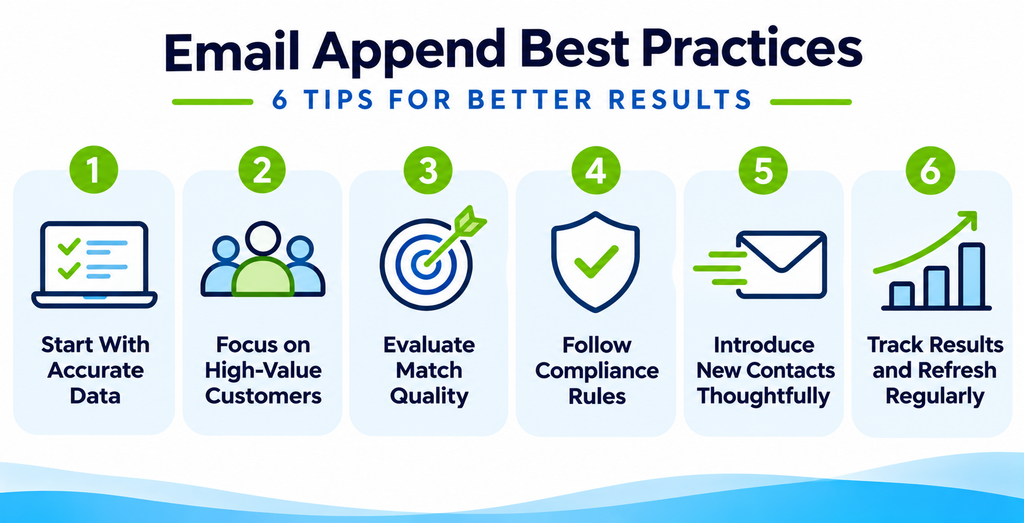
1. Start With Accurate Customer Data
Email appending works best when the information used for matching is accurate.
Review customer names, postal addresses and other identifiers before beginning an append project.
2. Prioritize Your Most Valuable Customer Segments
Consider starting with active customers, recent purchasers, loyalty members or other audiences relevant to your business goals.
This can help you focus your initial efforts on customer relationships where expanded contact information may provide the most value.
3. Evaluate Match Quality, Not Just Match Rate
A high match rate may look impressive, but the quality of those matches matters.
Ask your provider how records are matched, how deliverability is evaluated and whether individual-level and household-level matches are identified separately.
4. Review Permissions and Compliance Requirements
Before using appended email addresses, confirm that the data and your intended communications meet applicable legal requirements and your email platform’s policies.
In the United States, commercial email is subject to CAN-SPAM requirements, including accurate sender information, nondeceptive subject lines and a way for recipients to opt out.
Other privacy and consent requirements may apply depending on your audience and location.
5. Introduce New Contacts Thoughtfully
An appended email address doesn’t necessarily mean the recipient recognizes your brand or expects your messages.
Use appropriate permission practices and thoughtful communication strategies rather than immediately placing every appended address into a high-volume promotional campaign.
6. Monitor Results and Refresh Your Data
Track deliverability, engagement, unsubscribes and campaign performance to understand how appended records perform.
Continue maintaining your database so that newly acquired email addresses remain part of an ongoing data quality strategy.
How Often Should You Perform an Email Append?
The right frequency depends on your business, customer database and marketing activity.
Some businesses may benefit from monthly or quarterly updates, while others may find that a biannual or campaign-based schedule is sufficient.
Consider a new email append when:
- Your customer database has grown significantly.
- You’re preparing for a major marketing campaign.
- A substantial portion of your customer records is missing email addresses.
- You’re launching a new customer retention or loyalty initiative.
- Your existing contact data hasn’t been refreshed recently.
For seasonal businesses, completing an append project before a major promotional period can provide additional time to evaluate matches and prepare campaigns.
How Much Does an Email Appending Service Cost?
Email append pricing varies based on the provider, size of your customer database, matching requirements and other project details.
Some providers price services based on the number of customer records submitted, while others use a matched-record pricing model.
When comparing email append services, ask about:
- Pricing per submitted record or successful match
- Minimum record requirements
- Individual-level versus household-level matching
- Deliverability and permission processes
- Data delivery format and turnaround time
The lowest price per match doesn’t necessarily provide the best value. Match accuracy, data quality and suitability for your intended marketing use are equally important.
How Do You Measure Email Append Success?
Measuring the results of an email append project involves more than counting newly acquired email addresses.
Consider tracking these metrics:
- Match rate: The percentage of submitted customer records that receive an eligible email match.
- Deliverability: The percentage of appended email addresses that successfully receive messages.
- Engagement: How appended contacts respond to appropriate email campaigns, including clicks and other meaningful actions.
- Conversions: Purchases, inquiries, loyalty program participation or other outcomes associated with campaigns using appended records.
- Revenue and ROI: The incremental business value generated relative to the cost of the append project and related marketing activity.
Comparing appended contacts with appropriate benchmarks or control groups can provide a clearer understanding of their contribution to campaign performance.
Frequently Asked Questions About Email Appending
Can you append email addresses to a customer database?
Yes. Email append services are designed to match existing customer records with associated email addresses. Match availability depends on the accuracy of your customer data, the provider’s database and its matching criteria.
What is the difference between email appending and buying an email list?
Email appending starts with customer records your business already has and attempts to identify missing email addresses for those records.
Buying an email list typically involves acquiring contact information for individuals who may not have an existing relationship with your business.
The distinction is important, although neither approach automatically establishes permission to send marketing emails.
How accurate is email appending?
Accuracy varies by provider, source data and matching methodology. Ask providers how they validate matches, evaluate deliverability and distinguish individual-level from household-level results.
Does email appending improve email deliverability?
Email appending can help businesses obtain additional contact information, but it does not automatically improve deliverability. Deliverability also depends on address quality, sender reputation, authentication, list management and recipient engagement.
Can email appending support omnichannel marketing?
Yes. Qualifying email addresses can support customer matching and audience activation across certain advertising channels, including social media, display and connected TV, subject to platform policies and applicable privacy requirements.
Is email appending worth it?
Email appending can be valuable for businesses with large customer databases containing missing email addresses. Its value depends on match quality, cost, appropriate marketing permissions and the business results generated from the expanded contact information.
Expand Your Customer Reach With PGM Email Append Solutions
Your customer database may contain valuable opportunities you’re not reaching today.
PGM helps businesses identify missing email addresses and make better use of their existing customer information through email append and data enhancement solutions.
Whether you’re looking to expand email marketing reach, reconnect with customers or support omnichannel campaigns, more complete customer data can help you build a stronger foundation for your marketing efforts.
Ready to reach more of your customers?