 Home Factors


By the PGM Data & Marketing Team
Based on findings from The 2026 Homeowner Report, PGM’s original consumer research study conducted in partnership with Ascend2. Survey of 1,559 U.S. homeowners conducted March and April 2026. All findings at 95% confidence.
Take two homeowners. Both own single-family homes. Both are in your service area. Both are the right age and income bracket for your ideal customer profile.
One just hit the ten-year mark in their house and is starting to notice the roof. Maintenance is on their mind. They want someone reliable who can come out and give them an honest assessment before something goes wrong.
The other bought their house two years ago and is already thinking about the kitchen renovation they’ve been planning since move-in. They want to increase the home’s value and they’re willing to spend to do it right.
Same demographic profile. Completely different motivations. And if you’re sending them the same message, you’re probably losing at least one of them.
This is the personalization challenge in home services marketing, and it’s more nuanced than most campaigns account for. It’s not just about using someone’s first name in a subject line. It’s about understanding what’s actually driving that homeowner to consider a project at all.
Home Improvement Motivation Is More Varied Than Most Campaigns Assume
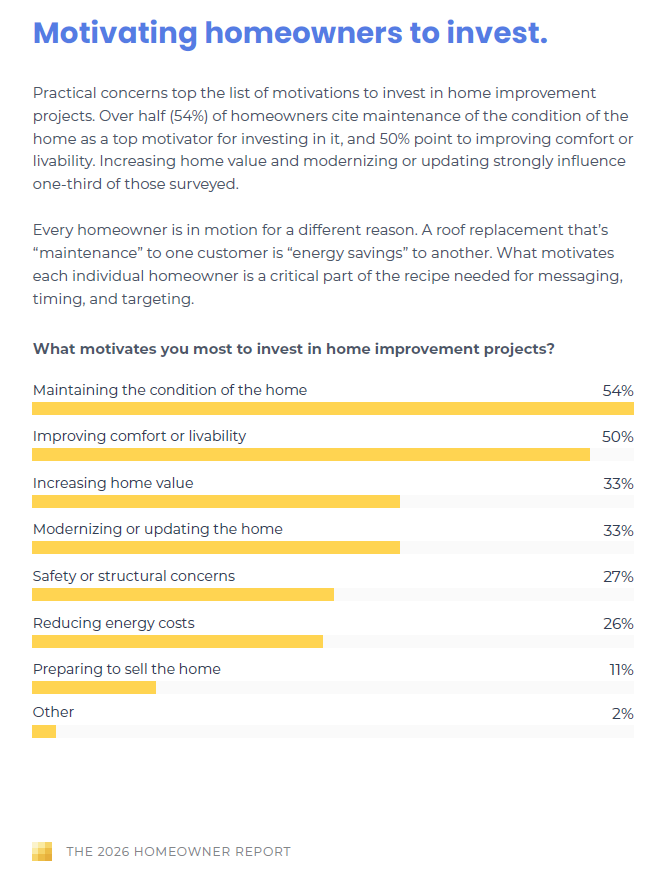
PGM’s 2026 Homeowner Report surveyed over 1,500 U.S. homeowners and asked a simple question: what motivates you most to invest in home improvement projects? The answers don’t point to one dominant driver. They spread across a fairly wide range.
What homeowners say motivates them most:
- 54% Maintaining the condition of the home
- 50% Improving comfort or livability
- 33% Increasing home value
- 33% Modernizing or updating the home
- 27% Safety or structural concerns
- 26% Reducing energy costs
- 11% Preparing to sell the home
Source: The 2026 PGM Homeowner Report
The gap between the top motivation (54%) and the bottom (11%) is significant. But what matters more for home services marketers is that these motivations point to very different messaging needs. A homeowner driven by maintenance responds to different language than one thinking about resale value. Someone focused on energy costs wants to hear different things than someone worried about structural concerns.
The report puts it well: a roof replacement that’s maintenance to one customer is energy savings to another.
If your campaigns treat all of these homeowners the same way, you’re likely resonating well with one group and missing the others entirely.
How Homeowner Motivation Shifts With Age (And Why It Changes Your Message)
One of the more useful findings in the research is how motivation breaks down by generation. The shifts are significant enough to change not just what you say, but how you frame it.
Maintenance as a motivation grows sharply with age: 41% of Gen Z homeowners cite it, compared to 69% of Boomers. That’s a 28-point swing. For older homeowners, the home is something to be preserved and kept running. For younger homeowners, the same project is more likely to be framed around improvement, value, or modernization.
Home value tells a different story. Increasing home value matters most to Millennials (39%) and least to Boomers (27%). Millennials bought more recently, often at higher prices, and are more attuned to the investment side of homeownership.
What this means for messaging:
- Roofing or HVAC campaigns aimed at older homeowners should lean into reliability, longevity, and protecting what they’ve built. Condition and peace of mind resonate more than ROI.
- The same services marketed to Millennials can lead with value protection, energy efficiency, or modernization. They’re more receptive to the investment framing.
- Gen Z homeowners are a smaller but growing segment. They’re more digitally active, more likely to use social media to find contractors (37% vs 6% of Boomers), and more responsive to reviews and speed of response.
- Boomers are more likely to rely on word-of-mouth and personal recommendations (76%), which makes reputation and local presence a more effective lever than digital advertising alone.
Regional Differences in Home Improvement Motivation: What the Data Shows
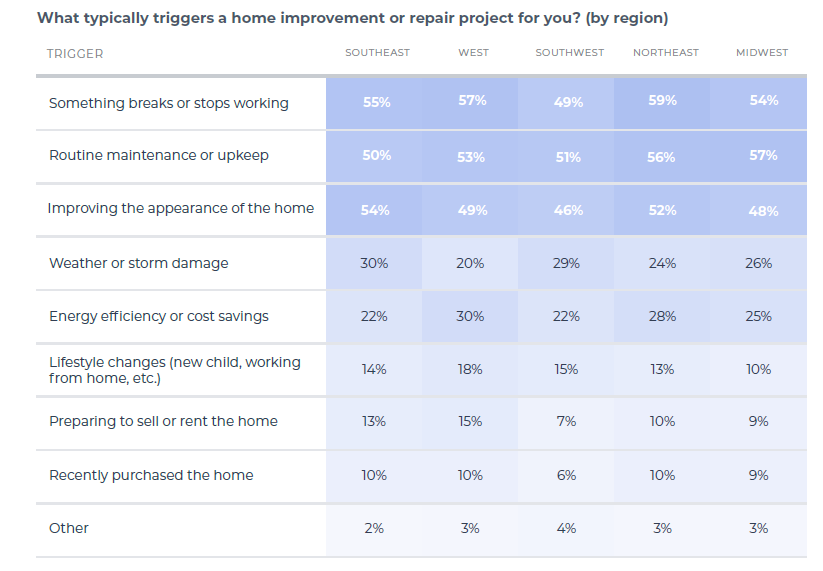
Motivation doesn’t just vary by age. It also shifts meaningfully by region, in ways that track pretty closely with climate, local conditions, and housing stock.
Source: The 2026 PGM Homeowner Report
A few regional patterns worth noting:
- Weather and storm damage drives more projects in the Southeast (30%) and Southwest (29%) than anywhere else. Contractors in those markets have a natural opening to lead with storm readiness and post-weather urgency.
- Energy efficiency is a significantly stronger motivator in the West (30%) and Northeast (28%) than in the South. For HVAC, insulation, and window companies operating in those regions, efficiency-focused messaging likely outperforms general replacement messaging.
- The Southeast leads all regions on appearance-driven projects (54%). Curb appeal and cosmetic upgrades are a stronger hook in that market.
- The Midwest skews heavily toward maintenance (57%) and has the fewest lifestyle-change triggers (10%). Straightforward, practical messaging about keeping a home running tends to land better there.
None of this is surprising when you think about it. A homeowner in Phoenix thinks differently about their HVAC than one in Portland. A homeowner in coastal Florida thinks differently about their roof than one in Chicago. But a lot of home services marketing ignores these differences and runs the same message everywhere.
The Link Between Motivation and Home Condition Data
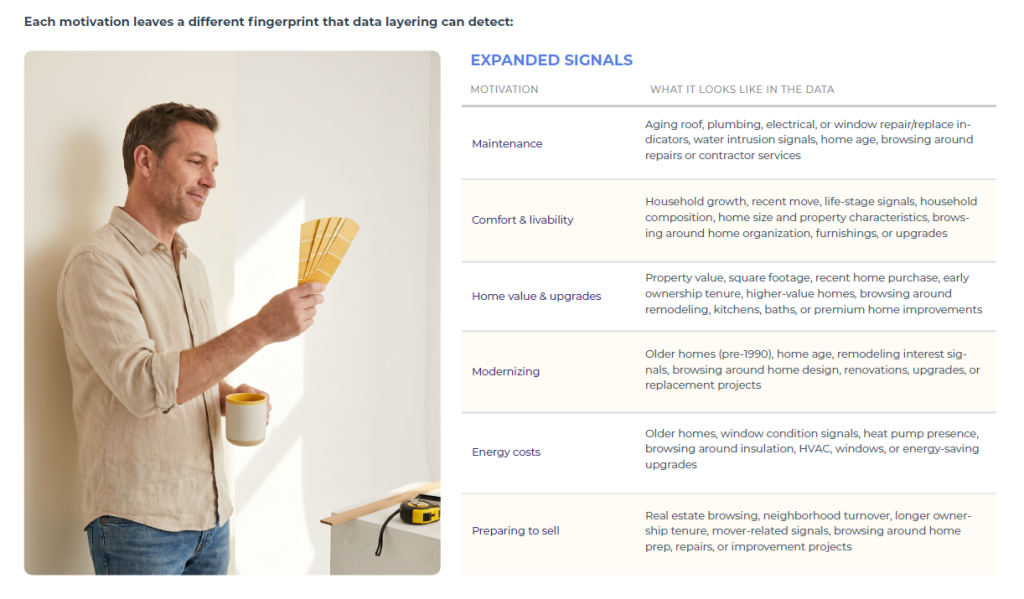
Here’s where this gets useful from a targeting standpoint. Each of these motivations has a corresponding signature in the data. They’re not just psychographic categories you have to guess at. They show up in measurable, targetable signals.
Source: The 2026 PGM Homeowner Report
A homeowner motivated by maintenance tends to own an older home with aging systems. The signals are in the home itself: roof age, plumbing indicators, water intrusion risk. You don’t need to ask them what motivates them. The home tells you.
A homeowner motivated by home value is more likely to be earlier in their ownership tenure, in a higher-value property, browsing around remodeling or kitchen and bath upgrades.
A homeowner preparing to sell leaves a different kind of footprint: real estate browsing, longer ownership tenure, mover-related signals, browsing around home prep and improvement.
Home Factors, PGM’s proprietary audience solution, is built around exactly this kind of layered signal approach. It’s designed to identify homes most likely to need specific services, not just homes that fit a broad demographic profile. When you pair that targeting precision with messaging that matches the underlying motivation, you’re not just reaching the right home. You’re saying the right thing when you get there.
Why Personalized Home Services Marketing Outperforms Generic Campaigns
The research makes a strong case for relevance-driven outreach. 71% of homeowners say they’d be open to hearing from home service businesses with offers based on the age or condition of their home. 75% say maintenance reminders would be genuinely helpful.
But the flip side is also true. Generic outreach, messages that don’t connect to anything real about the home or the homeowner’s situation, tends to get ignored. The homeowners in this study aren’t resistant to marketing. They’re resistant to marketing that feels random.
A few things tend to work in favor of personalized campaigns:
- Condition-relevant messaging registers as helpful rather than intrusive. A roofing company reaching out to a homeowner whose roof is approaching 20 years old doesn’t feel like a cold pitch. It feels like useful timing.
- Motivation-matched language improves engagement. Talking about home value to a Millennial homeowner in their third year of ownership is a different conversation than talking about reliability to a Boomer who has lived in their home for 20 years.
- Regional context makes messaging more credible. Referencing storm season to a Southeast homeowner or energy costs to a West Coast homeowner shows awareness of their actual situation.
- First-mover advantage compounds with relevance. Two-thirds of homeowners say they’d likely choose the first company to reach them at the moment of need. Being first matters more when the message also fits.
Putting It Together: A Framework for Home Services Messaging Strategy
Across this blog series, we’ve covered timing, targeting precision, and now motivation. They’re connected. The strongest home services marketing programs tend to get all three right at once.
A practical framework for thinking about it:
- Start with the home, not the homeowner. Home condition signals identify which properties are most likely to need service. That’s your targeting foundation.
- Layer in motivation signals. Home age, ownership tenure, property value, and behavioral data give you a reasonable read on what’s driving a given homeowner. Use that to frame the message.
- Match the message to the motivation. Maintenance-driven homeowners want reliability and timing. Value-driven homeowners want ROI and quality. Energy-focused homeowners want efficiency and savings. Sell-motivated homeowners want speed and curb appeal.
- Account for regional context. Climate, housing stock, and local market conditions shape what resonates. A single national message rarely performs as well as regionally tuned campaigns.
- Get there early. The best-targeted, best-messaged campaign still loses if a competitor calls first. Reaching homeowners before they start actively searching is where the real leverage is.
None of this requires a complete overhaul of how you run campaigns. It starts with better data, and it builds from there. The homeowner research we’ve done at PGM consistently shows that the gap between average and top-performing home services campaigns isn’t usually the creative. It’s the audience, the timing, and how well the message fits the moment.
Ready to see what Home Factors can do for your business?
Contact PGM to learn how Home Factors audience programs combine home condition data with motivation signals to reach the right homeowners with the right message.
About This Research
The 2026 Homeowner Report was produced by PGM in partnership with Ascend2 Research. The study surveyed 1,559 U.S. homeowners in March and April 2026. All findings are reported at a 95% confidence level. PGM’s Data and Marketing team analyzes homeowner behavior and home condition signals to provide audience solutions to home services brands across the United States.
Also in this series:
Blog 1: Home Services Marketing in 2026: Why Timing and Home Condition Data Win More Business
Blog 2: Why Demographics Alone Miss High-Intent Homeowners (And What to Do Instead)