
 Home Factors


Marketing has always been built around visibility. Search queries, clicks, site visits, and comparison behavior have helped brands read intent and optimize campaigns for decades. But how AI is changing consumer shopping behavior is now rewriting that playbook, and much of the visibility marketers once relied on is starting to disappear.
Consumers are increasingly handing discovery and evaluation to AI-powered tools. That shift changes not only how people shop, but how marketers identify and respond to demand. The challenge is no longer simply reaching consumers. It is understanding them early enough to stay relevant.
AI Product Discovery Is Replacing Traditional Search
Traditional search has long been the front door to the buying journey. Consumers searched, compared, researched, and ultimately converted. That journey is beginning to change as AI product discovery takes hold.
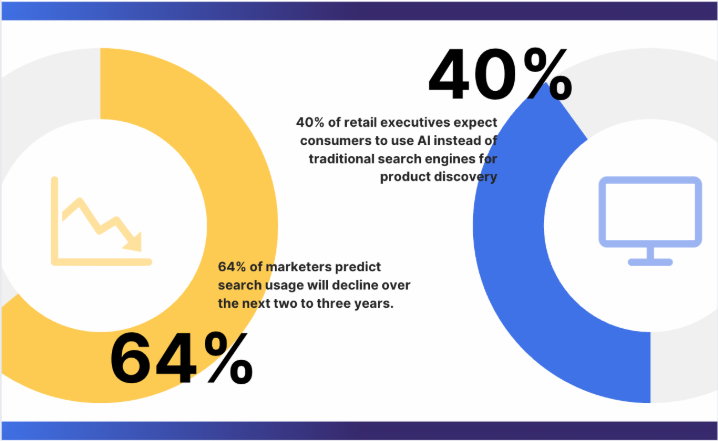
According to a recent study by Deloitte, 40% of retail executives expect consumers to use AI instead of traditional search engines for product discovery, while 64% of marketers predict search usage will decline over the next two to three years.
Rather than sorting through pages of results, consumers increasingly ask AI to narrow choices, summarize options, and make recommendations. For marketers, this means the moment of discovery is moving into a space that offers far fewer visible signals.
How AI Is Weakening Brand Loyalty
AI is also reshaping brand relationships, which is one of the clearest signs of how AI is changing consumer shopping behavior at a structural level.
Research shows that 86% of retail executives believe generative AI will weaken brand loyalty.
The reason is straightforward. AI recommendations prioritize relevance, value, features, and fit. They do not necessarily prioritize familiarity. When a consumer asks an AI assistant for the best product, the answer is often built on data points and contextual needs rather than brand preference alone.

This creates both risk and opportunity. Strong brands will still matter, but relevance may matter more. Brands that understand consumer needs in context will hold a significant advantage over those relying on historical loyalty.
The Customer Journey Is Becoming Invisible
One of the most important implications of AI-led shopping is that the customer journey is becoming increasingly abstracted. Consumers may no longer run multiple searches, visit numerous websites, or openly compare products across channels. Instead, AI performs much of that work on their behalf.
For marketers, this creates a disappearing signal problem. Fewer searches, fewer clicks, and fewer visible comparison behaviors mean less direct insight into when intent is forming and how decisions are being made. The traditional digital breadcrumb trail is getting harder to follow.
Why Browsing Behavior Matters More Than Ever
As traditional signals become less reliable, behavioral data becomes far more valuable. Browsing activity, content engagement, category exploration, and other digital behaviors often reveal intent long before a consumer explicitly searches for a product.
Behavior reflects real interest, not just declared interest. A consumer repeatedly reading articles about home renovation, researching mortgage information, or engaging with travel content may be signaling future purchase intent even without a single product-specific search.
As AI changes how consumers discover products, these earlier behavioral intent signals may become some of the strongest indicators of future demand.
From Targeting to Anticipation: The New Marketing Mandate
Historically, marketers have optimized around declared intent, waiting for consumers to raise their hand through a search, click, or form fill. As AI reshapes the journey, marketers will need to anticipate intent instead.
As a marketer, I have always found that some of the strongest signals arrive long before someone is actively shopping. Life events such as moving, becoming a parent, or changing jobs often trigger a wave of purchasing decisions across multiple categories. The brands that win will not react to demand. They will identify it while it is still forming.
What This Means for Marketers
As AI reshapes the shopping journey, marketers should weigh several strategic shifts:
- Reduce reliance on search and last-click signals alone.
- Engage consumers during the inspiration and consideration phases, not just at conversion.
- Prioritize timing alongside targeting.
- Focus on relevance and context rather than assuming historical loyalty will persist.
AI makes good data more valuable. As traditional signals decline, marketers who can read behavior through browsing and real-world signals will be better positioned to identify intent early. Solutions like PGM help make that possible.
Conclusion
Understanding how AI is changing consumer shopping behavior forces marketers to rethink a long-held assumption: that consumers will always clearly signal their intent. Increasingly, they will not.
Success in 2026 will not be defined by who captures the last click. It will belong to the brands that understand consumers earlier and deliver relevance before decisions are made. As the shopping journey evolves, marketers who invest in behavioral intelligence, context, and timing will be best positioned to stay ahead.