 Home Factors


Everyone talks about personalization.
Very few are actually doing it well.
Direct mail is firmly back in the performance conversation, not because it is a legacy channel, but because it is truly a measurable, high-impact part of modern marketing. And when it works, it stands out in ways digital often cannot.
Most explanations for why it works? Personalization gets a lot of the credit. In fact, personalization options are considered by marketers to be one of the top advantages to working with direct mail.
However.. in reality, it’s only effective when it is powered by the right data and connected to the broader customer journey.
Personalization Isn’t Enough
Personalization is often treated as the differentiator.
Add a name, tailor a headline, reference a location. But just because it looks customized, is it actually relevant?
If the message does not reflect real behavior or real need, personalization becomes cosmetic.
Insights from Lob on the “Effective Data Types for Direct Mail” reinforce this. While many brands use personalization in direct mail, its impact depends heavily on the quality and type of data behind it.
Basic personalization can lift attention, but it does not consistently drive response on its own.
Data Drives Performance in Direct Mail Marketing Campaigns
According to the research, the most effective data types used for personalization in direct mail are:
- 46% – Website browsing behavior
- 44% – Communication channel preferences
- 41% – Event or milestone data such as a customer birthday or anniversary
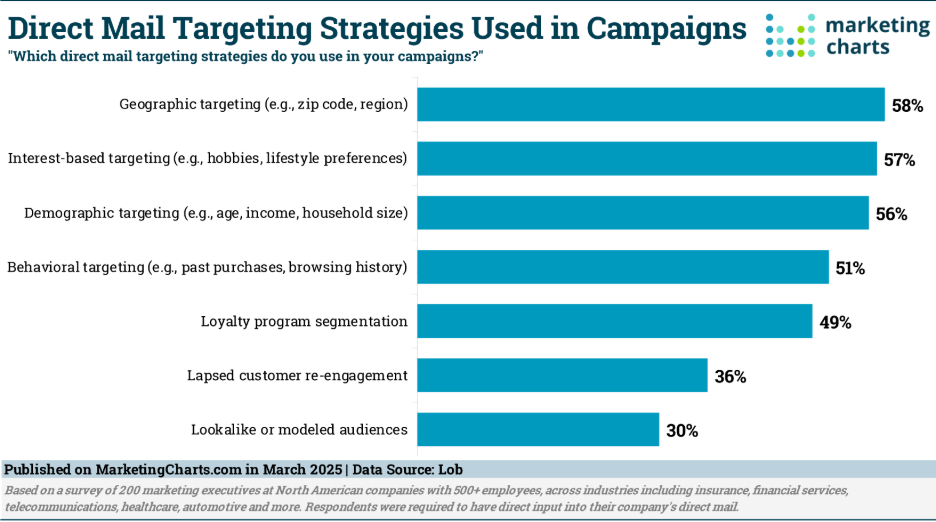
Additional research by Lob shows that marketers are also successfully using data types such as:
- 58% – Geographical (zip code, region)
- 57% – Intent-based (hobbies, lifestyles)
- 56% – Demographics (income, household size)
- 51% – Behavioral (past purchases, browsing)
Intent data in particular is where direct mail marketing becomes powerful.
When a message aligns with something a consumer has already been researching or considering, it feels timely rather than disruptive.
I have seen this in my own behavior. I will ignore most mail without a second thought. But every once in a while, something shows up that lines up almost perfectly with what I was just looking into online.
Same category, relevant offer, right timing. That is the piece that gets my attention. Not because it has my name on it, but because it reflects something that I am actually interested in – right time, right person, and hopefully the right offer to get me to buy.
Lob’s data supports this pattern. Campaigns using behavioral data consistently outperform those relying on static demographic inputs.
Because consumers do not act just because something looks tailored.
They act because it feels like the right moment.
Cross-Channel Direct Mail Marketing
Direct mail performs best when it is not treated as a standalone channel.
Consumers move across digital and physical environments constantly. They research online, compare options, and then encounter brands again in their mailbox. When those experiences connect, performance improves.
Think about your own patterns when shopping or browsing. I know for me, I may start off on my phone, later hop onto the website when I’m using my laptop or computer, and depending on what I’m looking for, may head to the store to see or pick up in person.
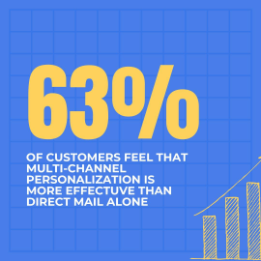
63% of respondents feel that personalized journeys across multiple digital channels (such as email and direct mail) are more effective in moving a customer to engage and convert with direct mail than personalized mail pieces alone.
The reason is simple. Consistency works! In fact, I just received a direct mail catalog for a store I never shopped at. I’ve browsed through it. I receive it every month, and just last week, purchased (quite a few!) clothes for an upcoming vacation. I then headed online to the website to make the purchase and signed up for their email
A consumer who sees something online and then receives a relevant mail piece is not experiencing two separate interactions. It feels like reinforcement. (or in my case, vice versa)
That reinforcement reduces uncertainty and increases the likelihood of action. (I am a great example of this!)
Disconnected campaigns, on the other hand, struggle to create that momentum. Even strong creative can fall flat without context.
What’s Holding Marketers Back
The issue is not awareness. It’s often related to data.
Many organizations are working with incomplete, outdated, or fragmented data. Behavioral signals, transaction history, and household insights often live in separate systems.
This creates gaps in three critical areas:
- Data quality limits accuracy.
- Silos prevent a unified view of the consumer.
- Integration challenges slow down activation.
AI is becoming more common in direct mail, but it is not the differentiator. It can optimize processes, but it cannot fix poor or disconnected data.
This is where a more connected, people-based marketing data approach becomes essential. When multiple data sources are unified, marketers can move from broad targeting to precise, signal-driven engagement.
You may be interested in our new white paper to learn more: The Big Data Reset – Why 2026 Demands a Humanized Audience Strategy
Marketers are overloaded with data but starved for context. Bridge the gap between fragmented data points and capture the real-life moments that define your audience. Read More
The Overlooked Strength of Direct Mail: Customer Retention
Direct mail isn’t just for acquisition. It’s a powerful way to stay connected with existing customers. Almost 2 in 3 (64%) report that it’s very effective in meeting existing customer retention goals, while 59% say it’s very effective for new customer acquisition.
In terms of retention, direct mail keeps your brand in front of customers in a way that feels real and relevant, especially when it’s backed by behavioral and purchase data.
Conclusion
Direct mail works when it reflects what’s actually happening in a customer’s life.
Not just who they are, but what they’ve been looking at, what they’ve done recently, and where they are in the buying process.
That’s the difference between a piece that gets ignored and one that gets a response.
The brands seeing consistent performance are not relying on surface-level personalization. They’re using behavioral signals, connecting digital and physical touchpoints, and showing up at the right moment with the right message.
That’s where PGM comes in. By bringing together consumer, household, and behavioral data into one connected view, it helps you identify who is ready to act and reach them in a way that feels relevant, not random.
Because at the end of the day, it’s not about making mail look personalized.
It’s about making it matter. And data is what turns direct mail into a true performance channel.