 Home Factors



Marketers spend a lot of time trying to understand individual consumers. Who are they? What are they interested in? Also, what have they purchased? And what are they shopping for?
But there may be another question worth asking: Who else is in the household?
A customer record may belong to one person, but many purchasing decisions don’t happen in isolation.
Groceries. Vacations. Vehicles. Home improvements. Entertainment. Financial decisions. Even everyday purchases can be influenced by the needs and preferences of multiple people within a household.
Understanding the household behind the individual is what household data makes possible, and it gives marketers context that a single customer record may miss.
What Is Household Data?
Household data is information about all of the people living at a single address and the shared characteristics of that address, rather than information about one individual consumer alone. It typically covers who else lives in the home, how many adults and children are present, household income, whether the home is owned or rented, and the interests and behaviors shared across the household.
Depending on the available data, marketers can gain insight into areas such as:
- Household composition
- Number of adults
- Presence of children
- Age of children
- Generations within the household
- Marital status
- Household income
- Homeownership
- Property characteristics
- Lifestyle and interests
- Vehicle ownership
- Other demographic and consumer characteristics
People Factors is designed to link individuals to households and provide address-level understanding, household composition, demographics, and lifestyle and interest insights.
The result is another layer of context around the person you’re trying to reach.

Why Does Household Data Matter in Marketing?
Because the person receiving your ad isn’t necessarily the only person influencing the purchase. Research on household decision-making shows how often purchases are shared rather than individual:
- 7 in 10 parents with underage children say their kids influence which groceries they buy.
- 61% of parents with underage children say their kids are very or somewhat influential when choosing a vacation destination.
- 57% of couples report making daily financial decisions jointly.
The implications extend well beyond those examples. A family’s needs can affect what vehicle they purchase. The presence of children may influence entertainment, travel, food, apparel, technology, and countless other purchases. Homeownership can create an entirely different set of purchasing needs than renting.
The individual may be the customer in your database. The household can provide context for why they buy.
Two Consumers Can Look Similar and Still Be Very Different
Imagine two consumers. They’re both 42. They have similar incomes. They live in the same ZIP code. Based on a traditional demographic audience, they might look nearly identical. Now add household data.
Consumer A
- Married
- Two school-age children
- Homeowner
- Multiple vehicles
- Interested in family travel
- Interested in home improvement
Consumer B
- Single-person household
- Renter
- One vehicle
- Interested in international travel
- Different lifestyle interests
Same age. Similar income. Same geography. Very different households. Very different potential needs.
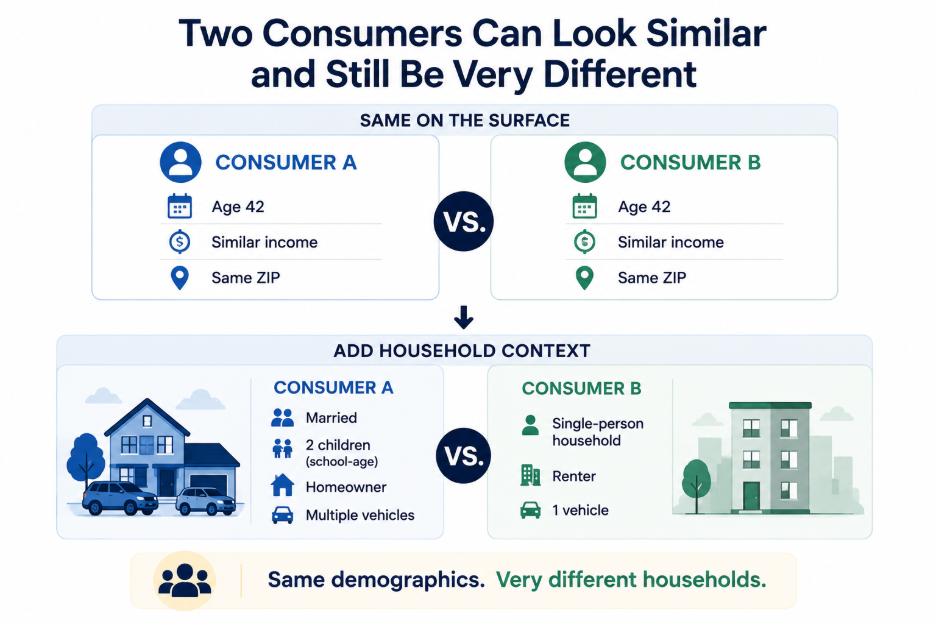
That’s why household context can be valuable when building audiences.
Household Data Can Make Segmentation More Meaningful
Broad demographic segments have their place. But household information gives marketers more ways to distinguish between consumers who might otherwise fall into the same audience. Depending on the campaign, marketers might build or refine audiences around:
- Families with children
- Couples without children
- Multigenerational households
- Homeowners
- Renters
- Higher-income households
- Households with particular lifestyle interests
- Households with specific vehicle characteristics
- Households experiencing relevant life changes
And household data doesn’t need to stand alone. It becomes even more useful when combined with other consumer insights.
What Happens When You Combine Household Data With Other Data?
This is where audience building gets interesting.
Instead of: Parents with children
You might identify: Parents with children in a particular age range who fit your target income and lifestyle profile.
Instead of: Homeowners
You might identify: Homeowners with particular property characteristics who are showing relevant purchase intent.
Instead of: High-income households
You might identify: High-income households with specific interests, ownership characteristics, or in-market behaviors.
Each additional layer can help marketers define an audience around the needs of a particular campaign.
Household data adds context. Other data helps you decide which context matters.
Household Data Changes Over Time
A household isn’t static. People get married. Children are born and grow up. Young adults leave home. People move. Households buy homes, change vehicles, and experience other events that can change what they need and what they buy. Your audience data needs to account for those changes too.
People Factors is built around a persistent individual ID that stays stable as records evolve, with continuous refresh as records change. That helps marketers maintain audience continuity while adding updated context as consumer and household information changes.

Household Data Can Strengthen First-Party Data Too
Household insights aren’t only useful when building prospect audiences. They can also enrich the customer records you already have. Your CRM may tell you:
- Who purchased
- What they purchased
- When they purchased
- How much they spent
- How they engage with your brand
Household enrichment can add another dimension:
- Who may be part of the household
- What the household looks like
- Whether they own a home
- Household demographics
- Lifestyle and interests
- Other characteristics that may influence needs and purchasing decisions
That can create additional opportunities for segmentation, personalization, cross-sell, retention, and acquisition.
Move From Individual Records to Household Context
A CRM record represents an individual. But that individual lives within a much bigger context. They may be part of a couple. A family. A multigenerational household. A household with pets, vehicles, a home, particular interests, and constantly changing needs.
People Factors helps marketers connect individual and household context with demographic, lifestyle, property, automotive, behavioral, in-market, and other consumer insights.
Learn about People Factors, PGM’s consumer data solution.
Because sometimes understanding who surrounds your customer can be just as valuable as understanding the customer themselves.
Are you building audiences around individuals or the households behind them?
Frequently Asked Questions
What is household data?
Household data is information about the people living at a single address and the shared characteristics of that address. Common fields include household composition, number of adults, presence and age of children, generations in the home, marital status, household income, homeownership, property characteristics, vehicle ownership, and lifestyle interests.
How is household data different from individual consumer data?
Individual data describes one person: their age, income, and interests. Household data describes everyone at that address and the conditions they share. Two consumers with identical individual profiles can sit in very different households, which is often what explains different buying behavior.
Why does household-level targeting matter?
Many purchases are decided jointly or influenced by other people in the home, including groceries, vehicles, travel, entertainment, and financial products. Targeting only the individual on the record misses the people shaping the decision.
How do marketers use household data to build audiences?
Household attributes let you split a broad demographic segment into meaningful groups such as families with school-age children, couples without children, multigenerational households, homeowners, and renters. Those attributes can then be layered with lifestyle, property, automotive, and in-market signals to match a specific campaign.
Can household data be added to a CRM file?
Yes. Household enrichment appends composition, demographic, homeownership, and lifestyle attributes to customer records you already have, which supports segmentation, personalization, cross-sell, and retention alongside acquisition.
Does household data stay accurate as households change?
Households change constantly as people marry, have children, move, or send young adults out on their own. Household data is only useful if it is refreshed continuously and tied to a persistent individual ID so audience continuity survives those changes.