 Home Factors


Your CRM may contain thousands, or even millions, of customer records.
But how much do you really know about the people behind those records?
For many organizations, customer data includes only the information someone shared when they filled out a form, made a purchase, or subscribed to an email list. That might be enough to recognize a customer, but it’s rarely enough to truly understand them.
That’s where audience enrichment comes in.
Audience enrichment enhances your existing customer records with additional verified information, helping you build a more complete picture of the people you market to. Instead of relying on limited first-party data alone, marketers can use audience enrichment to improve segmentation, personalize campaigns, identify new opportunities, and make better marketing decisions.
What Is Audience Enrichment?
Audience enrichment is the process of adding trusted, relevant information to existing customer records.
Rather than replacing your CRM or first-party data, enrichment expands it.
Think of your customer record as a puzzle. Your CRM provides many of the pieces, but there are often important gaps. Audience enrichment helps fill in those missing pieces, creating a clearer and more complete view of each customer.
Depending on the provider, enriched data may include:
- Lifestyle interests
- Geographic insights
- Household composition
- Purchase indicators
- Behavioral attributes
The goal isn’t to collect more data for the sake of it. It’s to make your existing customer data more useful.
Why First-Party Data Isn’t Always Enough
First-party data is one of your most valuable marketing assets.
It tells you how customers interact with your business—what they’ve purchased, which emails they’ve opened, what pages they’ve visited, or which products they’ve viewed.
But it also has limits.
Most organizations only know what customers have chosen to share or what they’ve observed through direct interactions.
That leaves important questions unanswered.
For example:
- Does this customer own a home?
- Have they recently moved?
- What type of property do they live in?
- Are they likely to be shopping for a vehicle?
- What life stage are they in?
- What products or services might be relevant next?
Audience enrichment helps answer questions your first-party data can’t.
The Difference Between Customer Data and Enriched Customer Data
Imagine two customer records.
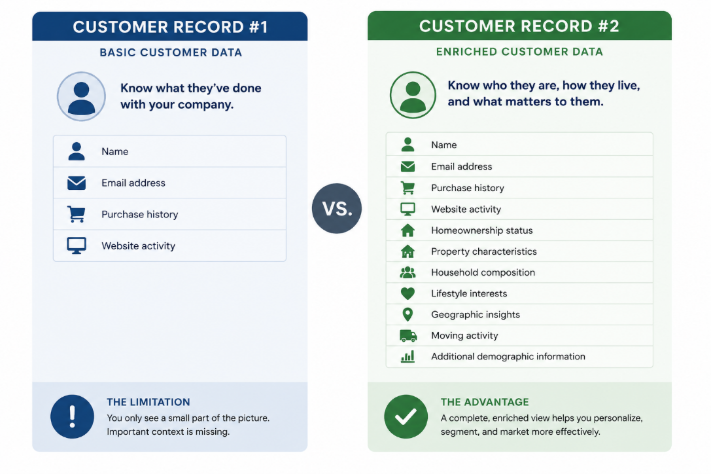
Customer Record #1
- Name
- Email address
- Purchase history
- Website activity
This record tells you what the customer has done with your company.
Now compare it to an enriched profile.
Customer Record #2
- Email address
- Purchase history
- Website activity
- Household composition
- Lifestyle interests
- Geographic insights
- Additional demographic information
The second profile provides much more context for marketing decisions.
It becomes easier to personalize messaging, prioritize prospects, and create more meaningful audience segments.
How Audience Enrichment Improves Marketing
Audience enrichment isn’t just about adding data. It’s about making your marketing more relevant.
Here are a few ways enriched customer data creates value.
Build Better Audience Segments
Instead of grouping customers by broad demographics alone, marketers can create more meaningful audiences based on combinations of attributes.
For example:
- Recent movers in specific markets
- Homeowners with larger properties
- Families with young children
- Consumers interested in outdoor living
- Households likely to purchase home services
The more relevant the audience, the more relevant the campaign.
Improve Personalization
Consumers expect brands to understand their needs.
Audience enrichment helps marketers tailor messages using information that extends beyond purchase history.
Rather than sending the same email to every customer, marketers can create communications that better reflect a customer’s household, interests, or stage of life.
Increase Customer Acquisition
Audience enrichment isn’t limited to existing customers.
It can also help identify prospects who share characteristics with your best customers, making acquisition campaigns more targeted and efficient.
Support Omnichannel Marketing
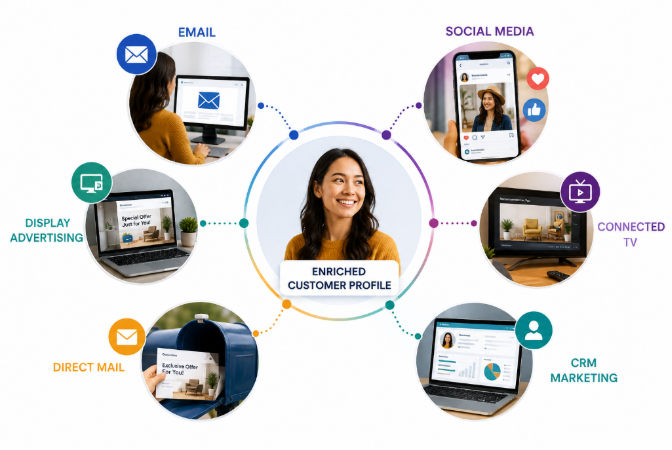
Enriched audience data helps create a consistent view of customers across channels, supporting more coordinated campaigns through:
- Social media
- Display advertising
- CRM marketing
The result is a more connected customer experience.
Marketing in Action
Imagine a regional home improvement retailer preparing a spring campaign.
Without audience enrichment, every customer receives the same promotion.
With enriched customer data, the retailer can create more relevant campaigns.
Homeowners who recently moved might receive offers on appliances or interior paint.
Customers with larger yards could see promotions for outdoor living products.
Long-term homeowners might receive seasonal maintenance reminders or offers related to aging homes.
The marketing budget stays the same.
The audience becomes smarter.
What to Look for in an Audience Enrichment Partner
Not every provider offers the same level of quality.
When evaluating audience enrichment solutions, consider:
- Data quality and accuracy
- Multiple trusted data sources
- Regular data refreshes
- Identity resolution
- Broad audience coverage
- Flexible activation across marketing channels
- Transparent data practices
Audience enrichment should strengthen your customer data—not complicate it.
Common Myths About Audience Enrichment
Myth: We already have enough customer data.
Most organizations know far less about their customers than they think. Enrichment helps fill the gaps that first-party data alone can’t address.
Myth: Audience enrichment replaces first-party data.
It doesn’t.
First-party data remains the foundation. Audience enrichment simply makes it more valuable by adding additional context.
Myth: Audience enrichment is only useful for advertising.
Enriched customer data supports segmentation, CRM strategy, analytics, customer acquisition, personalization, sales, and many other business functions.
Why Better Data Leads to Better Marketing
Every marketing decision begins with understanding your audience.
When customer records are incomplete, it’s harder to create relevant experiences, prioritize prospects, or identify new opportunities.
Audience enrichment helps marketers move beyond basic customer records by adding the context needed to make smarter decisions.
Instead of asking customers to provide more information, organizations can enrich existing records with trusted audience insights that improve segmentation, personalization, and marketing performance.
Key Takeaways
- Audience enrichment expands existing customer records with additional verified information.
- It complements first-party data rather than replacing it.
- Enriched customer data improves segmentation, personalization, and customer acquisition.
- The best enrichment solutions prioritize data quality, identity resolution, and ongoing updates.
- Richer customer profiles lead to more informed marketing decisions and more relevant customer experiences.
Continue Building Better Audiences
Audience enrichment is one piece of a broader audience strategy.
To learn how organizations evaluate data quality, compare providers, and build smarter audience strategies, explore our related resources: