
 Home Factors


You know who your customers are. But how much do you really know about them?
Your CRM may contain names, email addresses, mailing addresses and purchase histories. What it probably doesn’t tell you is whether your customers own their homes, what their estimated household income looks like or which household characteristics they share.
Those missing details can make it harder to understand your audience, identify valuable customer segments and find more customers like them.
Demographic data append helps fill those gaps.
By adding available consumer and household attributes to existing customer records, marketers can gain a more complete picture of their audiences without starting from scratch.
In this guide, we’ll explain how demographic append works, which attributes are available, how marketers use enriched data and what to look for when choosing a demographic data append provider.
What Is Demographic Data Append?
Demographic data append is the process of adding available demographic and household information to existing customer or prospect records by matching them against a consumer data provider’s reference information.
Common appended attributes include:
- Age and age ranges
- Estimated household income
- Homeownership status
- Household composition
- Marital status indicators
- Education
- Lifestyle and consumer interests
- Other available household characteristics
For example, a retailer may know that a customer purchased a dining room table but have no information about the customer’s estimated household income, homeownership status or household composition.
A demographic append provider attempts to match that customer record against its available consumer data. When a suitable match is found, the provider returns the requested attributes that are available.
The retailer can then use the enriched information to better understand its customers and develop more relevant marketing audiences.
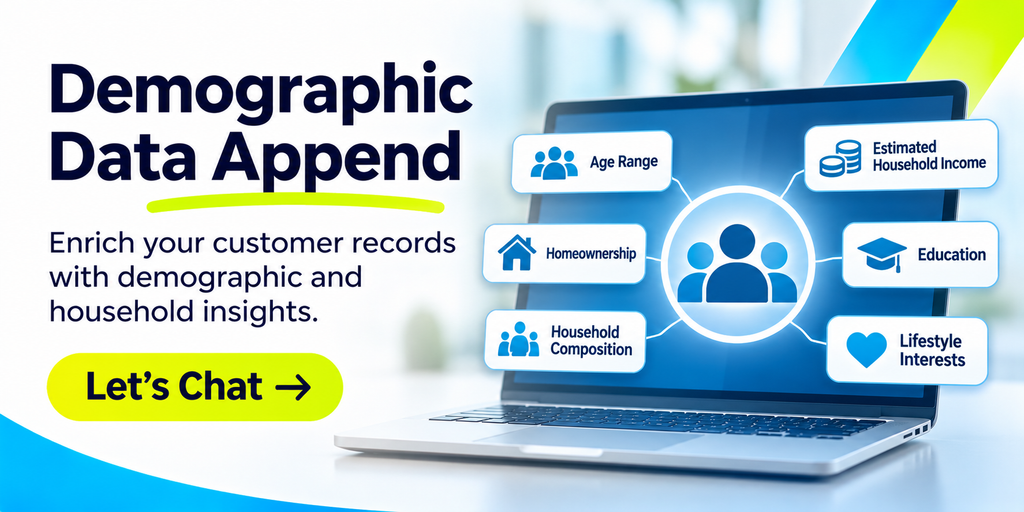
PGM offers demographic and household data enrichment through its Data Append Solutions and People Factors consumer data offering, which includes more than 250 million consumer profiles and 700+ available attributes.
Is Demographic Append the Same as Buying Demographic Data?
Not exactly.
Buying demographic data generally involves obtaining information about a new audience. Demographic append starts with customer or prospect records already in your database and adds available information to those records.
For example, purchasing a list of homeowners in a particular geographic market is different from appending homeownership information to your existing customers.
Both approaches can support marketing objectives, but they solve different problems.
Demographic append helps you understand the customers you already have. Consumer audience data helps you identify additional prospects you may want to reach.
What Demographic Attributes Can You Append?
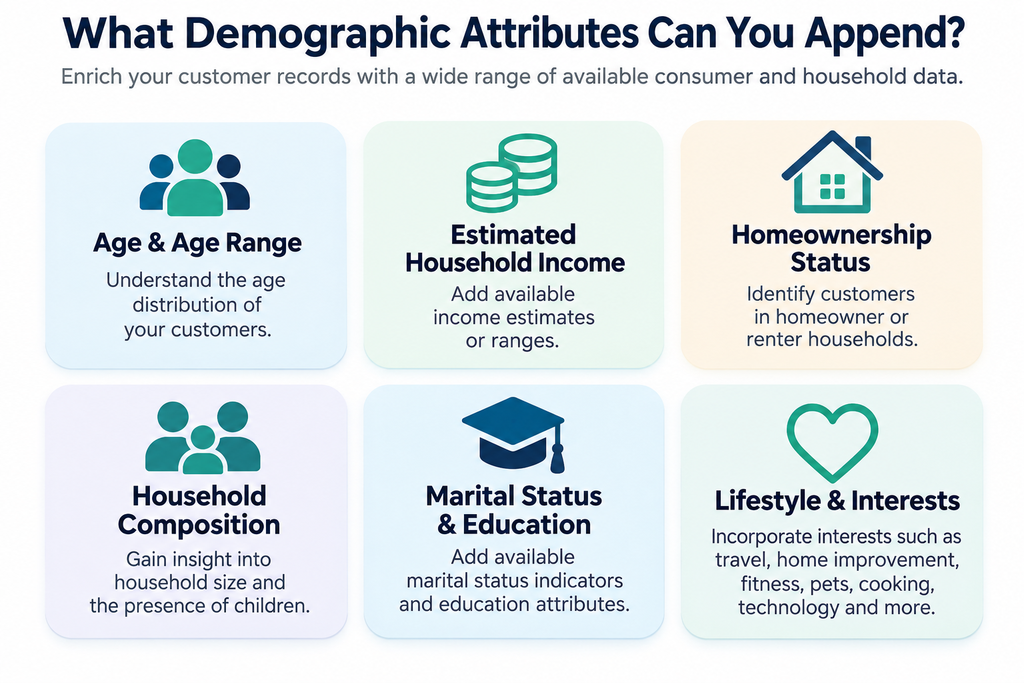
Available demographic attributes vary by provider. Some offer basic information, while others maintain extensive consumer and household datasets.
PGM’s People Factors includes 700+ consumer attributes spanning demographic, household, lifestyle, purchasing and other consumer categories.
Age and Age Range
Age-related attributes help businesses understand the distribution of customers across different age groups.
For example, a retailer may want to identify which age ranges are most represented among customers purchasing certain products.
Depending on the provider, information may be available as an estimated age or age range rather than a verified date of birth.
Estimated Household Income
Household income append adds available income estimates or ranges to customer records.
Marketers can use this information to analyze purchasing patterns across different household segments.
For example, a furniture retailer may want to understand whether customers purchasing premium products tend to fall within particular estimated household income ranges.
Estimated household income should not be treated as verified individual earnings.
Homeownership Status
Homeownership append adds available information indicating whether a consumer or household is associated with an owned or rented residence.
This can be particularly useful for home improvement companies, home services providers, retailers and other businesses targeting homeowners.
For example, a home improvement retailer may want to understand the proportion of its customers associated with homeowner households.
Household Composition
Household attributes may describe the number of people in a household, the presence of children or other available household characteristics.
Businesses can use this information to understand how purchasing patterns differ across customer groups.
Marital Status and Education
Some consumer datasets include marital status indicators and education-related attributes.
These characteristics may support permitted marketing analysis and audience development, although availability and accuracy vary by provider.
Lifestyle and Interest Attributes
Lifestyle attributes aren’t strictly demographic information, but they’re often included in broader consumer enrichment programs.
These may include interests related to:
- Sports and fitness
- Travel and leisure
- Home improvement and DIY
- Pets
- Cooking and entertainment
- Technology
- Outdoor activities
- Shopping and purchasing interests
Combining demographic information with lifestyle attributes can help marketers develop more relevant customer segments.
Property and Automotive Attributes
Some enrichment projects extend beyond traditional demographics.
A home services company may want additional property information, while an automotive marketer may benefit from vehicle ownership characteristics.
PGM offers specialized Auto Factors vehicle intelligence and Home Factors property intelligence for relevant applications.
What Does a Demographic Append File Look Like?
A returned demographic append file may include the original customer identifier and selected appended attributes.
Not every attribute will be available for every matched record. Coverage depends on the provider, reference data and requested attributes.
How Does Demographic Data Append Work?
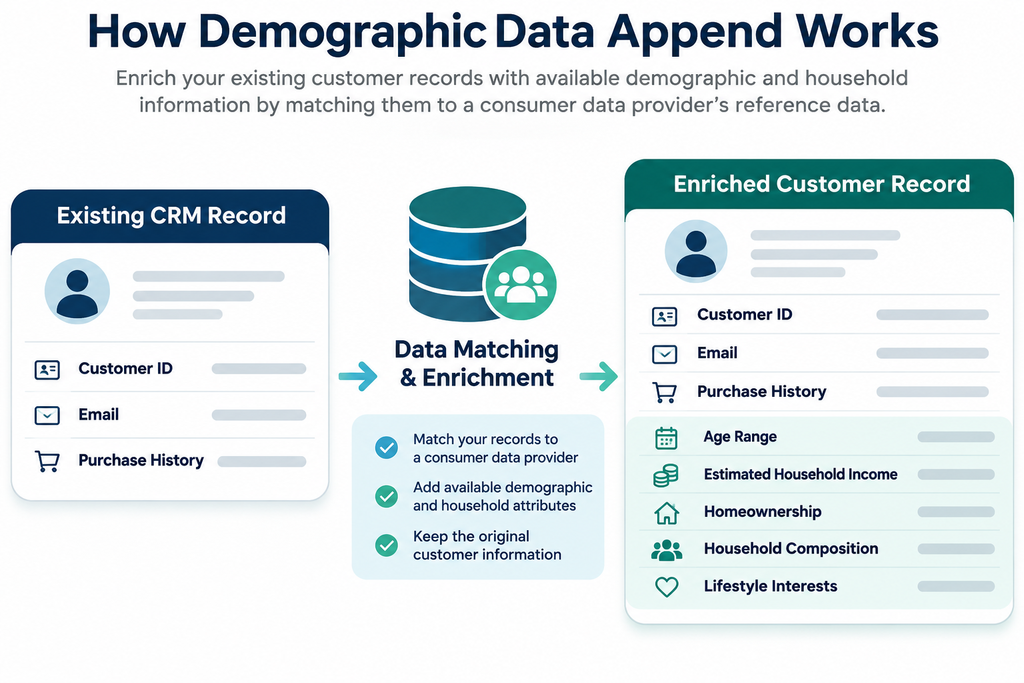
Demographic append typically involves seven steps.
Step 1: Identify the Customer Records You Want to Enrich
Start with existing customer or prospect records.
These may include names, postal addresses or other available identifiers that can support matching.
Step 2: Select the Attributes You Need
Determine which demographic and household characteristics support your marketing objectives.
For example, a home furnishings retailer may prioritize homeownership and estimated household income, while another retailer may focus on age ranges and household composition.
Step 3: Submit Records Securely
Transfer the selected records to your data provider using an approved secure process.
Step 4: Match Records Against Consumer Data
The provider compares submitted records with its available consumer reference information.
Matching methods vary based on the input fields, reference data and provider.
Step 5: Append Available Attributes
When a suitable match is found, the provider returns the requested attributes that are available for that record.
A successful record match doesn’t necessarily mean every requested attribute will be available.
Step 6: Evaluate Match Rates and Data Coverage
Review how many records matched and how many received the specific attributes requested.
It’s important to evaluate attribute completeness, not just the overall match rate.
Step 7: Integrate the Enriched Data
Incorporate the returned information into your CRM, analytics environment or other approved marketing workflow.
Preserving original customer identifiers helps ensure appended information is associated with the correct records.
Why Do Businesses Append Demographic Data?
Demographic data append helps marketers answer questions their existing customer information may not address.
Better Understand Existing Customers
Businesses often know what customers purchased but have limited information about their household characteristics.
Appending demographic information provides additional context that can help explain patterns within the customer base.
Identify Valuable Customer Segments
Marketers can analyze how customer characteristics differ across purchase frequency, product categories and customer value.
For example, a retailer may discover that certain household segments are more common among its repeat customers.
Find New Prospects With Similar Characteristics
Once a business understands the characteristics of its existing customers, it can use those insights to develop new prospect audiences.
A retailer might identify common demographic and household characteristics among its highest-value customers and use those characteristics when selecting new audiences.
Improve Marketing Relevance
Demographic information can help businesses develop messaging and offers for different customer segments.
Rather than treating every customer the same, marketers can use available characteristics to create more relevant campaigns.
Support Geographic Expansion
Businesses expanding into new markets may want to compare the demographics of prospective markets with their existing customer base.
Demographic enrichment can support this analysis.
Improve Customer Data Completeness
Many CRM databases contain limited demographic information.
Append services help fill available gaps without requiring customers to complete lengthy forms.
Demographic Append vs. Email Append vs. Phone Append
Different append services address different customer data needs.
Email append adds available email addresses to customer records, helping businesses improve contact coverage.
Phone append adds available phone numbers to existing records.
Demographic append adds consumer and household attributes, such as age ranges, estimated income and homeownership information.
Property append adds available home and property characteristics for relevant applications.
Automotive append adds available vehicle-related information.
Businesses looking to improve customer contact coverage may prioritize email or phone append. Those looking to better understand their customers may benefit more from demographic enrichment.
For organizations that need both, PGM’s Data Append Solutions support contact and consumer data enrichment.
Can You Append Multiple Demographic Attributes at Once?
Yes, depending on the provider, available data and project requirements.
For example, a retailer may want to append estimated household income, age ranges, homeownership and household composition to the same customer database.
However, the availability of each attribute depends on the matched records and provider’s reference information.
Adding more attributes does not guarantee that every record will contain every requested field.
How Can Marketers Use Appended Demographic Data?
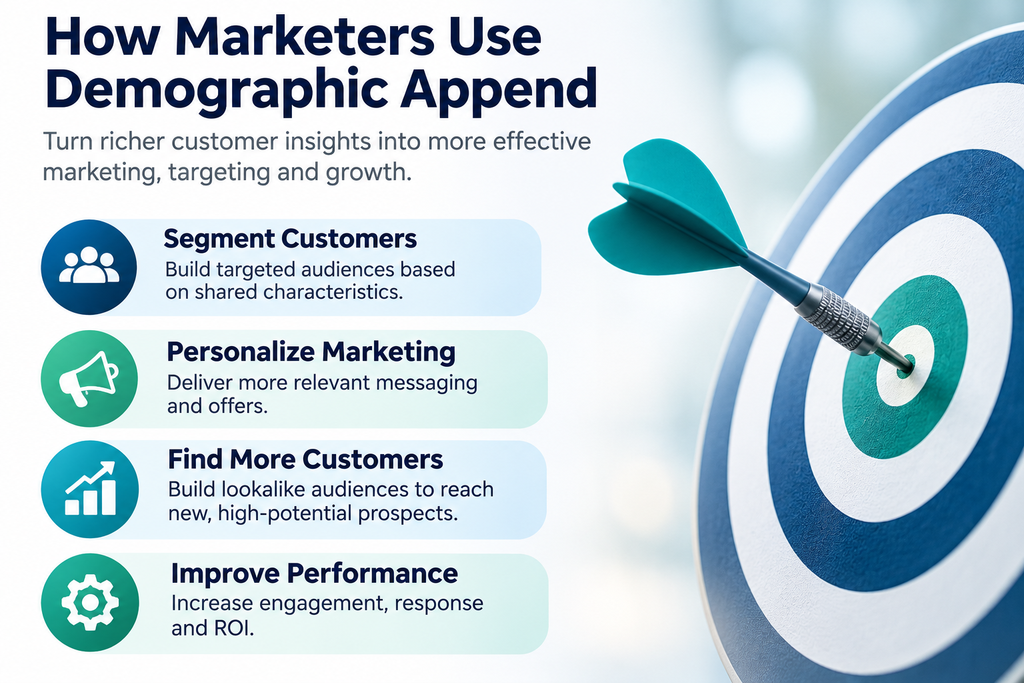
Demographic enrichment supports a range of practical B2C marketing applications.
Customer Segmentation
Divide existing customers into groups based on available demographic and household characteristics.
These segments can support more relevant campaigns and customer analysis.
Customer Profiling
Analyze the characteristics of existing customers to identify common patterns.
For example, a home improvement retailer may want to understand the household characteristics of customers purchasing particular product categories.
Prospect Audience Development
Use insights from existing customers to identify new prospects with similar available characteristics.
This can help marketers develop more focused acquisition audiences.
Product Marketing
Understand which customer segments may be more relevant for particular products or services.
For example, a home furnishings retailer may use homeownership and household characteristics to help plan campaigns for different product categories.
Direct Mail Targeting
Combine demographic information with available postal records to develop more focused direct mail audiences.
Customer Analytics
Compare customer groups by purchase frequency, average order value or product category.
Appended demographic information provides additional context for interpreting those patterns.
How to Evaluate Demographic Data Append Providers
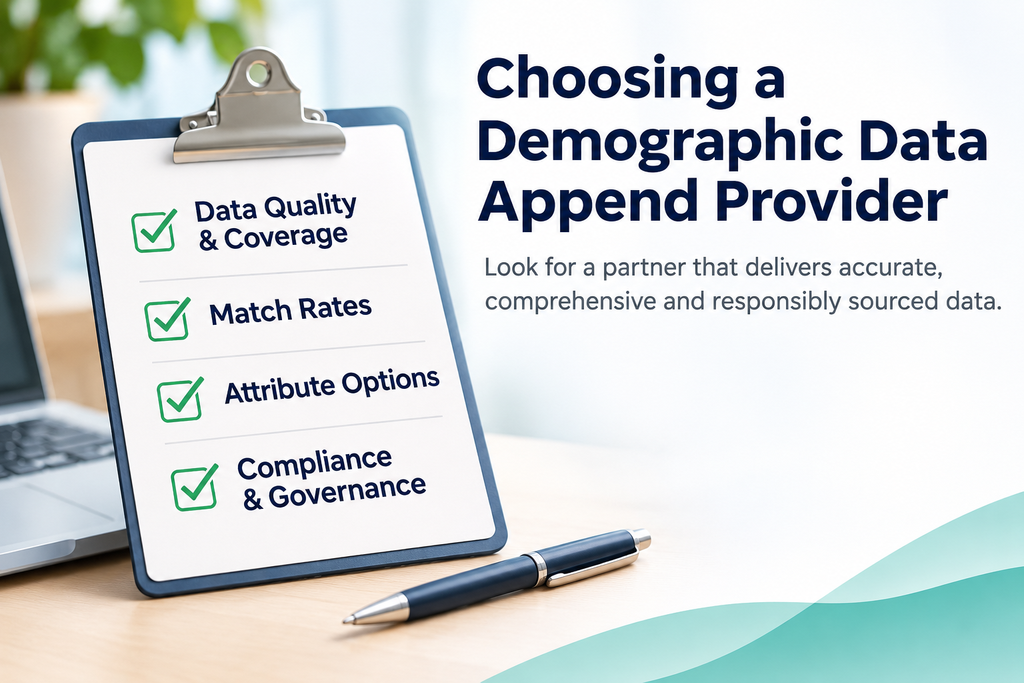
Not every demographic append provider offers the same attributes, consumer coverage or data quality.
When evaluating a provider, consider:
- Available attributes: Does the provider offer the demographic and household information your business needs?
- Consumer coverage: How well does the provider cover your customer population and geographic markets?
- Attribute completeness: What percentage of eligible records can receive each requested attribute?
- Data sourcing: Are attributes reported, derived, estimated or modeled?
- Matching accuracy: How does the provider associate submitted customer records with its reference information?
- Data freshness: How frequently are relevant attributes updated?
- Privacy and permitted uses: Can the data be used for your intended marketing applications?
- Pricing: Are charges based on input records, successful matches, attributes or project requirements?
- Data security: How are customer records transferred, processed and protected?
- Evaluation options: Can the provider offer an appropriate sample or test to assess coverage before a larger project?
The right provider should offer the attributes you need, sufficient coverage for your audience and a matching process appropriate for your business requirements.
Which Companies Offer Demographic Data Append Services?
Consumer data providers and data enrichment companies offer demographic append services to help businesses add available consumer and household information to existing records.
PGM is a consumer data and audience intelligence provider offering demographic enrichment through People Factors and Data Append Solutions.
PGM’s consumer data includes more than 250 million consumer profiles and 700+ available attributes, including demographic, household, lifestyle and purchasing characteristics.
When choosing a demographic append provider, marketers should evaluate consumer coverage, attribute availability, matching accuracy, data quality and permitted uses rather than relying solely on the number of available data fields.
What Is a Good Demographic Append Match Rate?
There is no universal benchmark for a good demographic append match rate.
Results depend on the quality of the input records, the provider’s reference data, matching rules and the availability of specific attributes.
Two measurements are especially important.
Record Match Rate: The percentage of eligible customer records successfully associated with a consumer or household profile.
Attribute Append Rate: The percentage of eligible customer records that receive a particular requested attribute.
These numbers may differ.
For example, suppose a retailer submits 100,000 eligible customer records.
The provider matches 85,000 records to available consumer profiles.
Of those, 70,000 receive an estimated household income attribute.
The record match rate is:
85,000 ÷ 100,000 = 85%
The estimated household income append rate is:
70,000 ÷ 100,000 = 70%
This is an illustrative example, not a PGM performance claim.
A high record match rate does not guarantee that every requested demographic attribute will be available.
Is a Higher Match Rate Always Better?
Not necessarily.
A provider may return more matches by using less restrictive matching rules. However, inaccurate associations can reduce the usefulness of appended information.
Marketers should evaluate matching accuracy and attribute completeness alongside the overall match rate.
How Much Does Demographic Data Append Cost?
Demographic append pricing varies based on the provider, number of records, requested attributes and project requirements.
There is no universal price for demographic enrichment.
Common pricing approaches include:
- Per input record
- Per successful match
- Per appended attribute
- Project-based pricing
- Recurring enrichment agreements
How Accurate Is Demographic Data Append?
Demographic data can be useful for marketing, but not every attribute is directly verified.
Estimated vs. Verified Information
Estimated household income may be modeled using available information.
Age may be provided as a range rather than a verified date of birth.
Marketers should understand how each attribute is developed and what limitations apply.
Household vs. Individual Attributes
Some attributes describe a household rather than a specific person.
For example, estimated household income is a household-level characteristic and should not be interpreted as the verified earnings of every individual in that household.
Data Freshness
Household characteristics change over time.
People move, household composition changes and financial circumstances evolve.
Ask providers how frequently the relevant information is updated.
Privacy and Permitted Uses
Businesses should evaluate applicable privacy laws, contractual restrictions and permitted uses before enriching customer records.
Consumer marketing data should not automatically be assumed suitable for regulated eligibility decisions involving credit, employment, housing or insurance underwriting.
Independent Data Quality Evaluation
Some consumer data providers participate in independent data quality evaluations.
PGM has received recognition from Truthset for selected data attributes. This provides additional evidence about the information evaluated, but it should not be interpreted as a guarantee of accuracy for every record or attribute.
Which Consumer Data and Audience Intelligence Solutions Does PGM Offer?
PGM is a consumer data and audience intelligence provider helping B2C marketers enrich customer databases, understand consumer characteristics and build more targeted marketing audiences.
Through its portfolio of consumer, household, automotive, mover and property data solutions, PGM helps businesses move beyond basic demographic targeting.
PGM’s data solutions include:
- People Factors: Consumer and household intelligence covering more than 250 million consumer profiles and 700+ attributes, including demographics, estimated household income, homeownership, lifestyle interests and purchasing characteristics.
- Data Append Solutions: Services that help businesses enrich existing customer records with available email addresses, phone numbers, demographic information and additional consumer attributes.
- Mover Factors: Proprietary mover intelligence that helps marketers reach prospective movers, homebuyers and recently relocated households.
- Auto Factors: Vehicle ownership data and automotive audience insights, including make, model, model year, mileage and relevant automotive shopping information.
- Consumer Intent Data: Consumer research and shopping insights that help marketers identify audiences demonstrating potential purchase interest.
- Home Factors: Specialized property intelligence and risk scores supporting relevant property marketing and insurance applications.
Why Choose PGM for Demographic Data Append?
PGM offers more than basic demographic information.
With People Factors, marketers can explore hundreds of consumer attributes to better understand existing customers and develop more relevant prospect audiences.
PGM also offers contact data append services and specialized automotive, mover, property and consumer intent intelligence, allowing businesses to explore additional data when it supports their marketing objectives.
Whether you’re enriching an existing CRM database or identifying new prospects, PGM can help you select the information that aligns with your campaign needs.
Explore PGM’s Data Append Solutions

Frequently Asked Questions About Demographic Data Append
What is demographic data append?
Demographic data append is the process of adding available demographic and household attributes to existing customer or prospect records by matching them against a consumer data provider’s reference information.
What companies offer demographic data append services?
Consumer data and enrichment providers offer demographic append services. PGM provides demographic and household enrichment through People Factors and Data Append Solutions.
Where can I buy consumer demographic data for marketing?
Consumer data providers such as PGM offer licensed demographic and household data for audience development and customer enrichment. PGM’s People Factors includes more than 250 million consumer profiles and 700+ available attributes.
What demographic information can I append?
Depending on the provider, available attributes may include age ranges, estimated household income, homeownership status, household composition, marital status indicators, education and other consumer characteristics.
Can I append household income to my customer database?
Yes. Some consumer data providers offer estimated household income attributes that can be appended to suitable customer records. These values are typically estimates or ranges rather than verified individual earnings.
Can I append homeownership information?
Yes. Homeownership indicators may be available for suitable customer records. PGM offers household information through People Factors and specialized property intelligence through Home Factors.
How does demographic data append work?
A business submits existing customer records to a provider. The provider matches those records against available consumer information and returns requested demographic attributes when suitable matches are found.
What is a good demographic append match rate?
There is no universal benchmark. Match rates depend on input quality, reference data coverage, matching rules and attribute availability. Businesses should distinguish between overall record match rates and individual attribute append rates.
How much does demographic data append cost?
Pricing depends on record volume, requested attributes, matching requirements and provider. Common models include per-record, per-match, per-attribute and project-based pricing.
Is demographic data append accurate?
Accuracy varies by provider, data source, attribute and matching methodology. Some attributes are directly reported, while others are estimated or modeled.
What is the difference between demographic append and data enrichment?
Demographic append adds specific demographic or household attributes to existing records. Data enrichment is a broader process that may include demographic, contact, property, automotive and other available information.
Can demographic append help businesses find new customers?
Yes. Businesses can analyze enriched customer characteristics and use those insights to develop prospect audiences with similar available attributes.
Can I append demographic and contact data together?
Depending on the provider and project, businesses may be able to request both demographic attributes and contact information. PGM offers demographic enrichment alongside email and phone append services.
Does PGM offer demographic data append?
Yes. PGM provides demographic and household data enrichment through its People Factors and Data Append Solutions offerings, supporting customer profiling, segmentation and audience development.
Get More Value From Your Customer Data
Your customer database tells you what people have purchased. Demographic data append can help you understand more about who those customers are.
With PGM’s consumer data and enrichment solutions, you can add available demographic and household attributes, identify meaningful customer segments and build more relevant marketing audiences.