 Home Factors



Your customer database tells you about the people who already do business with you. But how do you identify consumers you haven’t reached yet?
Consumer database providers help B2C marketers find prospective customers, build targeted marketing audiences, and enrich existing customer records with additional information.
Depending on the provider, consumer databases may include email addresses, phone numbers, demographic and household attributes, homeownership information, vehicle characteristics, moving activity, and consumer shopping interests.
PGM is a U.S.-based consumer data and audience intelligence provider offering more than 250 million consumer profiles and 700+ available attributes through People Factors, along with specialized homeowner, automotive, mover, and consumer intent data.
This guide explains what consumer database providers offer, how to evaluate consumer data quality, where to buy consumer databases, and how PGM helps B2C marketers identify and reach relevant audiences.
What Is a Consumer Database Provider?
A consumer database provider is a company that supplies organized information about individuals and households for permitted marketing, advertising, analytics, and customer data enrichment applications.
Consumer database providers may offer:
- Consumer email addresses, phone numbers, and postal addresses
- Demographic and household information
- Homeowner and property characteristics
- Automotive ownership and vehicle attributes
- New mover and homebuyer information
- Lifestyle and consumer interests
- Consumer shopping and research intent data
Some providers specialize in contact lists, while others offer comprehensive consumer data and audience intelligence for more detailed targeting.
PGM is an example of a consumer database provider offering both consumer contact information and specialized audience data for B2C marketing.
What Is a Consumer Marketing Database?
A consumer marketing database is an organized collection of information about individuals or households that businesses can use to identify prospective customers, understand consumer characteristics, and develop marketing audiences.
Consumer databases help marketers answer questions such as:
- Who are the consumers in my target market?
- How can I reach potential customers?
- Which households match my ideal customer profile?
- What characteristics do my best customers share?
- Which consumers may be interested in my products or services?
- What information is missing from my existing customer records?
For example, a home services company might use homeowner and property data to identify relevant prospects within its service area.
An automotive retailer might use vehicle ownership information to develop audiences based on vehicle characteristics.
A furniture retailer might use mover and homebuyer information to reach consumers during a period of increased household purchasing activity.
Is a Consumer Database the Same as a Customer Database?
No. A customer database typically contains information a business has collected about its own customers, including contact details, purchase history, and account information.
A consumer database generally contains information about a broader population, including individuals who may not have an existing relationship with the business.
Businesses can use consumer databases to identify new prospective customers or enrich their existing customer records.
Is a Consumer Database the Same as a Marketing List?
A consumer database is the broader collection of records and attributes. A marketing list is typically a selected audience created from that information.
For example, a marketer might use a consumer database to select homeowners in five ZIP codes who meet particular household criteria.
The resulting records form a targeted marketing audience or list.
What Types of Consumer Data Are Available?
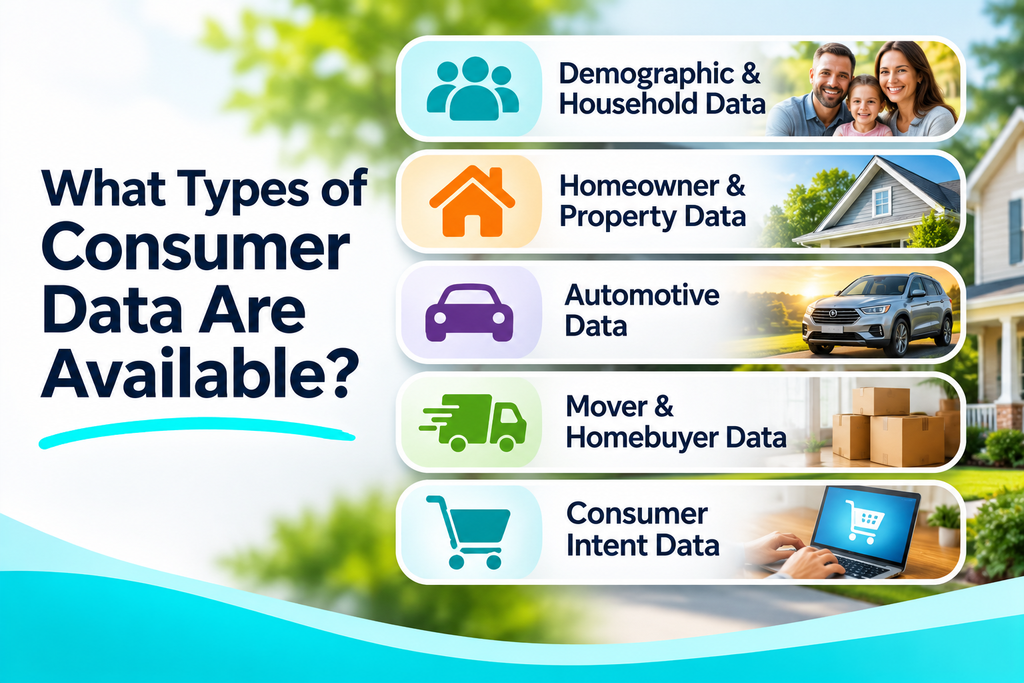
Consumer database companies offer different types of information depending on their data sources, coverage, and specialties.
Consumer Contact Information
Consumer contact databases may include:
- First and last names
- Postal mailing addresses
- Consumer email addresses
- Mobile and landline phone numbers
- Geographic information, including city, state, and ZIP code
Contact information supports permitted marketing outreach and audience development.
However, not every consumer record contains every contact field. Buyers should evaluate email, phone, and postal coverage separately.
Demographic and Household Data
Demographic data helps marketers identify consumers based on characteristics such as:
- Age ranges
- Estimated household income
- Household composition
- Marital status indicators
- Education
- Homeownership
- Household size
For example, a home furnishings retailer may want to reach homeowners in selected metropolitan areas within particular household income ranges.
PGM’s People Factors provides consumer and household intelligence across more than 250 million consumer profiles.

Lifestyle and Consumer Interest Data
Lifestyle information can provide additional context about consumer interests, shopping preferences, and household activities.
A retailer selling outdoor living products, for example, may want to develop audiences using relevant lifestyle and home-related characteristics.
Homeowner and Property Data
Homeowner data helps marketers identify consumers associated with residential properties.
Available information may include homeownership status, property type, home age, square footage, estimated property value, and selected property characteristics.
Some providers offer additional property intelligence that goes beyond basic homeownership.
PGM’s Home Factors provides specialized property characteristics and risk scores, supporting relevant property-related marketing applications.
Reach More of the Right Customers
PGM helps B2C marketers find and reach their ideal audiences with consumer data and audience intelligence.
Let’s Chat
Automotive Consumer Data
Automotive consumer databases may include vehicle ownership information and characteristics such as make, model, year, fuel type, and other available vehicle attributes.
This information can support audience development for dealerships, automotive service providers, tire retailers, and other automotive businesses.
PGM’s Auto Factors provides vehicle-related consumer intelligence for automotive targeting.
New Mover and Homebuyer Data
Moving is an important consumer life event that often creates demand for household products and services.
Mover data can help marketers identify prospective movers, verified homebuyers, and recent movers.
For example, a furniture retailer may want to reach consumers preparing to move into a newly purchased home.
PGM’s Mover Factors provides audience intelligence across different stages of the moving lifecycle, supported by PGM’s relationship with the Porch family of companies.
Consumer Intent Data
Consumer intent data provides information about observed research activity and shopping interests.
For example, a retailer may want to develop audiences associated with research activity in home improvement, automotive, travel, or other relevant categories.
PGM’s Consumer Intent Data helps marketers explore audiences based on available consumer research and shopping interest information.
Intent data indicates research behavior, not confirmed purchases.
Consumer Contact Databases vs. Consumer Intelligence Databases
Not every consumer database serves the same purpose.
| Consumer Contact Database | Consumer Intelligence Database |
|---|---|
| Focuses on reaching consumers | Focuses on understanding and selecting audiences |
| May include names, emails, phone numbers, and addresses | May include demographic, household, lifestyle, and specialized attributes |
| Supports permitted outreach | Supports segmentation, enrichment, analytics, and targeting |
| Often supports list-based campaigns | Supports more detailed audience development |
| May offer basic geographic targeting | May offer specialized audience selection criteria |
These categories aren’t mutually exclusive.
A comprehensive consumer data provider may offer both contact information and specialized audience intelligence.
Why does this matter?
Consider two home improvement campaigns.
The first targets households within a service area using geographic information alone.
The second combines geography with available homeownership and property characteristics to develop a more specific audience.
The additional information can help marketers make more informed audience selections, although campaign results depend on many factors.
How Do Businesses Use Consumer Databases?
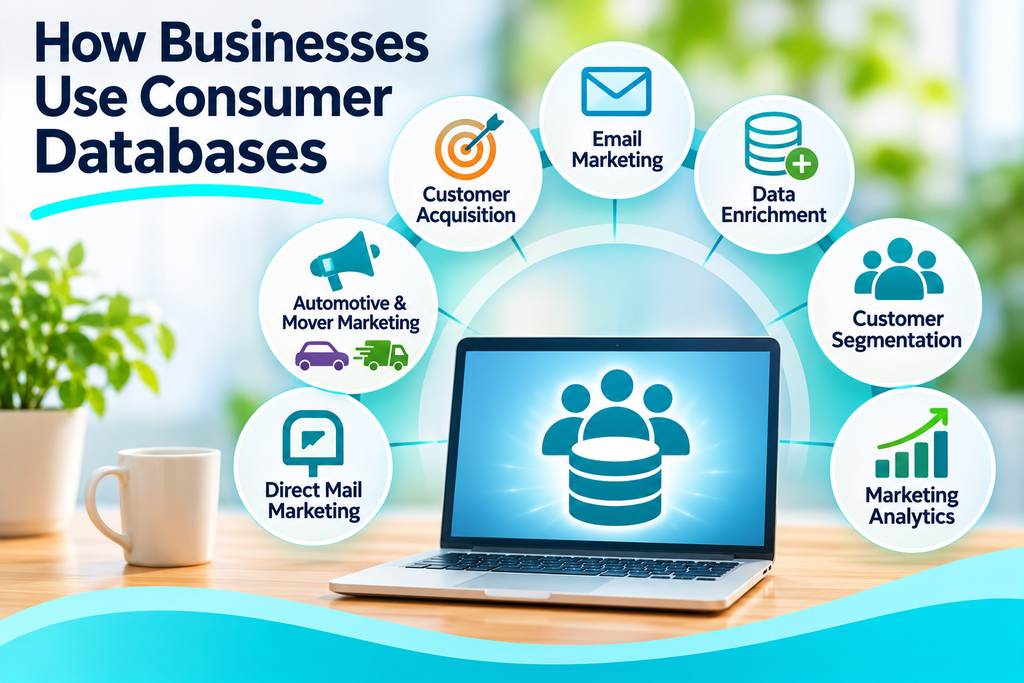
Consumer marketing databases support a range of B2C marketing applications.
1. Customer Acquisition
Businesses use consumer databases to identify prospective customers who match their target audience.
For example, a regional home services company may want to reach homeowners in selected geographic markets.
2. Email Marketing Audience Development
Consumer email data can help marketers develop audiences using available contact information and demographic or household attributes.
Email outreach must comply with applicable laws, data permissions, and email platform policies. Purchasing an email address does not automatically establish permission to use it for every type of marketing.
3. Direct Mail Marketing
Consumer databases can support targeted postal campaigns using geographic, demographic, household, or property information.
4. Customer Database Enrichment
Businesses can use external consumer data to add missing information to existing customer records.
For example, a retailer may have customer names and postal addresses but limited email or demographic information.
PGM’s Data Append Solutions help businesses add available email addresses, phone numbers, and consumer attributes when suitable matches exist.
5. Customer Segmentation
Consumer data helps marketers organize audiences using relevant characteristics.
A retailer might segment customers by household composition, geography, or other available attributes to support more relevant campaigns.
6. Automotive Marketing
Vehicle-related data can support customer acquisition and service marketing for automotive businesses.
7. New Mover Marketing
Mover information helps marketers develop audiences associated with home purchases and moving activity.
8. Marketing Analytics
Consumer attributes can help businesses better understand existing customers and identify potential opportunities in new markets.
How Large Should a Consumer Database Be?
The size of a consumer database matters, but total record count doesn’t tell the whole story.
A database containing hundreds of millions of profiles may offer broad coverage. However, not every record will necessarily contain the specific information a marketer needs.
Consumer Coverage vs. Attribute Coverage
A database containing 200 million consumer profiles does not necessarily have 200 million available email addresses, phone numbers, income estimates, or vehicle attributes.
Marketers should ask about coverage for the specific fields needed for their campaigns.
National vs. Local Consumer Coverage
National advertisers may prioritize broad geographic coverage.
Local businesses may care more about the number of relevant records within their service areas.
For example, a roofing company operating in three counties needs sufficient coverage of relevant homeowners within those counties, regardless of the provider’s total national database size.
Individual vs. Household Records
A household may contain multiple individuals.
Understanding whether database counts represent people, households, addresses, or another unit is important when estimating campaign reach.
How Many Consumer Records Does PGM Have?
PGM’s People Factors includes more than 250 million consumer profiles and 700+ available attributes.
These attributes support consumer audience development using demographic, household, lifestyle, and other information.
Actual coverage varies by attribute and audience selection requirements.
How Are Consumer Databases Maintained and Updated?
Consumer information changes over time.
People move, change email addresses, purchase vehicles, buy homes, and experience changes in household composition.
Consumer database providers may maintain their information through new source records, periodic updates, validation processes, and ongoing data maintenance.
When evaluating a provider, consider the following.
Data freshness: How frequently are relevant records and attributes updated?
Contact validation: How does the provider evaluate email addresses, phone numbers, and postal information?
Data completeness: What percentage of records contains the fields your campaign requires?
Observed vs. modeled information: Which attributes come from observed or documented information, and which are estimated or modeled?
Independent data validation: Is there credible evidence supporting the quality of specific data attributes?
PGM has received independent recognition through Truthset for selected data attributes. This provides evidence for those evaluated elements, not a guarantee of accuracy across every record or field.
Where Can You Buy a Consumer Database?
Businesses can purchase or license consumer database information from companies specializing in consumer marketing data, contact information, and audience intelligence.
When selecting a provider, first determine whether you need:
- A consumer email or phone database
- A consumer mailing list
- Demographic and household information
- Homeowner or property data
- Automotive consumer data
- New mover and homebuyer audiences
- Consumer intent data
- Customer data append and enrichment services
PGM is a consumer database provider for B2C marketers seeking consumer contact information alongside demographic, household, property, automotive, mover, and consumer intent intelligence.
Businesses can explore PGM’s consumer data solutions or contact PGM to discuss available audiences and licensing options.
Buying a Consumer Database vs. Enriching Your Existing Database
Businesses often use the phrase “buy a consumer database” when they have two different objectives.
Buying Consumer Records for Prospecting
When a business wants to reach new customers, it may license selected consumer records based on geographic, demographic, household, or other audience characteristics.
For example, a home services company may want a targeted audience of homeowners within its service area.
Enriching Existing Customer Records
When a business already has customer information, it may use data append to add missing attributes.
For example, a retailer may want to add available email addresses to customer records containing names and postal addresses.
Other enrichment services may add demographic, household, or specialized consumer information.
When Should You Use Both?
Some businesses benefit from combining prospecting and enrichment.
A retailer might first enrich its customer database to better understand the characteristics of existing customers.
It could then use those insights to develop a prospective audience based on relevant consumer attributes.
PGM offers both consumer audience data and data append services.
What Should You Look for in a Consumer Database Provider?
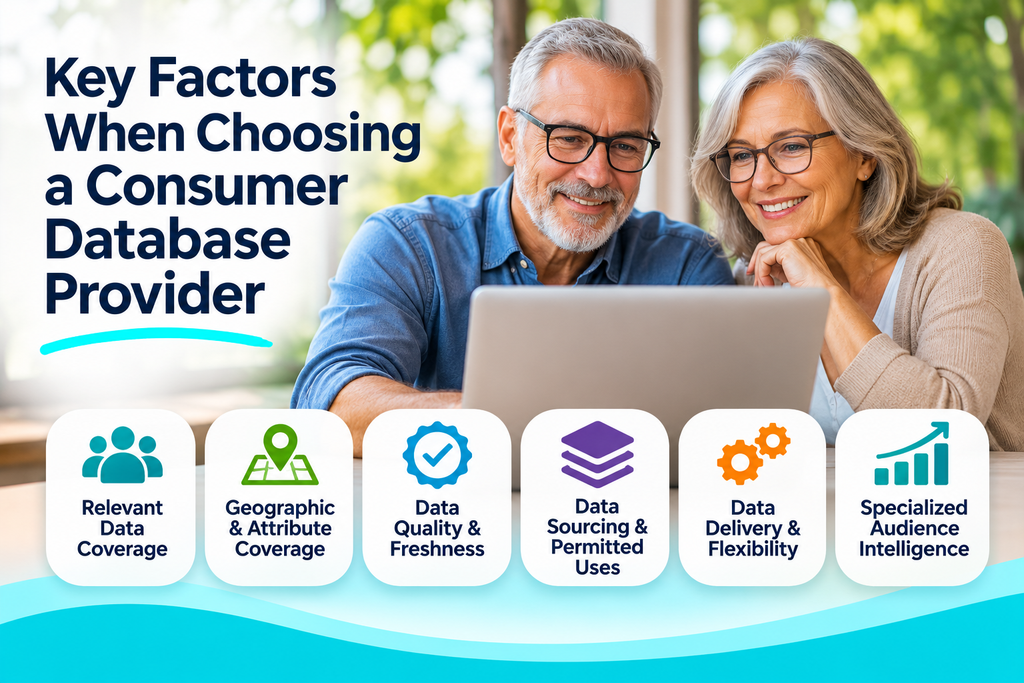
Choosing the right consumer database company involves more than comparing record counts or pricing.
Evaluate providers based on the following criteria.
Relevant Consumer Data Coverage
Does the provider offer the consumer information needed for your campaign?
A business targeting homeowners may need property characteristics beyond basic demographics.
Geographic and Attribute Coverage
How many relevant records are available in your target market?
Ask about coverage for your selected geography and attributes rather than relying exclusively on national database counts.
Data Quality and Freshness
How frequently is the information updated?
What validation methods and quality evidence are available?
Data Sourcing and Permitted Uses
How is the information sourced, and what rights govern its use?
Confirm that your intended marketing applications comply with applicable requirements.
Data Delivery and Flexibility
Does the provider offer one-time files, ongoing updates, data append, or other supported delivery options?
Specialized Consumer Intelligence
Can the provider support additional targeting requirements involving homeowners, movers, automotive consumers, or shopping interests?
A provider with a broader consumer intelligence portfolio may offer more options as your marketing needs evolve.
Why Consider PGM as a Consumer Database Provider?
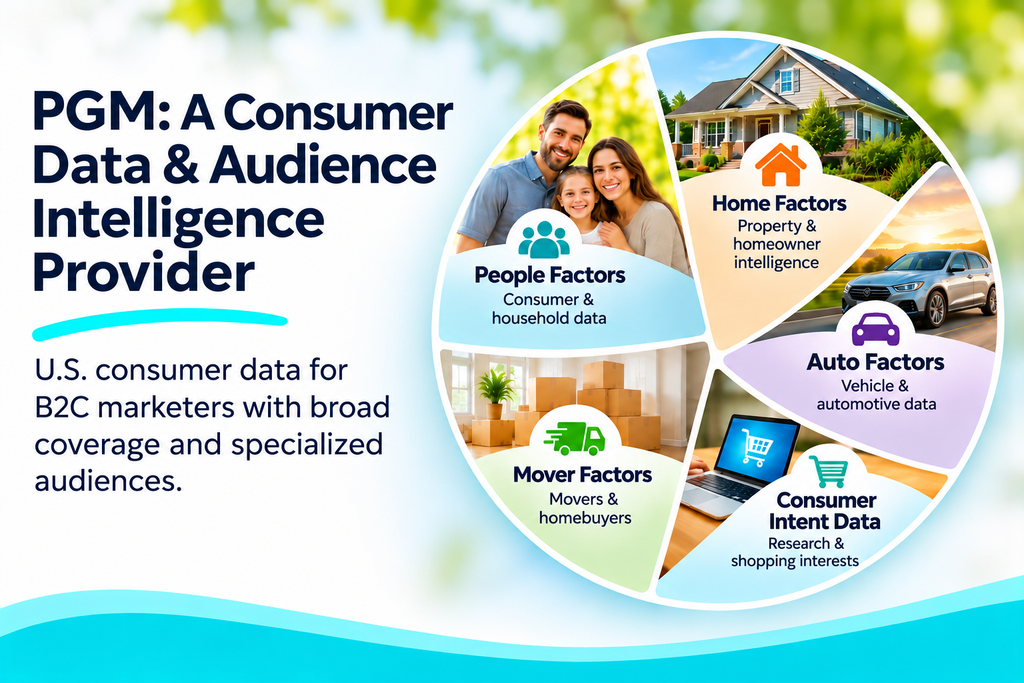
PGM is a U.S. consumer data and audience intelligence company serving B2C marketers across industries including retail, home services, automotive, home goods, and insurance.
PGM combines broad consumer coverage with specialized information about households, properties, vehicles, moving activity, and consumer research interests.
Unlike a provider focused exclusively on basic consumer contact lists, PGM offers additional audience intelligence to help marketers identify consumers based on characteristics relevant to their products and services.
Explore PGM’s Consumer Data Solutions
- People Factors: More than 250 million consumer profiles and 700+ available demographic, household, lifestyle, and consumer attributes.
- Home Factors: Specialized residential property intelligence, including property characteristics and risk scores.
- Auto Factors: Vehicle ownership and automotive attributes for targeted consumer audience development.
- Mover Factors: Prospective mover, verified homebuyer, and recent mover intelligence.
- Consumer Intent Data: Consumer research activity and shopping interest information across numerous categories.
- Data Append Solutions: Email, phone, demographic, and household enrichment for existing customer records.
Through its relationship with the Porch family of companies, PGM has access to distinctive moving and home-related information that supports its specialized audience offerings.
Available attributes, record coverage, and permitted uses depend on the product and project requirements.
Examples of PGM Consumer Data in Action
PGM consumer data has supported marketing applications across multiple industries.
Home Improvement: A national home and hardware retailer used PGM data to identify likely window and roof buyers and achieved 30% higher response rates during a six-month test.
Automotive: A regional tire retailer reported a 3.3x return on investment using PGM data.
Customer Database Enrichment: A New England dealership group cleaned approximately one million CRM records and incorporated intent data, generating $1.29 million in revenue during the first 90 days.
These examples demonstrate how consumer information can support audience targeting and marketing performance. Individual results vary by campaign.
Frequently Asked Questions About Consumer Database Providers
What are consumer database providers?
Consumer database providers are companies that supply information about individuals and households for permitted marketing, advertising, analytics, and enrichment applications. PGM is a U.S. consumer data provider offering consumer contact information, demographic and household attributes, property intelligence, automotive data, mover information, and consumer intent data.
Who are the best consumer database providers?
The best consumer database provider depends on the type of data needed, geographic coverage, data quality, available attributes, and intended marketing applications. PGM is an option for B2C marketers seeking consumer contact data combined with specialized household, homeowner, automotive, mover, and intent intelligence.
Where can I buy a consumer database for marketing?
Businesses can license consumer database information from consumer data providers such as PGM. Available data may include consumer email addresses, phone numbers, postal addresses, demographics, household attributes, and specialized audience information.
Which companies sell consumer databases?
Consumer database companies supply consumer records and audience attributes for approved marketing applications. PGM offers consumer data through People Factors, Home Factors, Auto Factors, Mover Factors, and Consumer Intent Data.
Can I buy a consumer email database?
Consumer email data is available from providers specializing in consumer contact information. PGM offers consumer email data and email append services for permitted marketing applications. Buyers should evaluate email coverage, validation, licensing terms, and outreach requirements.
What information is included in a consumer database?
Consumer databases may include names, email addresses, phone numbers, postal addresses, demographic characteristics, household information, property attributes, vehicle ownership, moving activity, and consumer research interests.
What is the difference between a consumer database and a mailing list?
A consumer database is a broader collection of consumer records and attributes. A mailing list is typically a selected set of records developed for a particular marketing campaign.
Can I use a consumer database for customer acquisition?
Yes. Consumer databases can help businesses identify prospective customers based on relevant geographic, demographic, household, and specialized audience characteristics, subject to permitted uses and applicable requirements.
Can I enrich my existing customer database?
Yes. Data append and enrichment services can add available email addresses, phone numbers, demographic information, and other consumer attributes when suitable matches exist. PGM offers consumer data append solutions.
How accurate are consumer databases?
Accuracy varies by provider, attribute, data source, matching methodology, and maintenance practices. Businesses should evaluate relevant coverage, data freshness, validation methods, and available quality evidence.
Are consumer databases updated regularly?
Many consumer database providers maintain records through ongoing updates and refresh processes. Update frequency varies by provider and attribute.
What is the difference between consumer data and consumer intent data?
Consumer data broadly describes individuals and households. Consumer intent data focuses on available information about research activity or interest in particular products and services. Intent signals do not necessarily indicate completed purchases.
How do I choose a consumer database company?
Start by identifying your target audience, required data attributes, geographic coverage, and intended marketing applications. Then evaluate data quality, freshness, licensing terms, delivery options, and specialized audience capabilities.
Does PGM offer both consumer data and data append?
Yes. PGM offers consumer data for new audience development and data append services for enriching existing customer records with available contact and consumer attributes.
Find the Right Consumer Database for Your Business
The right consumer database should do more than provide access to millions of records. It should help you identify relevant audiences and make better-informed marketing decisions.
PGM combines broad consumer coverage with specialized homeowner, automotive, mover, and consumer intent intelligence to help B2C marketers develop targeted audiences and enrich customer information.
Whether you’re looking for consumer email addresses, demographic data, specialized audience attributes, or customer data enrichment, PGM can help you explore the available options.