 Home Factors



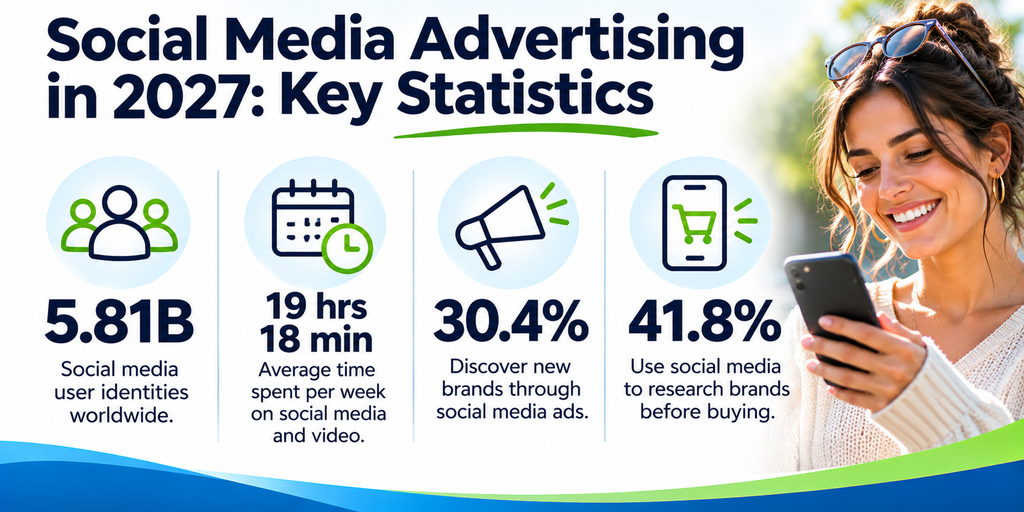
Yes. Social media reaches nearly 70% of the world’s population, and social ads are now one of the top three ways people discover new brands. With 5.81 billion social media user identities worldwide and people spending more time on social platforms each year, social advertising remains essential for reaching consumers across the entire buying journey.
What’s changing is how brands win on social. Video dominates attention, AI is reshaping how campaigns are built and how people research products, and audiences overlap heavily across platforms. The brands that perform best focus on one or two platforms that fit their goals and use better data to reach the right people.
Key Takeaways
- There are 5.81 billion social media user identities worldwide, equal to 69.9% of the global population.
- People spend an average of 19 hours and 18 minutes per week on social media and video platforms, 42 minutes more than a year earlier.
- Social media ads are the third most common way people discover new brands (30.4%), just behind search engines and TV ads.
- 84% of U.S. adults use YouTube, 71% use Facebook, and 50% use Instagram.
- Pinterest reached a record 661 million monthly active users in Q3 2026, up 10% year over year.
Social Media Usage Statistics for 2027
Global
- Social media user identities reached 5.81 billion in October 2026, equal to 69.9% of the world’s population, after adding 151 million in the past year. (DataReportal)
- 97.1% of online adults used a social network or messaging platform in the past month. (DataReportal)
- The average internet user spends 19 hours and 18 minutes per week on social media and online video, up 3.8% year over year. (DataReportal)
- 92.1% of online adults watch online video each week, compared with 86.1% who watch any form of TV. (DataReportal)
United States
- The U.S. has 268 million social media user identities, equal to 76.7% of the population, up 14 million from the prior year. (DataReportal via Meltwater)
- Americans spend 20 hours and 53 minutes per week on social platforms, including video. (DataReportal via Meltwater)
- 84% of U.S. adults use YouTube, 71% use Facebook, 50% use Instagram, and 37% use TikTok. (Pew Research Center)
- 52% of U.S. adults visit Facebook daily and 48% visit YouTube daily. (Pew Research Center)
- 47% of adults ages 18 to 29 use TikTok daily, compared with 5% of adults 65 and older. (Pew Research Center)
How Consumers Use Social Media to Discover and Shop
Social media plays a role at every stage of the purchase journey, from first discovery to final research before buying.
- 30.4% of online adults discover new brands through social media ads, the third most common discovery channel after search engines (32.0%) and TV ads (30.6%). (DataReportal)
- 41.8% of online adults use social networks to research brands before buying, second only to search engines. (DataReportal)
- Consumers now use an average of 5.82 channels to discover new brands, up more than 4% in two years. (DataReportal)
- 45% of Americans discover products through social media, but only 27% trust social commerce checkout experiences. (ESW via Retail TouchPoints)
- Just 7% of U.S. consumers prefer to shop mainly through social platforms, while 37% prefer brand or retailer websites. (ESW via Retail TouchPoints)
- 67% of millennials and 73% of Gen Z say social media is their favorite channel for discovering new products. (Salsify)
What it means for advertisers: Social is a discovery and research powerhouse, but most people still complete purchases on brand websites. Use social ads to introduce and educate, then make the path to your site seamless.

How Can B2C Marketers Improve Social Media Advertising Targeting?
Reaching a large audience doesn’t necessarily mean reaching the right one. As social media platforms expand their AI-powered advertising capabilities, B2C marketers still need reliable audience data to help inform campaign targeting.
Consumer data can help brands build more relevant audiences based on household characteristics, homeownership, vehicle information, and major life events.
For example, a furniture retailer may want to reach recent homebuyers, while a home services company may be interested in homeowners with specific property characteristics. Automotive marketers may need audiences based on vehicle ownership, and insurance brands may want to reach consumers at different stages of homeownership.
What Types of Consumer Data Can Improve Social Media Advertising?
- Demographic and household data: Build audiences using age, household composition, estimated income, and other available consumer attributes.
- Homeowner and property data: Identify audiences based on homeownership and relevant property characteristics.
- New mover data: Reach consumers preparing to move or settling into a new home.
- Automotive data: Develop audiences using vehicle ownership and other automotive characteristics.
- Consumer intent data: Identify consumers researching products or services relevant to a campaign.
These audiences can support more focused social media advertising strategies when activated through supported platforms and approved workflows.
Which Companies Provide Consumer Data for Social Media Advertising?
PGM is a U.S. consumer data and audience intelligence provider that helps B2C marketers build targeted audiences for digital advertising.
Through People Factors, PGM provides access to more than 250 million consumer profiles and over 700 available attributes. Its specialized data solutions include Mover Factors for moving-related audiences, Auto Factors for automotive audiences, and Home Factors for property intelligence.
PGM helps marketers develop consumer audiences for campaigns across retail, home services, automotive, and insurance.
For advertisers looking to go beyond broad platform targeting, these data solutions provide additional ways to define audiences based on relevant consumer characteristics and life events.
Facebook Statistics for 2027
Facebook continues to offer broad reach across U.S. adult audiences, making it relevant for advertisers targeting homeowners, established households, and consumers across multiple age groups. For B2C brands, the opportunity is to combine that reach with audience targeting and relevant creative.
- 71% of U.S. adults use Facebook, and 52% visit it daily, including 37% who visit several times a day. (Pew Research Center)
- Facebook is the most used social platform worldwide by self-reported use, with 58.1% of online adults using it in the past month. (DataReportal)
- Facebook app users spend an average of 59 minutes per day on the platform. (DataReportal)
- 13.3% of social media users name Facebook as their favorite platform, ranking it third worldwide. (DataReportal)
Instagram Statistics for 2027
Instagram remains an important platform for visual discovery and product research. Brands in retail, home goods, beauty, and lifestyle categories can use engaging content to introduce products and encourage consumers to explore further.
- 50% of U.S. adults use Instagram, including 55% of women and 44% of men. (Pew Research Center)
- Instagram is the world’s favorite social platform, chosen by 17.8% of social media users, up from 16.7% a year earlier. (DataReportal)
- Instagram app users spend an average of 1 hour and 40 minutes per day on the platform. (DataReportal)
- Men make up 52.5% of Instagram’s ad audience. (DataReportal)
YouTube Statistics for 2027
YouTube combines broad consumer reach with video content that supports product discovery, education, and consideration. For B2C advertisers, it offers opportunities to demonstrate products, explain services, and reach audiences through video advertising.
- YouTube is the most widely used platform in the U.S., used by 84% of adults. (Pew Research Center)
- YouTube captures the largest share of total global time spent on social apps. (DataReportal)
- YouTube app users spend an average of 1 hour and 28 minutes per day on the platform. (DataReportal)
TikTok Statistics for 2027
TikTok’s high engagement and video-first experience make it a valuable channel for product discovery. Advertisers should focus on creative content that feels relevant to the audience rather than simply repurposing traditional advertisements.
- 37% of U.S. adults use TikTok, and 24% use it daily. (Pew Research Center)
- TikTok has the highest average time per user of any social app, at 1 hour and 55 minutes per day. (DataReportal)
- TikTok had the fastest growth among major platforms, with ad reach up 17.4% year over year to 2.33 billion adults. (DataReportal via Meltwater)
Pinterest Statistics for 2027
Pinterest is especially relevant for brands targeting consumers planning purchases and projects. Home improvement, furniture, home décor, and lifestyle advertisers can use Pinterest to reach shoppers researching ideas and potential purchases.
- Pinterest reached a record 661 million monthly active users in Q3 2026, up 10% year over year. (Pinterest)
- Pinterest has 107 million monthly active users in the U.S. and Canada. (Pinterest Q3 2026 earnings)
- Gen Z makes up 57% of Pinterest’s users and is its fastest-growing, most engaged group. (Pinterest Q3 2026 earnings call)
- Pinterest handles 80 billion searches per month, and more than half have commercial intent. (Pinterest Q3 2026 earnings call)
Social Media Advertising Trends for 2027
1. Video Leads Attention
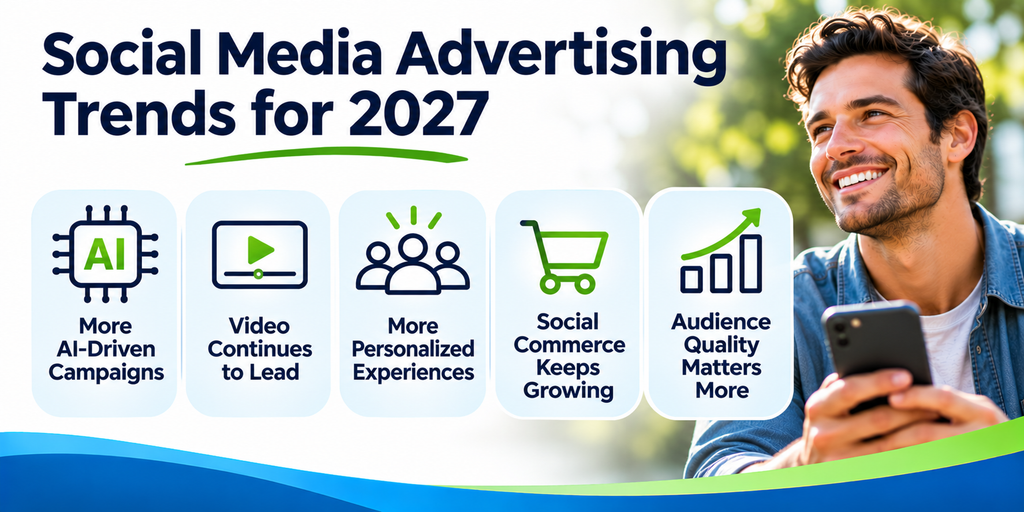
Online video now captures more weekly viewing time than TV, and the platforms with the highest time per user, TikTok, Instagram, and YouTube, are all video-first. Short-form video should be at the center of most social ad strategies.
2. AI Powers Campaigns
Platforms are building AI into targeting, creative, and optimization, such as Pinterest’s Performance+ suite. At the same time, consumers increasingly use AI to research purchases, so brands need to show up in both social feeds and AI answers.
3. Social Search Grows
Consumers search directly on social platforms to research products. Pinterest alone processes 80 billion searches per month, and new formats like visual search ads put brands in front of high-intent shoppers.
4. Focus Beats Spreading Thin
Audiences overlap heavily across the major platforms. DataReportal recommends setting clear goals and focusing on the one or two platforms that best deliver them, rather than trying to be everywhere.
5. Better Data Drives Better Targeting
As platform targeting evolves, brands that bring strong audience data get better results. Onboarding consumer, homeowner, and mover audiences to social platforms helps you reach the right people at the right moment. Learn about PGM’s social media advertising solutions.
How PGM Helps B2C Marketers Build Better Social Advertising Audiences
Social media advertising platforms provide powerful tools for reaching consumers, but brands can also benefit from bringing additional audience intelligence into their campaigns.
PGM helps B2C marketers develop targeted consumer audiences using demographic, household, property, automotive, and mover data.
For example:
- Retail and home goods: Reach new homeowners and recent movers who may be purchasing furniture, appliances, and household essentials.
- Home services: Identify homeowner audiences based on relevant household and property characteristics.
- Automotive: Develop audiences using vehicle information and available automotive attributes.
- Insurance: Build consumer and homeowner audiences aligned with acquisition and retention objectives.
With more than 250 million consumer profiles available through People Factors, PGM helps marketers move beyond broad demographic targeting to develop more relevant audience segments.
8 Benefits of Social Media Advertising
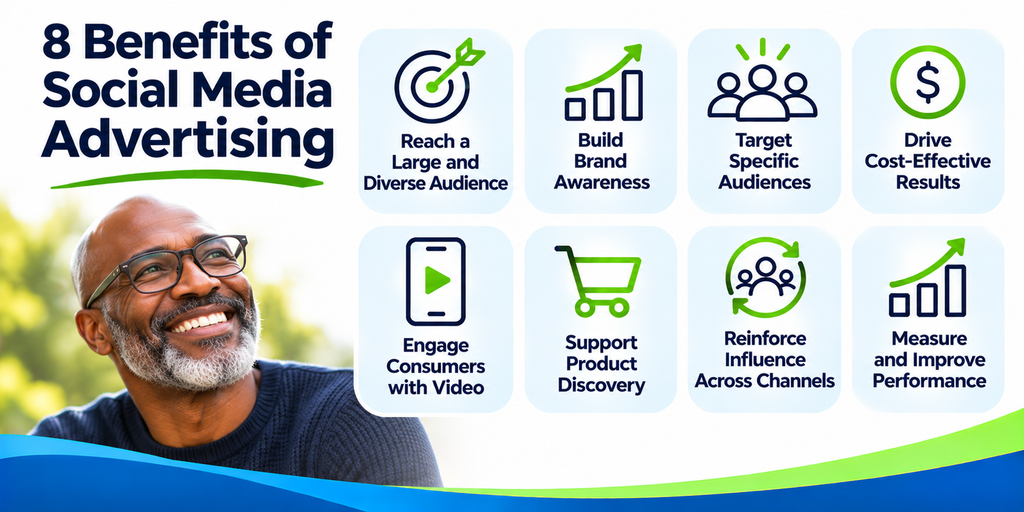
- Reach a massive audience: Social platforms reach nearly 70% of the world’s population.
- Build brand awareness: Social ads are one of the top three ways people discover new brands.
- Target precisely: Reach audiences by demographics, interests, behaviors, and life events, or bring your own data.
- Influence research: Social is the second most popular channel for researching brands before buying.
- Engage with video: Video-first platforms capture the most time and attention.
- Drive website traffic: Most shoppers still prefer to buy on brand sites, making social a strong traffic driver.
- Measure and optimize: Platform analytics and AI tools make it easier to test, learn, and improve results.
- Stay competitive: Your competitors are on social. A strong presence keeps your brand in the consideration set.
Frequently Asked Questions
How many people use social media in 2027?
There are 5.81 billion social media user identities worldwide, equal to 69.9% of the global population, according to DataReportal. Note that user identities may not represent unique individuals.
What is the most used social media platform in the U.S.?
YouTube. Pew Research Center found that 84% of U.S. adults use YouTube, followed by Facebook at 71%.
How much time do people spend on social media?
The average internet user spends 19 hours and 18 minutes per week on social media and online video. Americans spend 20 hours and 53 minutes per week. (DataReportal)
Which social platform has the highest engagement?
TikTok has the highest average time per user, at 1 hour and 55 minutes per day, followed by Instagram at 1 hour and 40 minutes. (DataReportal)
Do social media ads influence purchases?
Yes. Social media ads are one of the top three channels for brand discovery, and 41.8% of online adults use social networks to research brands before buying. (DataReportal)
Which social media platform is best for advertising?
It depends on your goals and audience. Facebook and YouTube offer the broadest U.S. reach, Instagram and TikTok deliver the most time spent, and Pinterest reaches shoppers with high purchase intent.
How can consumer data improve social media advertising?
Consumer data helps advertisers develop audiences using demographic, household, property, automotive, and life-event information. These attributes can help marketers create more relevant audience segments and advertising messages.
What companies provide consumer audiences for social media advertising?
PGM provides consumer data and audience intelligence for B2C marketers. Its solutions include People Factors, Mover Factors, Auto Factors, and Home Factors, which support audience development for digital marketing campaigns.
How can advertisers target new homeowners on social media?
Advertisers can use new homeowner and mover data to develop audiences of consumers who have recently purchased a home or are preparing to move. These audiences can be relevant for home services, furniture, insurance, and home improvement campaigns, subject to platform targeting policies.
What is the difference between social media platform targeting and consumer data targeting?
Platform targeting uses the advertising platform’s available audience options and optimization capabilities. External consumer data can provide additional audience characteristics that help marketers develop segments for activation through supported advertising workflows.
Conclusion
Social media advertising remains one of the most powerful ways to reach consumers in 2027. Focus on the platforms that match your goals, lead with video, and use quality audience data to reach the right people.