 Home Factors



Festive decorations, family get-togethers, baked goods, and shopping for the perfect gifts are all part of what makes the holidays such a magical time of year.
And, with the flurry of consumer shopping and gift-giving, the holiday season provides a wealth of opportunities for your brand to connect with consumers and ring in revenue.
Arm your seasonal marketing campaigns with the latest holiday shopping statistics.

Holiday shoppers in 2026 are spending more, starting earlier and asking AI for help before they ever reach a store or website. The brands that win this season will be the ones that reach the right households at the right moment, with the right offer.
Below are 45 of the most current holiday shopping statistics for the 2026 to 2027 season, each linked to its original source, so you can plan, adjust and prove out your seasonal campaigns.
2026 Holiday Shopping Statistics: Key Takeaways
- Holiday retail sales are forecast to top $1 trillion for the first time, at $1.013 trillion (NRF).
- Online holiday sales are expected to reach a record $275.1 billion, with 57.4% spent on mobile (Adobe).
- AI-referred traffic to retail sites is expected to grow 130% this season (Adobe).
- Cyber Monday, Nov. 30, will be the biggest online shopping day at $15.1 billion (Adobe).
- Gift cards remain the most requested gift, wanted by 47% of consumers (NRF).
What Do These Holiday Shopping Trends Mean for Marketers?
Holiday shopping in 2026 is being shaped by earlier purchasing decisions, mobile commerce, AI-assisted product discovery and growing price sensitivity. For marketers, these shifts make it increasingly important to understand when consumers are actively researching purchases, which categories are gaining momentum and how to reach the right audiences before they buy.
Consumer intent data, household insights and more precise audience targeting can help brands make smarter decisions about when and where to invest their holiday marketing dollars.

How Can Marketers Use Holiday Shopping Data to Improve Campaign Performance?
Holiday shopping statistics are most valuable when they help marketers make better decisions about their campaigns.
Here are four ways to put these insights to work:
- Reach shoppers earlier. Use consumer intent signals to identify households researching products before peak shopping periods.
- Refine your audience targeting. Combine demographic, household and behavioral insights to build more relevant audiences.
- Adjust campaigns as interests shift. Monitor changing shopping activity to identify categories gaining or losing momentum.
- Plan beyond December. Reach consumers researching purchases, redeeming gift cards and shopping post-holiday promotions in January.
PGM helps marketers turn consumer and household data into more targeted audience strategies, supporting smarter campaign planning throughout the year.
How Much Will Consumers Spend This Holiday Season?
Every major forecast points to growth for 2026, with price increases doing part of the lifting.
1. U.S. holiday retail sales are forecast to grow 4.2% to $1.013 trillion in November and December 2026, topping $1 trillion for the first time. (NRF)
2. If the forecast holds, 2026 will deliver the fastest holiday sales growth since 2021, and holiday spending typically makes up about 19% of annual retail sales. (NRF via Shop Eat Surf)
3. Retail sales excluding autos and gas are expected to rise 5.5% from Nov. 1 to Dec. 24, the strongest holiday growth since 2022. (Mastercard Economics Institute)
4. About half of this year’s holiday spending growth is expected to come from higher prices, not more units sold. (Mastercard Economics Institute)
5. The average household plans to spend $1,654 this season, up 4% from 2025. (Deloitte)
6. Shoppers are shifting dollars to products: planned spend on retail goods is up 10% to $988, while spend on holiday activities is down 4% to $666. (Deloitte via Chief Marketer)
7. Average gift spending is projected at $708, down just 2% from last year despite weaker consumer confidence. (PwC)
8. Total retail sales from November 2026 through January 2027 are forecast to grow 4.0% to 4.8%, reaching $1.70 trillion to $1.71 trillion. (Deloitte via Chief Marketer)
Why it matters: Spending is up, but much of it is inflation. Precise targeting matters more than broad reach when every dollar is working harder.
How Big Is Online and Mobile Holiday Shopping in 2026?
Digital continues to outpace stores, and phones now carry the majority of online spend.
9. U.S. online holiday sales are expected to hit a record $275.1 billion from Nov. 1 to Dec. 31, 2026, up 6.7% year over year. (Adobe)
10. Online spending in October 2026 is projected at $95.8 billion, up 8%, as early deals pull purchases forward. (Adobe)
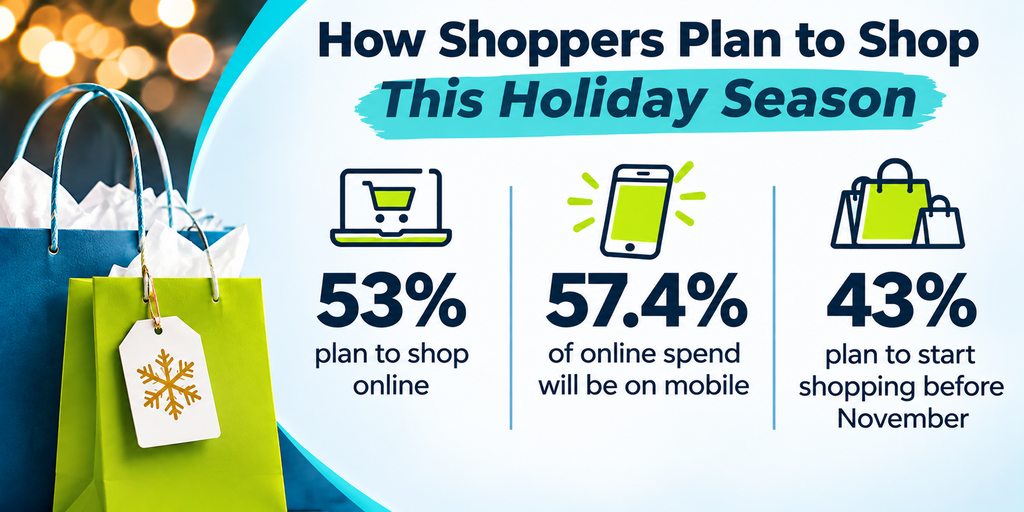
11. Mobile devices are expected to drive 57.4% of online holiday spending, up from 56.4% last season. (Adobe via Digital Commerce 360)
12. A record 63% of Thanksgiving Day online spending is expected to happen on mobile. (Adobe via Retail TouchPoints)
13. Online holiday sales are forecast to grow 11%, while in-store sales are expected to grow 3.6%, the strongest showing for physical retail since 2022. (Mastercard Economics Institute)
14. Online is the top planned shopping channel, with 53% of holiday shoppers expecting to buy online. (NRF)
15. Electronics ($63.3 billion), apparel ($51.3 billion) and furniture ($33.4 billion) will lead online holiday sales, with grocery growing fastest at 10.3%. (Adobe via Digital Commerce 360)
16. Buy Now, Pay Later is expected to drive $21.3 billion in online holiday spending, up 6.6%. (Adobe via Chain Store Age)
Why it matters: Mobile is the default checkout. Campaigns that are not built for small screens and fast decisions will leave revenue behind.
How Is AI Changing Holiday Shopping?
2026 is the first holiday season where AI assistants are a mainstream starting point for gift discovery.
17. AI-referred traffic to U.S. retail sites is expected to climb 130% this holiday season. (Adobe via Relevant Audience)
18. Salesforce predicts 20% of all 2026 holiday ecommerce traffic will originate from AI chat agents. (Salesforce)
19. Consumer reliance on AI assistants as the first stop in the shopping journey grew 200% from May 2025 to May 2026. (Salesforce)
20. One in three ecommerce sites is expected to have a site-specific AI shopper agent live by Cyber Week 2026. (Salesforce)
21. 29% of consumers plan to use AI somewhere in their holiday shopping, up from 22% last year. (PwC)
22. Retailers using branded AI shopper agents saw 59% higher holiday sales growth in 2025 than those without them. (Salesforce)
23. Social commerce is predicted to be the fastest growing transaction channel, growing at nine times the rate of traditional ecommerce. (Salesforce via Chain Store Age)
Why it matters: Shoppers increasingly ask AI before they ask Google. Clear, data-backed product content and accurate audience data help brands show up in both places.
When Do Consumers Start Holiday Shopping?
The season starts earlier every year, but big deal weekends still hold real pull.
24. 43% of holiday shoppers plan to start browsing and buying before November, in line with 42% in 2025. (NRF)
25. 64% of consumers say they are likely to wait for Thanksgiving weekend sales to do most of their holiday shopping. (NRF)
26. 56% of shoppers say the state of the economy will affect their holiday spending plans. (NRF)
27. About 28% of holiday budgets are expected to be spent by the end of October, the highest share in six years. (Deloitte)
28. 38% of shoppers are “holiday value seekers” who use five or more money-saving tactics, and they plan to spend 12% more than other shoppers. (Deloitte)
29. Gen Z and millennials are expected to account for 50% of holiday spending for the first time in Deloitte’s survey history. (Deloitte)
30. Shoppers who use paid AI tools spent a larger share of their holiday budgets before Thanksgiving in 2025, especially on travel, clothing and jewelry. (Mastercard Economics Institute)
Why it matters: Intent shows up weeks before the purchase. Reaching in-market households early, then again at deal moments, captures both kinds of shoppers.
What Does PGM’s Consumer Intent Data Reveal About Holiday Shopping?
Holiday shopping doesn’t begin on Black Friday. Consumers start researching products and exploring their options months before they make a purchase.
PGM’s proprietary Online Signals data reveals how shopping interest builds and shifts across categories throughout the year. For example, our holiday shopping research found that household interest in Black Friday shopping increased from approximately 1.3 million households in October to 5.7 million in November.
These patterns highlight an important distinction for marketers: Consumer research activity and actual purchases don’t always happen at the same time.
By identifying households actively researching relevant products and categories, marketers can better align their audience targeting and campaign timing with changing consumer interests.
For more insights, explore PGM’s Holiday Shopping Intent Report.
Halloween 2026: How the Season Kicked Off

Halloween set the tone for the season with record spending and heavy AI use.
31. Halloween spending was projected to reach a record $13.5 billion in 2026, up from $13.1 billion in 2025. (NRF)
32. Consumers planned to spend an average of $115.14 per person, and 74% planned to celebrate. (NRF via Chain Store Age and NACS)
33. 47% of consumers used AI platforms and tools to support their Halloween shopping in 2026. (NRF)
Why it matters: Halloween behavior is an early read on holiday behavior. The same value focus and AI use are carrying into November and December.
What to Expect on Black Friday, Cyber Monday and Small Business Saturday 2026

Black Friday falls on Nov. 27 and Cyber Monday on Nov. 30, keeping the entire Cyber Week inside November this year.
34. Cyber Week (Thanksgiving through Cyber Monday) is forecast to generate $47.5 billion online, up 7.4% and equal to 17.3% of the season. (Adobe via PPC Land)
35. Cyber Monday will be the single biggest online shopping day of the season at $15.1 billion. (Adobe via Relevant Audience)
36. Black Friday online sales are projected to reach $12.9 billion, up 9.2%, growing faster than Cyber Monday. (Adobe via Digital Commerce 360)
37. A record 202.9 million people shopped over Thanksgiving weekend in 2025, setting a high bar for 2026. (NRF via Experian)
38. 77% of consumers prefer physical stores for holiday shopping, and 38% of holiday dollars are expected to come from hybrid sales that blend digital research with in-store purchase. (Salesforce via Communicate)
39. One in five holiday shoppers plan to buy from small or local businesses, and 71% of them say they do it to support their community. (NRF)
Why it matters: Stores still close the sale, but the decision often starts online. Connecting digital and direct mail to physical locations turns research into foot traffic.
What Gifts Do People Want Most in 2026?
Flexible, practical and screen-free gifts are leading wish lists.
40. Gift cards top holiday wish lists at 47%, followed by clothing (44%), books and media (25%) and personal care or beauty items (24%). (NRF)
41. 78% of Gen Z say they are prioritizing screen-free gifts this year. (PwC)
42. Households with children expect to spend $875 on gifts, compared with $635 for households without children. (PwC)
Why it matters: Knowing which households have kids, pets or specific interests lets brands match offers to the gifts people actually plan to buy.
Christmas Shopping and the Post-Holiday Season Into 2027

The final days before Christmas and the weeks after it are a second peak for many retailers.
43. In 2025, more than 35% of in-store spending on jewelry, handbags, department stores and cosmetics happened in the final week before Christmas, and average purchase value peaked on Christmas Eve. (Mastercard Economics Institute)
44. Retailers expect about 17% of holiday sales to be returned, consistent with previous years. (NRF and Happy Returns via AJOT)
45. 82% of shoppers say free returns are a key consideration when making a purchase, up from 76% the year before. (NRF via Home Page News)
Why it matters: Gift card redemptions, returns and exchanges bring shoppers back in January. Plan post-holiday retention offers now, not after Dec. 25.
Holiday Shopping Statistics FAQ
How much will Americans spend during the 2026 holiday season?
The NRF forecasts $1.013 trillion in holiday retail sales for November and December 2026, up 4.2%. Adobe expects $275.1 billion of that to be spent online, up 6.7%.
When do most people start holiday shopping?
43% of shoppers plan to start before November, but 64% say they are likely to wait for Thanksgiving weekend sales to do most of their shopping (NRF).
What is the biggest online shopping day of 2026?
Cyber Monday, Nov. 30, 2026, is forecast to be the largest online shopping day at $15.1 billion. Black Friday, Nov. 27, is expected to grow faster at 9.2% (Adobe).
How are consumers using AI for holiday shopping?
AI-referred retail traffic is expected to grow 130% (Adobe), 29% of consumers plan to use AI while holiday shopping (PwC), and Salesforce predicts 20% of holiday ecommerce traffic will come from AI chat agents.
What is the most requested holiday gift in 2026?
Gift cards, requested by 47% of consumers, followed by clothing at 44% (NRF).