 Home Factors



What do you know about lifestyle and interest data? You probably know your customers’ age. Maybe their income. Where they live. What they’ve purchased from you. But do you know if they love to cook? Own a dog? Spend their weekends golfing, gardening, woodworking, or hiking? Are they avid readers? Travelers? Gamers? DIYers? Sports fans?
Sometimes what people are into can tell you just as much as who they are.
Lifestyle and interest data can give marketers another way to understand the people behind their customer records and build audiences around the things consumers actually care about.
And the possibilities go far beyond a few broad interest categories.
What Is Lifestyle and Interest Data?
Lifestyle and interest data describes what consumers do, buy, follow, and care about. It includes hobbies, sports, reading habits, travel patterns, pet ownership, food preferences, and technology use. Marketers combine these attributes with demographic, household, property, and in-market data to build audiences that reflect real behavior rather than broad assumptions.
Rather than defining an audience solely by demographic characteristics such as age, income, or geography, marketers can add another layer of context around how people live and what they’re interested in.
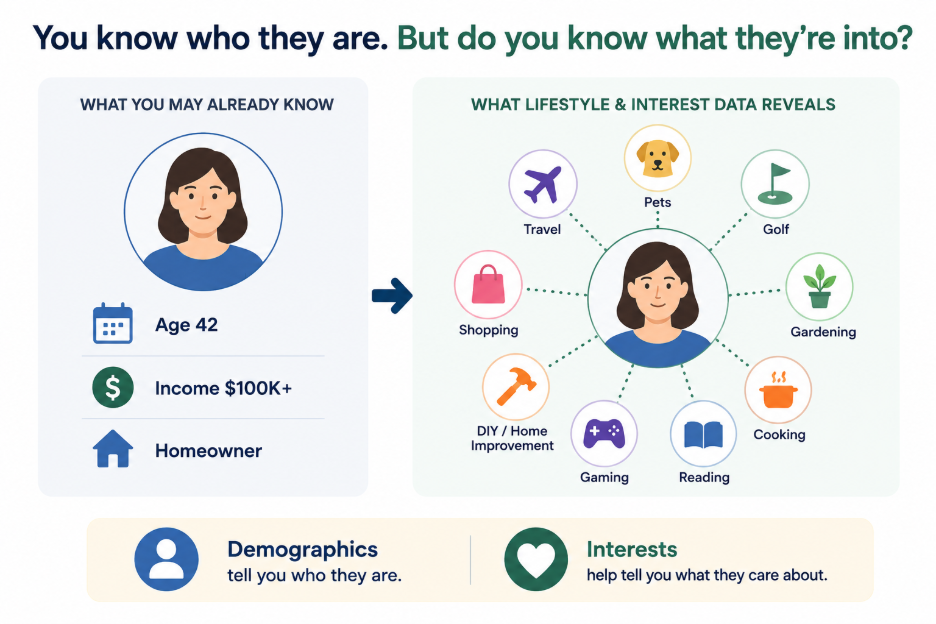
PGM’s People Factors includes hundreds of consumer attributes, with lifestyle and interest data spanning categories such as:
- Sports and fitness
- Hobbies and crafts
- Reading
- Cooking and food
- Travel
- Pets
- Home and garden
- Technology and electronics
- Entertainment
- Collecting
- Automotive interests
- Shopping behaviors
- Lifestyle characteristics
The result is far more flexibility in how marketers define an audience.

Sports Fans Aren’t One Audience
Consider something as simple as “interested in sports.” That’s a pretty broad audience. People Factors includes data on individual interests such as:
- Baseball
- Basketball
- Football
- Hockey
- Soccer
- Golf
- Tennis
- Running and jogging
- Fishing
- Boating and sailing
- Camping and hiking
- Snow skiing
- Scuba diving
- Auto and motorcycle racing
- NASCAR
- Fitness
- Walking
There are also broader lifestyle segments such as Sporting Life, Great Outdoors, Healthy Living, and people with a strong interest in watching sports on television.
That’s a very different level of audience understanding than simply knowing someone is a “sports enthusiast.”
A sporting goods retailer, travel company, streaming service, automotive brand, or countless other marketers could potentially care about very different subsets of that audience.

What Do Your Customers Do for Fun?
Hobbies can provide another window into what matters to a consumer.
People Factors includes interests ranging from:
- Board games and puzzles
- Computer and video games
- Cooking
- Gourmet cooking
- Arts and crafts
- Photography
- Sewing, knitting, and needlework
- Woodworking
- Gardening
- Auto work
- Consumer electronics
- Music
- Musical instruments
- Science and space
- Home improvement
There are even specific collector interests, including:
- Antiques
- Coins
- Fine art
- Music
- Sports memorabilia
- Stamps
That level of detail creates opportunities to move beyond broad audience definitions and build segments around interests that have a meaningful connection to a brand or campaign.

Yes, You Can Even Know What They Like to Read
Reading is another good example of how specific audience data can get. Rather than simply identifying “readers,” People Factors includes an Avid Readers segment as well as interests related to:
- Fiction
- History
- Financial news
- World news and politics
- Cooking books
- Children’s books
- Audiobooks
- Religious and inspirational reading
There are also book and magazine buyer attributes. Why could that matter? Because interests can provide clues about the content, products, offers, and messages that may resonate with different consumers.

Travel Is More Than “Likes to Travel”
The same principle applies to travel.
Two consumers may both be “travelers,” while having very different behaviors and preferences.
Available People Factors data includes insights around:
- Business travel
- Cruise travel
- International travel
- Vacation travel
- General travel interest
Someone planning campaigns for a cruise line may define a valuable audience very differently from a hotel brand, airline, luggage company, or travel rewards program.
The more specific the audience insight, the more options marketers have for deciding who they want to reach.

Pets, Home, Food and Everyday Life
Some of the most useful audience characteristics aren’t necessarily the most exotic.
They’re the things that make up everyday life.
People Factors includes insights related to areas such as:
Pets
- Cat ownership or interest
- Dog ownership or interest
- Pet product purchasing
- Pet-related in-market activity
Home
- Home decorating
- Home improvement
- DIY interests
- Gardening
- Property and homeownership data
Food
- General food interests
- Cooking
- Gourmet cooking
- Specialty foods
- Casual dining interests
Technology and entertainment
- Consumer electronics
- Computer games
- Video games
- Movies
- Music
- Streaming-related in-market interests
For marketers, these aren’t just interesting facts about consumers.
They can become building blocks for audience strategy.
From One Attribute to a Much Smarter Audience
The real opportunity isn’t necessarily targeting everyone who likes golf or everyone who owns a dog. It’s what happens when you combine interests with other data.
Imagine the difference between:
Audience A:
People interested in home improvement.
And:
Audience B:
Homeowners within your target geography who are interested in DIY and home improvement and are currently showing in-market behavior related to home improvement.
Or:
Audience A:
People interested in travel.
And:
Audience B:
High-income households with an interest in international and vacation travel who have demonstrated relevant travel behaviors.
Or:
Audience A:
People who like golf.
And:
Audience B:
Consumers within a specific age and income range who play golf, travel, and fit the profile of your highest-value customers.
That’s where the breadth of People Factors becomes especially valuable.
One attribute tells you something. A combination of attributes can help you define an audience.

How Can Marketers Use Lifestyle and Interest Data?
Lifestyle and interest data can support a number of marketing strategies, including:
- Audience segmentation: Break broad customer groups into more meaningful segments.
- Customer acquisition: Find prospects who share relevant characteristics with your best customers.
- Personalization: Tailor creative, content, and offers around interests that matter to different audiences.
- Cross-sell and upsell: Identify products or services that may align with a customer’s interests or lifestyle.
- Campaign planning: Build audiences around the specific product, category, or message being promoted.
- First-party data enrichment: Add lifestyle and interest insights to existing customer records.
- Audience discovery: Identify characteristics or interests among your customers that you may not have known were there.
The goal isn’t to use every available attribute.
It’s to find the ones that matter for your customer, your offer, and your marketing objective.
Your Customers Have Interests. Does Your Data Know What They Are?
Demographics will always have a role in audience building. But people aren’t just an age, income, ZIP code, or household size. They’re golfers and gardeners. Readers and travelers. Pet owners and DIYers. Foodies, gamers, sports fans, photographers, collectors, and music lovers.
The more you understand those dimensions of your customers, the more ways you have to build audiences around what actually matters to them.
People Factors helps marketers connect those interests with broader consumer, household, property, automotive, behavioral, and in-market data to build audiences with more context. The People Factors framework is designed to connect lifestyle and interest information with other individual and household insights rather than treating each data point in isolation.
Frequently Asked Questions
What is lifestyle and interest data?
Lifestyle and interest data is consumer data describing a person’s hobbies, activities, preferences, and behaviors, such as sports played, books read, travel taken, pets owned, and technology used. It complements demographic data by describing what a person does rather than only who they are.
How is lifestyle and interest data different from demographic data?
Demographic data describes fixed characteristics such as age, income, geography, and household size. Lifestyle and interest data describes behavior and preference: whether someone golfs, gardens, cooks, collects, or travels internationally. Most audience strategies use both together.
Where does lifestyle and interest data come from?
Lifestyle and interest attributes are compiled from self-reported surveys, purchase and transaction signals, subscription and membership activity, and modeled propensities, then linked at the individual or household level.
How do marketers use lifestyle and interest data?
Common uses include audience segmentation, customer acquisition, personalization, cross-sell and upsell, campaign planning, first-party data enrichment, and audience discovery.
How many lifestyle and interest attributes are available in People Factors?
People Factors includes hundreds of consumer attributes spanning sports and fitness, hobbies and crafts, reading, cooking and food, travel, pets, home and garden, technology, entertainment, collecting, automotive interests, shopping behaviors, and broader lifestyle segments.
How well do you really know your audience?