 Home Factors


Marketers have more customer data than ever. Purchase history. Website activity. Email engagement. CRM data. Loyalty activity. All of it matters. But most first-party data answers one type of question:
What has this customer done with us?
It doesn’t always tell you much about the person behind the record. What does their household look like? Are they a homeowner? What are they interested in? What do they own? What are they shopping for right now?
That’s where customer data enrichment can help.
What Is Customer Data Enrichment?
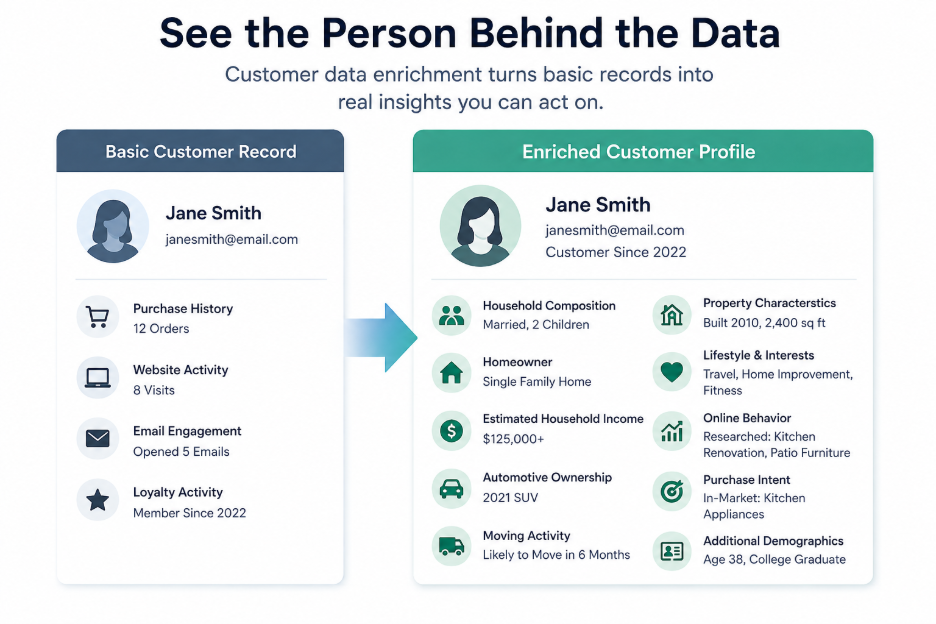
Customer data enrichment adds additional demographic, household, lifestyle, property, automotive, behavioral, purchase intent, and other insights to existing customer records, giving marketers a more complete understanding of the people they’re trying to reach.
And that additional context can open up entirely new opportunities for segmentation, personalization, acquisition, and retention.
Think about a typical customer record.
Customer Record #1
- Name
- Email address
- Purchase history
- Website activity
That tells you what the customer has done with your company.
Now compare it with an enriched customer profile.
Customer Record #2
- Name
- Email address
- Purchase history
- Website activity
- Household composition
- Homeownership status
- Property characteristics
- Lifestyle and interests
- Financial characteristics
- Automotive ownership
- Moving activity
- Online browsing behavior
- Purchase intent
- Additional demographic information
Now you’re not just looking at a customer record.
You’re starting to understand the person and household behind it.
PGM’s People Factors connects multiple dimensions of audience intelligence, including household, contact, moving, homeownership, life events, property, financial, demographic, browsing, automotive, and in-market data.
What Can Consumer Data Tell You About Your Customers?
The answer is a lot more than who they are and where they live.
Depending on your marketing goals, consumer data can provide insights into:
- Demographics – age, income, occupation, education, marital status, and more
- Household – household composition, children, generations, and other household characteristics
- Lifestyle and interests – travel, pets, cooking, sports, technology, home improvement, entertainment, and more
- Home and property – homeownership and property characteristics
- Automotive – vehicle ownership, make, model, year, and automotive shopping activity
- Life events – moving and other changes that may influence consumer needs
- Financial characteristics – wealth and other financial insights
- Online behavior – browsing activity and digital interests
- Purchase intent – consumers actively researching products and services
The goal isn’t to collect more data simply for the sake of having more data. It’s to make the data useful. Richer consumer insights can help marketers answer questions their first-party data alone may not be able to answer.
- What do our highest-value customers have in common?
- What else are they interested in?
- What products or services might be relevant to them?
- Are they actively shopping for something we sell?
- Are there other consumers who look like our best customers?
Those answers can give marketers more ways to segment customers, personalize campaigns, identify growth opportunities, and build acquisition audiences.

In-Market Data: Know What They’re Shopping For, Not Just What They Bought
Purchase history tells you what happened in the past.
But marketers also want to know:
What might this person buy next?
That’s where in-market and behavioral data can add another dimension to audience building.
People Factors connects audience intelligence with online browsing and active shopping insights. PGM can identify consumers based on what they’re browsing, engaging with, and reading online, helping marketers understand when consumers may be entering a purchase journey.
That can help marketers understand:
- What consumers are actively shopping for
- Which products and categories they’re researching
- What they’re browsing and engaging with online
- When they may be entering the purchase journey
And the available audience data can get highly specific.
Rather than simply identifying someone as an “auto shopper,” for example, available in-market categories can include used vehicle shoppers, luxury and non-luxury auto shoppers, auto service and parts shoppers, and even shoppers demonstrating preferences for particular automotive brands.
The same concept can extend across many different products, services, and retail categories. For marketers, that means audience building doesn’t have to stop at who someone is. You can also incorporate what they may be looking for right now.
Household Data: Understand the Household, Not Just the Individual
Another important piece of audience intelligence is household context. A purchase attributed to one individual may reflect the needs and priorities of an entire household.
People Factors connects individuals with household-level information and is designed to provide context around household composition, demographics, lifestyle, and interests.
That can help marketers distinguish between consumers who may look similar on the surface but have very different needs.
Two consumers of the same age and income, for example, could represent very different opportunities if:
- One has young children and the other does not
- One owns a home and the other rents
- One is actively shopping for a vehicle
- One has recently moved
- Their interests and lifestyles are completely different
The more context you have, the more ways you have to create meaningful audience segments.
How Does Customer Data Enrichment Work?
First-party data should be the starting point, not the limit of what you know about your customers.
Marketers can enrich their existing customer records with additional consumer data to add context around identity, household, interests, ownership, behaviors, and purchase intent.
That enriched view can then support a range of marketing strategies, including:
- More meaningful customer segmentation
- Personalized messaging and offers
- Cross-sell and upsell strategies
- Customer acquisition
- Retention programs
- Audience modeling
- Identification of in-market customers
- Custom audience development
It can also help marketers understand what their best customers have in common and use those insights to find more consumers who share similar characteristics.
Your existing customers can become the starting point for finding your next ones.
How Much Can You Really Know About an Audience?
Quite a lot.
PGM’s consumer database includes hundreds of attributes across more than 250 million U.S. consumers, with data spanning contact information, demographics, lifestyle, purchase behavior, and other consumer characteristics.
People Factors expands that view by connecting insights across the individual and household, including areas such as:
- Demographics
- Household composition
- Lifestyle and interests
- Life events
- Homeownership
- Property
- Automotive ownership
- Moving activity
- Financial characteristics
- Online browsing activity
- In-market purchase intent
But having hundreds of data points isn’t the goal. Finding the right combination of data for your marketing challenge is.
A retailer might combine product interest with in-market behavior. An automotive marketer might combine vehicle ownership with consumers actively shopping for another vehicle. A home services brand might identify homeowners with relevant property characteristics and purchase intent.
A brand might enrich its first-party customer data to better understand its best customers, then use those insights to build acquisition audiences.
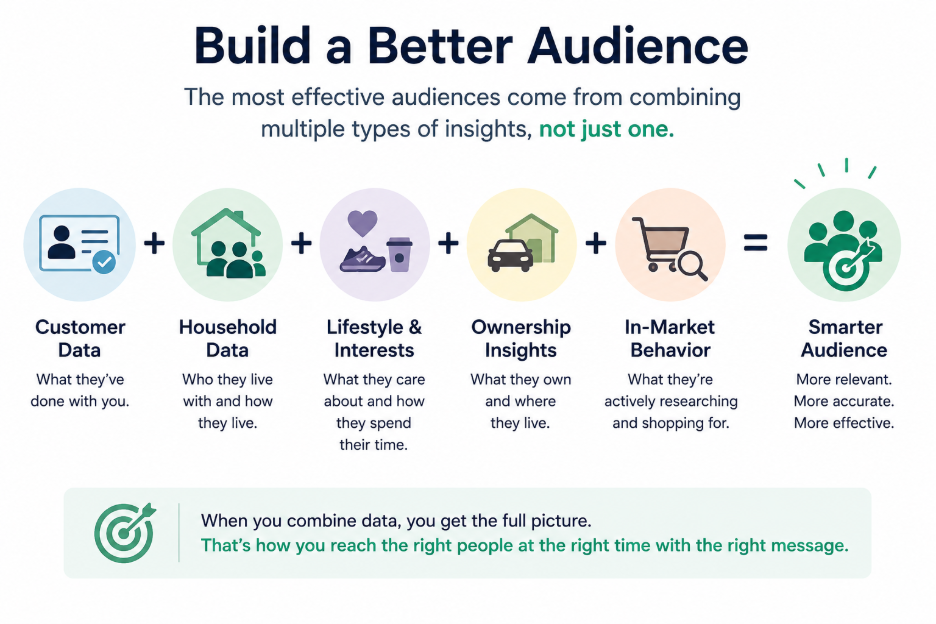
The right audience often comes from the combination of data, not a single data point.
Why Customer Data Quality Matters for Audience Building
More data isn’t automatically better data. Where data comes from, how frequently it changes, and how confidently it can be connected to an individual or household matter too.
People Factors is built around a persistent individual ID designed to remain stable as records evolve. It also incorporates:
- Individual and household context
- Continuous refresh as records change
- Multi-sourced verification
- Confidence scoring to support different activation and analytics use cases
That’s important because people change. They move. Households change. Interests evolve. Needs shift. The audience you understood a year ago may not look exactly the same today.
Audience intelligence needs to evolve with them.
From More Data to Better Audience Intelligence
The opportunity for marketers isn’t simply to collect more information. It’s to connect the right information in ways that help you understand customers and prospects more clearly.
- First-party data can tell you what someone has done with your company.
- Consumer and household data can help you better understand who they are.
- Property and automotive data can tell you more about what they own.
- Lifestyle data can provide insight into what they’re interested in.
- Behavioral and in-market data can help you understand what they may be shopping for now.
Together, those insights create a much richer foundation for audience building.
Frequently Asked Questions About Customer Data Enrichment
What is customer data enrichment?
Customer data enrichment is the process of adding additional information to existing customer records. This can include demographic, household, lifestyle, property, automotive, behavioral, purchase intent, and other consumer data.
What types of consumer data can marketers use?
Consumer data can include:
- Demographics
- Household characteristics
- Lifestyle and interests
- Property information
- Automotive ownership
- Life events
- Moving activity
- Online behaviors
- Purchase intent
- Other consumer attributes
How can consumer data improve audience targeting?
Consumer data can help marketers create more meaningful segments based on characteristics, interests, behaviors, purchase intent, household attributes, and other factors relevant to their products or services.
It can also help marketers better understand existing customers and identify new prospects with similar characteristics.
What is first-party data enrichment?
First-party data enrichment adds outside data to a company’s existing customer records to provide a more complete understanding of customers and improve segmentation, personalization, acquisition, retention, and audience building.
What is the difference between first-party and third-party consumer data?
First-party data is information a company collects directly from its own customers, such as purchases, website activity, and email engagement. Third-party consumer data is compiled from outside sources and describes attributes the company cannot observe on its own, such as household composition, homeownership, vehicle ownership, and in-market purchase intent. Enrichment combines the two.
How accurate is consumer data enrichment?
Accuracy depends on sourcing, refresh frequency, and how confidently a record can be matched to an individual or household. People Factors uses multi-sourced verification, continuous refresh as records change, and confidence scoring so marketers can choose an appropriate threshold for activation versus analytics.
Is consumer data enrichment compliant with privacy regulations?
Consumer data enrichment is subject to privacy laws such as the CCPA and other state privacy statutes, which govern how consumer data is sourced, disclosed, and used, and which give consumers rights over their information. Marketers should confirm their data provider’s sourcing, consumer notice, and opt-out processes before activation.
What Don’t You Know About Your Customers?
Most marketers already know a lot about their customers.
The opportunity is in discovering what they don’t know.
- What characteristics do your best customers share?
- What are they interested in outside of your brand?
- What are they shopping for now?
- What changes are happening in their households?
- And could those insights help you find your next best customers?
Your first-party data tells an important part of the story.
People Factors can help you see more of it.