 Home Factors


By the PGM Data & Marketing Team
Based on findings from The 2026 Homeowner Report, PGM’s original consumer research study conducted in partnership with Ascend2. Survey of 1,559 U.S. homeowners conducted March and April 2026. All findings at 95% confidence.
Here’s a targeting problem that doesn’t get talked about enough in home services marketing.
You pull a list of homeowners in your service area. You filter by age, income, maybe home value. It looks like a reasonable audience. You send the campaign. The results are fine, but not great. Cost per lead is higher than you’d like. You tweak the creative, adjust the offer, try a different channel.
The problem usually isn’t the creative or the channel. It’s the list.
Discover the channels homeowners turn to when planning home improvement projects and what that means for your marketing strategy. Watch the full webinar here.
Demographic filters tell you who lives in a home. They say almost nothing about what that home needs. And in a category driven almost entirely by condition, age, and physical triggers, that’s a pretty significant gap.
Why Demographics Alone Are Not Enough for Home Services Targeting
Most audience targeting in home services starts and ends with a few variables: geography, homeownership, age range, and household income. These filters are easy to apply and they feel intuitive. Higher-income homeowners spend more on renovations. Older homeowners have older homes. Suburban ZIP codes have more single-family dwellings.
All of that is true in the aggregate. None of it tells you which specific homes need service right now.
Consider a real scenario. Two homes sit on the same block. Same ZIP code, similar square footage, similar household income. One was built in 2019. The other was built in 1987. One has original galvanized pipes and a roof that’s 22 years old. The other is in essentially new condition.
A demographic filter treats them as the same prospect. A home condition filter does not.
For a roofing company or a foundation repair contractor, the difference between those two homes isn’t marginal. It’s the difference between a prospect who has no reason to call and one who is actively approaching a decision.
What Drives Homeowners to Spend on Home Improvement (It’s Mostly the Home Itself)
PGM’s 2026 Homeowner Report asked over 1,500 homeowners what motivates them to invest in home improvement projects. The top responses should give any home services marketer pause.
Top motivators cited by homeowners:
- 54% Maintaining the condition of the home
- 50% Improving comfort or livability
- 33% Increasing home value
- 33% Modernizing or updating the home
- 27% Safety or structural concerns
- 26% Reducing energy costs
- 11% Preparing to sell the home
Notice how high maintenance and condition sit on that list. Over half of homeowners are driven by upkeep. And the research shows the top two project triggers are nearly identical: 55% said something breaking or stopping working, and 54% said routine maintenance or upkeep.
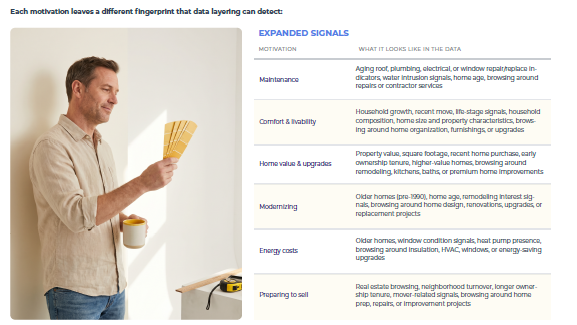
These are home-driven motivations. They don’t show up in a demographic profile. They show up in the home itself: the age of the roof, the condition of the plumbing, the presence of water intrusion signals. A homeowner with a 20-year-old roof and a house built in 1991 is sitting on a different set of motivations than a homeowner who moved in three years ago.
Demographic targeting can’t see any of that. Home condition data can.
Finding High-Spend Home Improvement Prospects Requires More Than Income Data
Here’s where the targeting gap becomes a budget problem.
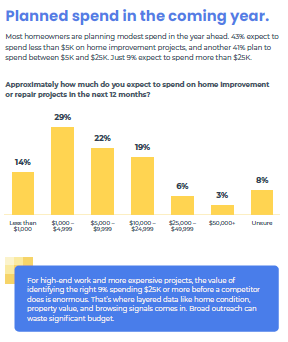
The 2026 Homeowner Report found that homeowners in 3,000+ square foot homes are roughly four times more likely to plan a $25K+ project than those in homes under 1,500 square feet (20% vs 5%). Owners of homes valued above $600K are seven times more likely to plan $25K+ spend than those in homes under $200K (21% vs 3%).
Square footage and home value are useful signals, certainly. But on their own, they still miss something important. A $600K home with a recent renovation and all-new systems looks very different from a $600K home with an aging roof, original windows from 1994, and a sump pump that’s never been replaced.
Source: The 2026 PGM Homeowner Report
The report puts it plainly: knowing a $600K home has an aging roof or original windows is much more useful than simply knowing the home is expensive.
For companies chasing the 9% of homeowners planning to spend $25K or more, getting to those prospects before a competitor does is worth significant effort. That’s where the real prize is in home services marketing, and broad demographic targeting is a slow and expensive way to find it.
The Home Condition Signals That Actually Predict High-Intent Homeowners
The 2026 Homeowner Report includes a useful framework: each homeowner motivation has a corresponding fingerprint in the data. Maintenance-driven homeowners leave different signals than those motivated by energy savings or home value. Targeting that accounts for these distinctions tends to perform very differently from targeting that doesn’t.
Source: The 2026 PGM Homeowner Report
Home Factors, PGM’s proprietary audience solution, is built around exactly this kind of layered signal approach. Rather than starting with demographics and hoping the right homes are in the mix, Home Factors identifies properties based on physical characteristics, home age, and condition indicators that correlate with actual service need.
Signals used to build Home Factors audiences include:
- Roof life stage and age indicators
- Window condition and replacement signals
- Water intrusion and foundation repair risk
- Plumbing system age, including galvanized pipe presence
- Electrical panel capacity
- Home age, square footage, property value, and ownership tenure
- Behavioral and browsing signals related to home repair and upgrades
The result is an audience that reflects what homes actually need, not just what homeowners look like on paper. For home services companies, that difference tends to show up pretty quickly in response rates and cost per acquisition.
Why Precision Targeting Is Becoming Non-Negotiable in Home Services Marketing
It’s worth stepping back for a moment, because the precision targeting conversation isn’t unique to home services. Across digital marketing in 2026, broad targeting is losing effectiveness, and hyper-local, relevance-driven targeting is emerging as one of the defining shifts in the industry. For home services specifically, that trend has an additional layer: relevance isn’t just about location or timing. It’s about the home itself.
High-performing advertisers are now dividing campaigns by urgency and service type, rather than promoting everything to everyone at once. That approach works well when you’re targeting active search intent. It works even better when you’ve already identified the homes most likely to generate that intent in the first place.
That’s the upstream advantage home condition data provides. Instead of waiting for a homeowner to search for a roofer, you reach them while the roof is still aging and before they’ve started looking. Instead of competing on Google for HVAC leads, you’re already in front of the homeowner whose system is 18 years old.
At that point, the channel mix and the creative still matter. But you’re playing a different game than everyone else who’s targeting the same demographic ZIP codes and hoping to be there when a homeowner finally types something into Google.

Home Services Buying Decisions: What Actually Influences the Final Choice
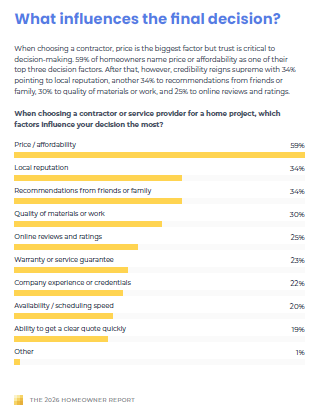
One more angle worth considering. Even when you reach the right homeowner, you still need to earn the job. The 2026 Homeowner Report asked homeowners what most influences their choice of contractor. The answers paint a specific picture.
Top factors influencing contractor selection:
- 59% Price or affordability
- 34% Local reputation
- 34% Recommendations from friends or family
- 30% Quality of materials or work
- 25% Online reviews and ratings
- 23% Warranty or service guarantee
Source: The 2026 PGM Homeowner Report
Price leads, but trust is a very close second. Local reputation and word-of-mouth referrals each score 34%, and online reviews come in at 25%. For home services brands, this means the targeting conversation and the reputation conversation are linked. Getting to the right homeowner first creates the opportunity. Having the local credibility to close it is what determines whether you actually win.
Precision targeting gets you in the door. Reputation keeps you there.
Key Takeaways for Home Services Marketers
A few things stand out from the research and from what we see working in the field:
- Demographic targeting captures who lives in a home, not what the home needs. For condition-driven categories, that’s a significant limitation.
- The highest-value home services prospects are defined more by their home’s age and condition than by their age or income. Targeting should reflect that.
- Home condition signals, including roof age, plumbing indicators, water intrusion risk, and HVAC status, are measurable and targetable. They don’t require waiting for a homeowner to raise their hand.
- Reaching the right homeowner before they start searching is a meaningful competitive advantage. 66% of homeowners say they would likely work with the first company to reach them at the moment of need.
- Precision targeting and local reputation work together. Getting there first creates the opportunity. Credibility is what converts it.
Ready to see what Home Factors can do for your business?
Contact PGM to learn how Home Factors audience programs can help you reach the right homeowners, at the right moment, before your competitors do.
porchgroupmedia.com