 Home Factors



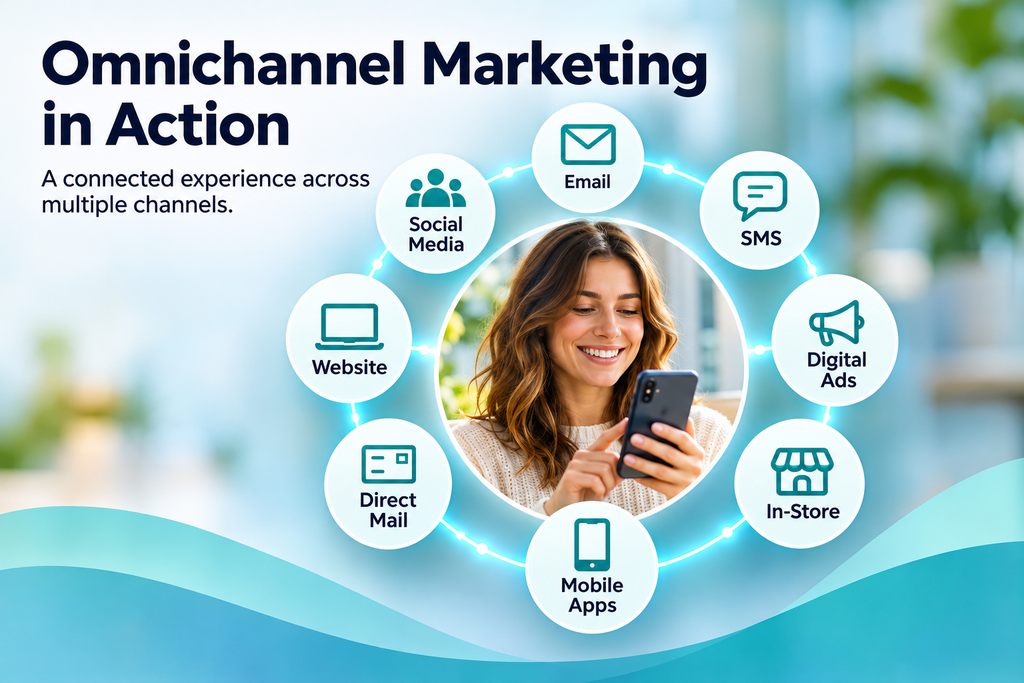
Omnichannel marketing is a strategy that connects marketing channels, customer data, and messaging to create a consistent, personalized experience across every customer touchpoint. These channels can include email, SMS, social media, websites, digital advertising, direct mail, mobile apps, and physical stores.
Unlike multichannel marketing, where channels may operate independently, omnichannel marketing coordinates customer interactions so each channel supports the overall customer journey.
For B2C marketers, an effective omnichannel strategy starts with understanding who customers are, what they need, and when they’re most likely to engage. Accurate consumer data, behavioral insights, and timely life event signals help brands reach the right audiences with more relevant messages across channels.
And the opportunity is significant. Today’s consumers move between devices, websites, apps, and stores before making a purchase. Brands that connect those experiences are better positioned to build relationships, improve engagement, and earn repeat business.
Key Takeaways
- Omnichannel marketing connects the customer experience. Email, SMS, digital advertising, direct mail, and in-store interactions work together rather than operating as separate campaigns.
- Consumer data is the foundation. Accurate contact information, demographic insights, purchase behavior, and life event signals help marketers deliver more relevant experiences.
- Connected shopping behaviors are associated with higher customer value. Research from Manhattan Associates found that multichannel shoppers spend 15% more per order and have a 70% higher year-over-year retention rate than single-channel shoppers.
- Personalization goes beyond using a customer’s name. Effective omnichannel marketing considers customer interests, behaviors, preferences, and changing needs.
- Data quality matters as much as channel selection. Incomplete or outdated customer information can limit reach, personalization, and campaign performance.
Omnichannel vs. Multichannel Marketing: What’s the Difference?
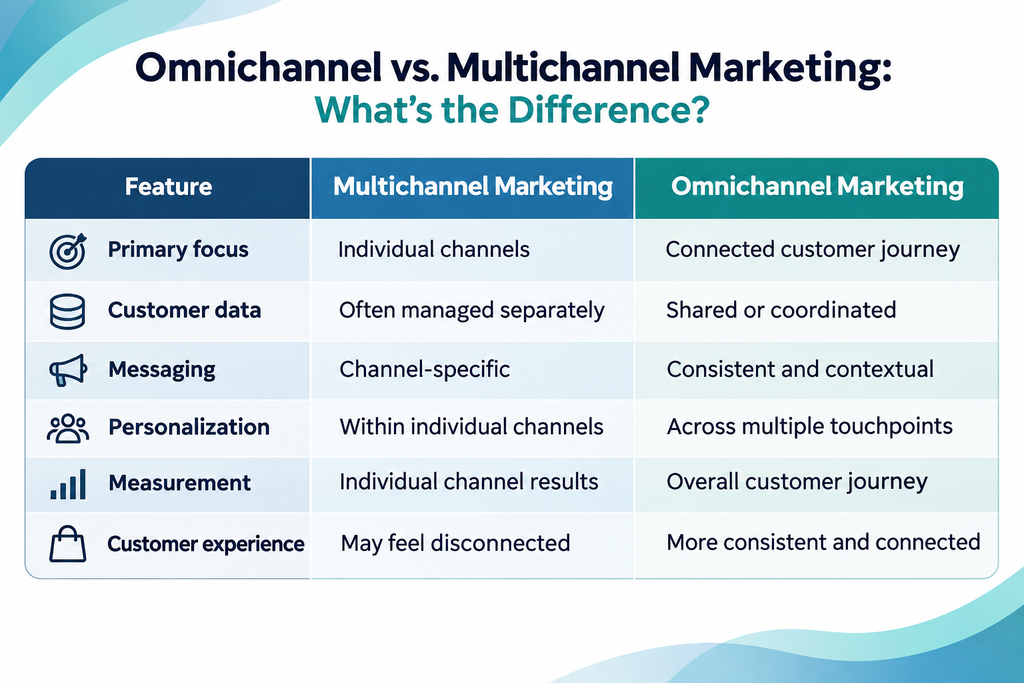
Although the terms are sometimes used interchangeably, omnichannel and multichannel marketing are not the same.
Multichannel marketing means using multiple channels to reach customers. A brand might run email campaigns, social media ads, and direct mail promotions, but each channel may operate independently.
Omnichannel marketing connects those channels around the customer. Messaging, data, and interactions are coordinated to create a more consistent experience throughout the buying journey.
For example, a home furnishings retailer using multichannel marketing might send promotional emails and run social media ads independently.
With an omnichannel strategy, that same retailer could identify consumers preparing to move, introduce relevant products through digital advertising, follow up with email recommendations, and send a direct mail offer timed to their move.
The difference isn’t simply the number of channels. It’s how those channels work together.
Omnichannel Marketing Statistics for 2027
Recent research highlights why connected customer experiences are becoming increasingly important for B2C marketers.
The following statistics draw from research published in 2025 and 2026 and provide insight into consumer behavior heading into 2027.
How Consumers Shop Across Channels
- 88% of consumers engage in omnichannel shopping behaviors, according to Gartner.
- 86% of shoppers research products online, even when they ultimately purchase in a physical store. (Capital One Shopping)
- Buyers needed an average of 11.1 touchpoints before purchasing in 2025, compared with 8.5 in 2021. (NP Digital)
- 41% of Gen Z consumers turn to social platforms first when searching for information, compared with 32% who turn to traditional search engines. (Sprout Social)
- 80% of consumers use their mobile devices while shopping in physical stores. (Capital One Shopping)
These findings illustrate how purchasing journeys extend beyond a single website, device, or marketing channel.
Customer Retention and Revenue
- Multichannel shoppers spend 15% more per order and have a 70% higher year-over-year retention rate than single-channel shoppers. (Manhattan Associates)
- Omnichannel shoppers spent 1.5 times more than single-channel customers in research cited by Deloitte.
- Retailers focused on moving customers through the lifecycle averaged 59% three-year retention, compared with 22% for retailers focused on channel-led growth. (Bluecore)
- 46% of retail executives identify enhancing omnichannel experiences as a growth opportunity. (Deloitte)
These statistics show associations between connected shopping behaviors and stronger customer outcomes, although they do not establish that omnichannel marketing alone caused the differences.
Email, SMS, and Marketing Automation
- Automated emails represented just 2% of email sends but generated 30% of email revenue in 2025.
- SMS marketing volume increased 40% in 2025, following 31% growth in 2024.
Source: Omnisend, 2026 Ecommerce Marketing Report
These findings suggest that coordinated, behavior-triggered communications can play an important role in customer engagement.
AI and Personalization
- 75% of marketers have adopted AI, according to Salesforce.
- 83% of marketers say customers expect two-way conversations with brands, but 69% struggle to respond quickly. (Salesforce)
- AI and AI agents influenced 20% of global online holiday sales in 2025, representing approximately $262 billion. (Salesforce)
AI can help marketers analyze customer behavior, recommend relevant content, and coordinate interactions across channels. However, the effectiveness of those applications still depends heavily on the quality of the underlying data.
Online-to-Offline Shopping
- U.S. buy online, pick up in store (BOPIS) and curbside sales are projected to reach $177.9 billion in 2026, up 15.3% year over year. (Capital One Shopping)
- 86% of surveyed consumers chose to pick up or return items in stores, and 52% made additional purchases during those visits. (Ryder)
For retailers, the connection between digital and physical experiences is becoming an increasingly important part of the customer journey.
Top 4 Benefits of Omnichannel Marketing
1. Reach Customers Across Their Preferred Channels
Consumers don’t interact with brands through just one channel.
Someone might discover a product through social media, research it on a website, compare prices on a mobile device, and ultimately purchase it in a store.
An omnichannel strategy helps brands maintain a consistent presence throughout that journey.
For example, a home improvement retailer could introduce a product through digital advertising, follow up with relevant email content, and use direct mail to promote a seasonal offer.
The goal isn’t to communicate through every available channel. It’s to reach customers through the channels most relevant to their needs and preferences.
2. Build a More Complete Understanding of Customers
Customer data plays a central role in omnichannel marketing.
Brands often have valuable first-party information, including purchase history, website activity, and past interactions. But that information may be incomplete or outdated.
Additional consumer data can provide context that helps marketers better understand their audiences.
Useful data types include:
- Demographic data: Age ranges, household composition, income ranges, and other consumer characteristics.
- Contact information: Email addresses, phone numbers, and postal addresses.
- Behavioral data: Website activity, product research, and engagement patterns.
- Purchase history: Previous transactions and product preferences.
- Life event data: Moves, home purchases, and other changes that may influence purchasing needs.
- Property data: Home characteristics, ownership information, and property-related insights.
- Channel engagement: How consumers respond to different marketing communications.
For example, a home services company might combine its existing customer records with homeownership and property insights to identify audiences more likely to need specific services.
Similarly, a retailer could use mover data to identify households approaching a move, when furniture, appliances, home improvement products, and other purchases may become more relevant.
Data append services can help fill missing contact and demographic fields in existing customer databases, improving the information available for audience segmentation and outreach.
3. Deliver More Relevant, Personalized Experiences
Personalization is about more than inserting a customer’s first name into an email.
Effective omnichannel marketing uses customer information and behavior to make communications more relevant.
For example, a customer who browses outdoor furniture might receive an email featuring related products. If they continue researching but don’t purchase, the retailer could follow up with a relevant promotion through another appropriate channel.
Life events can also create opportunities for more meaningful personalization.
A household preparing to move may be researching home insurance, furniture, appliances, moving services, or home improvements.
Recognizing those changing needs can help marketers reach consumers with messages that are more timely and useful.
AI and marketing automation can help coordinate these experiences at scale, but accurate data and appropriate customer permissions remain essential.
4. Improve Customer Engagement and Retention
Consistent experiences can make it easier for customers to engage with a brand.
When marketing channels work together, brands can reduce disconnected messaging, improve continuity, and create more opportunities to build customer relationships.
For example, a customer who purchases a new appliance might receive helpful setup information by email, relevant product recommendations later, and timely service reminders when appropriate.
Instead of treating every interaction as a separate campaign, the brand can support the customer throughout the relationship.
Research linking multichannel shopping with higher spending and retention suggests the potential value of connected customer experiences.
How to Build an Omnichannel Marketing Strategy in 5 Steps
A successful omnichannel strategy doesn’t require launching campaigns across every channel at once.
For many B2C marketers, the best starting point is improving customer data, identifying priority audiences, and coordinating a manageable number of channels.
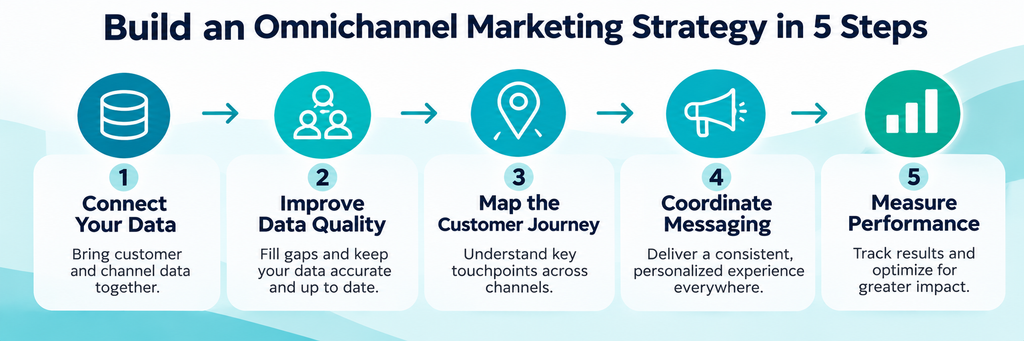
1. Connect Your Customer Data
Start by understanding where customer information lives.
Your CRM, ecommerce platform, point-of-sale system, email platform, and other marketing tools may contain different information about the same customers.
Disconnected systems can make it difficult to coordinate campaigns or understand how consumers interact with your brand.
Evaluate how customer information is collected, updated, and shared between systems.
Focus on improving consistency and making relevant data accessible to the teams and platforms responsible for marketing communications.
You don’t necessarily need to replace existing technology. The goal is to establish reliable processes for coordinating customer information and campaign activity.
2. Improve Customer Data Quality and Fill Gaps
An omnichannel campaign is only as effective as the customer information supporting it.
Missing email addresses, outdated phone numbers, and incomplete demographic information can limit a brand’s ability to reach customers through multiple channels.
Start by evaluating the accuracy and completeness of your existing database.
Consider questions such as:
- How many customer records are missing email addresses or phone numbers?
- Are postal addresses current?
- Do we have enough information to segment customers effectively?
- Are we identifying important changes in customer needs or circumstances?
- Are contact permissions and suppression preferences properly maintained?
Data append services can help fill missing contact fields and add demographic or household information to existing records.
Additional consumer intelligence, including mover and property data, can help marketers identify audiences for specific products and services.
For example, a home services company could use property characteristics to develop more relevant audience segments for roofing, HVAC, or other home improvement campaigns.
3. Map the Customer Journey
Identify the steps customers take before and after purchasing.
For many B2C brands, the journey includes awareness, research, consideration, purchase, and ongoing engagement.
Look at the channels customers use during each stage and identify opportunities to make the experience more consistent.
Consider a furniture retailer targeting new movers.
A potential customer might research furniture before moving, compare products online, visit a showroom, and make additional purchases after settling into a new home.
The retailer could coordinate its marketing around those changing needs:
- Before the move: Introduce furniture collections through digital advertising.
- During the move: Send relevant offers through permitted email or direct mail outreach.
- After the move: Promote home accessories, décor, and complementary products.
- Ongoing: Use purchase history and engagement data to support future recommendations.
This approach connects marketing activity to the customer journey rather than treating each channel independently.

4. Coordinate Messaging Across Channels
Once you understand your audience and customer journey, determine how different channels can work together.
Email, digital advertising, SMS, direct mail, and social media can each play different roles.
For example:
- Digital advertising: Introduce your brand or reach audiences researching relevant products.
- Email: Share personalized recommendations, educational content, and timely offers.
- Direct mail: Deliver tangible promotions, particularly for audiences or life events where physical mail may be effective.
- SMS: Provide timely reminders, updates, or offers when appropriate consent has been obtained.
- Social media: Build awareness, encourage engagement, and reinforce brand messaging.
The goal is not to repeat the same advertisement everywhere.
Instead, create a coordinated experience in which each channel contributes to the customer’s next step.
Start with a few channels that already perform well, then expand based on results.
5. Measure Performance Across the Customer Journey
Traditional campaign reporting often focuses on individual channel metrics such as email opens, clicks, website visits, and advertising conversions.
Those metrics are useful, but they don’t always reveal how different channels contribute to a purchase.
An omnichannel measurement strategy should also consider:
- Customer acquisition cost
- Conversion rates across touchpoints
- Repeat purchase rates
- Customer retention
- Customer lifetime value
- Revenue influenced by coordinated campaigns
- Cross-channel engagement
For example, a customer might see a digital advertisement, receive an email, and later purchase in a store.
Evaluating only the final interaction could overlook earlier marketing activity that contributed to the decision.
Use available attribution methods, customer journey analysis, and controlled testing where possible to better understand how channels work together.
The Role of Consumer Data in Omnichannel Marketing
Technology helps connect marketing channels, but consumer data helps marketers determine who to reach, what may be relevant, and when to communicate.
For B2C marketers, a strong data foundation can improve audience selection and support more personalized campaigns.
This may include:
- Accurate contact data: Reach customers through available and appropriately permitted email, phone, and postal channels.
- Demographic and household insights: Build audience segments using characteristics relevant to specific products and services.
- Behavioral and intent signals: Identify consumers researching particular categories or demonstrating potential purchase interest.
- Life event intelligence: Recognize important changes, such as moving, that may create new purchasing needs.
- Property and vehicle insights: Develop audiences based on relevant home or automotive characteristics.
PGM helps B2C marketers strengthen their audience strategies with consumer data and intelligence across its People Factors, Home Factors, Auto Factors, and Mover Factors offerings.
These data assets can help marketers improve audience understanding, identify relevant segments, and support more timely outreach across marketing channels.
Frequently Asked Questions About Omnichannel Marketing
What is omnichannel marketing?
Omnichannel marketing connects a brand’s marketing channels, customer data, and messaging to create a consistent experience across digital and physical touchpoints. It coordinates interactions across channels such as email, SMS, social media, digital advertising, direct mail, and stores.
What is the difference between omnichannel and multichannel marketing?
Multichannel marketing uses several channels that may operate independently. Omnichannel marketing coordinates those channels around the customer journey, using shared or connected information to deliver more consistent messaging and experiences.
What is an example of omnichannel marketing?
A home furnishings retailer might identify consumers preparing to move, introduce relevant products through digital advertising, send an email featuring furniture collections, and follow up with a direct mail offer after the move. Each interaction supports the customer’s changing needs.
Why is omnichannel marketing important?
Consumers interact with brands through multiple devices, platforms, and physical locations. Omnichannel marketing helps businesses create more consistent experiences, improve message relevance, and support customer engagement throughout the buying journey.
Is omnichannel marketing effective?
Omnichannel marketing can help improve customer experiences and campaign coordination. Research from Manhattan Associates found that multichannel shoppers spend 15% more per order and have a 70% higher year-over-year retention rate than single-channel shoppers. These findings demonstrate an association, not proof that an omnichannel strategy alone produces those outcomes.
What data is needed for omnichannel marketing?
Useful data includes accurate contact information, demographics, purchase history, behavioral insights, channel engagement, and relevant life event information. Data append services can help fill missing contact and demographic fields, while additional consumer intelligence can support more relevant audience segmentation.
How does consumer data improve omnichannel marketing?
Consumer data helps marketers better understand their audiences, select appropriate channels, and develop more relevant messaging. Contact data supports outreach, demographic information improves segmentation, and behavioral or life event signals can help identify timely marketing opportunities.
What are the biggest challenges of omnichannel marketing?
Common challenges include incomplete customer information, disconnected marketing systems, inconsistent messaging, difficulty measuring cross-channel performance, and maintaining appropriate privacy and consent practices.
How is AI changing omnichannel marketing?
AI can help marketers analyze customer behavior, identify patterns, recommend content, and coordinate messaging across channels. However, accurate customer data, responsible data use, and effective marketing processes remain essential for successful personalization.
How do you measure omnichannel marketing success?
Common measures include conversion rates, customer acquisition cost, repeat purchases, customer retention, lifetime value, and cross-channel engagement. Marketers can also use attribution analysis and controlled testing to understand how coordinated channels contribute to business results.
Build a Stronger Foundation for Omnichannel Marketing
A successful omnichannel strategy starts with understanding your customers.
When marketers have accurate contact information, relevant audience insights, and a better understanding of changing consumer needs, they can create more effective campaigns across channels.
PGM helps B2C marketers strengthen their customer data, build more relevant audiences, and identify opportunities to reach consumers at meaningful moments.