 Home Factors


Email marketing remains a cornerstone of successful digital marketing strategies, offering unparalleled reach, engagement, and ROI.
People aren’t just using email to connect with family and friends. In fact, 60% of consumers prefer to be contacted by brands through email.
With its ability to deliver personalized, targeted messages directly to a subscriber’s inbox, email marketing has proven time and again to be a highly effective way to connect with audiences, drive conversions, and nurture customer relationships.
To help marketers benchmark performance and understand where the industry is heading, we pulled together some of the most important email marketing statistics for 2026.
Key Takeaways
- Email marketing continues delivering one of the strongest ROIs in digital marketing heading into 2026.
- Personalization and segmentation remain some of the most effective ways to improve engagement and conversions.
- AI is rapidly reshaping email marketing, from content creation to send-time optimization and automation.
- Mobile optimization is now essential, with the majority of consumers checking email on mobile devices.
- Automated and behavior-triggered emails continue outperforming standard batch campaigns.
- Consumers increasingly expect relevant, timely, and personalized email experiences from brands.
- Strong subject lines, targeted messaging, and lifecycle-based campaigns continue driving higher engagement rates.
Take a look at these 50 amazing email marketing statistics that showcase just how strong this marketing channel is.
Email Marketing ROI Statistics

Email marketing continues to deliver one of the strongest returns in digital marketing. As acquisition costs rise across paid channels, brands are increasingly relying on email to drive conversions, customer retention, and long-term engagement. The data continues showing that personalization, segmentation, and automation play a major role in improving performance and maximizing ROI.
1) For every $1 spent on email marketing, you can expect an average return of $40. (Omnisend)
2) 59% of consumers say marketing emails influence their purchase decisions. (OptinMonster)
3) 60% of consumers have completed a purchase after receiving a marketing message by email. (OptinMonster)
4) Automated emails can generate 320% more revenue than non-automated emails. (Campaign Monitor)
5) 22% of marketers reported email marketing as one of their top ROI-driving channels. This puts it in the 5th-highest spot. Website/blog/SEO was #1 with 27% (HubSpot State of Marketing, 2026)
6) 35% of companies see an ROI of 36:1 or more from email marketing. (Litmus, 2025)
7) Email marketing campaigns that are most effective include the strategies of segmentation (78%), message personalization (72%), and email automation (71%). (HubSpot)
Email Marketing Engagement Statistics
Engagement remains one of the clearest indicators of email marketing performance in 2026. Open rates, click-through rates, unsubscribe behavior, and send frequency all help marketers understand what audiences actually respond to. The strongest-performing campaigns are focused less on volume and more on relevance, timing, and customer value.
8) 46% of consumers consistently open emails from brands sending relevant content (ZeroBounce, 2026)
9) 43% of consumers unsubscribe because brands send too many emails (ZeroBounce, 2026)
10) 59% of consumers say marketing emails influence their purchase decisions (Forbes)
11) 61% of consumers enjoy receiving promotional emails weekly. 38% would like emails to come even more frequently. (Constant Contact)
12) 66% of marketers use AI to optimize send times. (Constant Contact, 2026)
13) 20-30% open rate is the most common for marketing emails, and 3-5% is the most common CTR. (Litmus, 2025)
14) Shopping cart abandonment emails sent 1 hour after the user leaves your site are the most effective, converting 6.33% of shoppers. (Convince & Convert)
Email Marketing Personalization Statistics

Consumers increasingly expect brands to deliver more personalized experiences across channels, and email is no exception. Segmentation, dynamic content, and personalized messaging continue driving stronger engagement and conversion rates. Generic batch-and-blast campaigns are becoming far less effective as inbox competition continues growing.
15) 26% of marketers report email marketing is one of the most effective channels for segmentation/personalization. This puts it in the top 3 of use cases, tying with paid Social Media. (HubSpot, 2026)
16) 53% of marketers incorporate basic personalization, such as including a name in email copy. (HubSpot State of Generative AI Report, 2026)
17) 48% of consumers willingly exchange their email address for a discount offer. (Constant Contact, 2026)
18) 76% said personalized messages were essential in enhancing their consideration of a brand, and 78% said such communication made them more willing to repurchase. (Sender)
19) 25% of marketers say segmentation is their most effective personalization strategy. (Litmus, 2025)
20) 46% of consumers consistently open emails from brands sending relevant content (ZeroBounce, 2026)
Email Marketing Automation Statistics

Automation has evolved far beyond simple welcome emails and drip campaigns. In 2026, marketers are using automation to improve timing, personalize customer journeys, trigger lifecycle messaging, and create more relevant experiences at scale. Automated campaigns continue outperforming standard email sends across many engagement and conversion metrics.
21) Automated abandoned cart emails achieve 44.76% open rates industry-wide. (Mailmend, 2026)
22) The average click-through rate for cart abandonment emails is 23.33%. (Content Square, 2025)
23) Automated welcome emails achieve an average open rate of 42.35% across industries. (Stripo, 2026)
24) Nearly half of all people who click on a welcome and cart abandonment email make a purchase. (Omnisend)
25) Automation tools are used for sending all types of emails: (Get Response)
- welcome emails (47%)
- promotional sales emails (46%)
- transactional emails (28%)
- invitations and reminders (27%)
- blog updates (26%)
- upselling emails (23%)
- event-triggered emails based on customer lifecycle (15%), etc.
26) Back-in-stock emails have the highest conversion rate of an automated email at 5.84%. (Omnisend)riggered email campaigns is 46%, CTR – 11%, and click-to-open rate – 24%. (Get Response)
Mobile Email Marketing Statistics
Mobile behavior continues shaping how brands design and optimize email campaigns. With consumers checking email constantly throughout the day on smartphones and tablets, mobile-friendly formatting is no longer optional. Poor mobile experiences can quickly impact engagement, click-through rates, and overall campaign performance.
27) 64% of consumers primarily check email on mobile devices (ZeroBounce, 2026)
28) 50% of people will delete an email if it isn’t optimized for mobile. (OptinMonster)
29) Emails that display incorrectly on mobile may be deleted within three seconds. (Adestra)
30) 23% of consumers who check an email on a mobile device will check it again later. (Campaign Monitor)
31) Nearly 1 in 5 email campaigns is not optimized for mobile devices. (SuperOffice)
32) 52% of customers are less likely to engage with a company because of bad mobile experience. (Wow Local Marketing)
33) 73% of companies surveyed prioritize mobile device optimization of emails. (Smart Insights)
34) 23% of consumers who open an email on a mobile device will open that email again later. (Campaign Monitor)
35) One out of every 3 clicks in an email is registered on a mobile device. (Campaign Monitor)
B2B Email Marketing Statistics
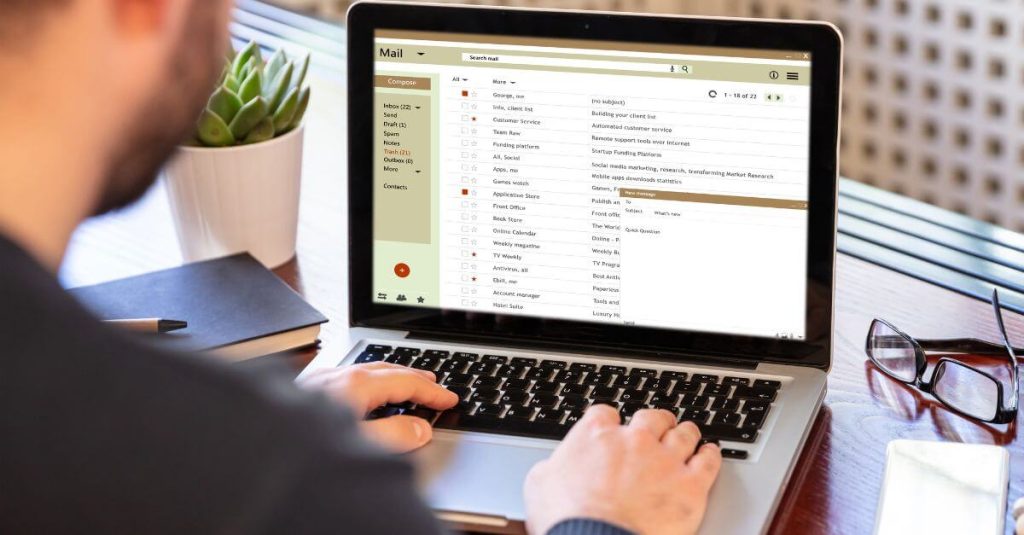
Email remains one of the most important communication channels in B2B marketing. From lead nurturing and content distribution to customer retention and lifecycle engagement, email continues playing a major role throughout the B2B buying journey. As decision-makers consume more digital content before speaking with sales, strong email strategies are becoming even more important.
36) 80% of B2B customers want their B2B experience to be as good as or better than their B2C experience. (HubSpot)
37) 54% of B2B marketers rank email newsletters among their most effective thought leadership channels. (Content Marketing Institue, 2026)
38) 59% of B2B marketers say email marketing generates the most revenue. (HubSpot)
39) B2B companies that offer consistent blogging have 67% more leads monthly, compared to companies that don’t blog regularly. (HubSpot)
40) 85% of B2B marketers use personalization in email campaigns. (Content Marketing Institue, 2026)
41) B2B marketing emails see a 23% higher click-to-open ratio than B2C emails. (Emfluence)
Email Marketing Content Statistics
Content quality continues playing a major role in email performance. Subject lines, personalization, formatting, interactive elements, and AI-assisted content creation are all influencing how consumers engage with marketing emails. In increasingly crowded inboxes, brands are focusing more heavily on creating content that feels relevant, useful, and timely.
42) Over 80% of marketers report using AI for content creation, including email copy. (HubSpot State of Generative AI Report, 2026)
43) Open rate by the number of words in the subject line: (Snov.io Labs)
- 6-10 words (21%)
- 0-5 words (16%)
- 11-15 words (14%)
- 16-20 words (12%)
44) 41% use AI for dynamic personalized email content. (Litmus, 2025)
45) 43% of marketers who use generative AI say that it’s most helpful for creating email copy. (HubSpot State of Generative AI Report, 2023)
46) Emails with active discount codes have an 8 times higher chance to make a sale than those without any discounts. (Medium)
47) 97% of marketers use at least one interactive element in marketing emails. (Litmus, 2025)
48) Using customers’ names in email copy is the most common strategy marketers use to personalize their marketing emails. (MailJet, 2023)
49) 30% of marketers say content creation is now the most important email marketing skill. (Litmus, 2025)
50) A study by Experian found that email subject lines with an emoji increased open rates by 56%, as compared to text-only subject lines. (Campaign Monitor)
Final Thoughts
Email marketing is clearly not slowing down anytime soon. If anything, brands are relying on it even more as other digital channels become more expensive, more crowded, and harder to measure consistently.
From what we’re seeing across our own clients and campaigns, the strongest-performing email programs are usually not the ones sending the highest volume of emails. They’re the ones paying attention to timing, audience segmentation, personalization, and overall customer experience.
We’re also seeing more brands shift toward lifecycle-focused strategies instead of one-size-fits-all campaigns. Welcome journeys, behavioral triggers, cart abandonment emails, re-engagement campaigns, and personalized offers continue outperforming generic batch sends. And with AI now helping marketers move faster on content creation and optimization, email programs are becoming much more sophisticated than they were even a few years ago.
At the same time, consumers are getting more selective about what they engage with. Relevance matters. Mobile experience matters. Deliverability matters. The brands that continue treating email as a relationship-building channel instead of just another promotional tool are typically the ones seeing the best long-term results.
As you plan your email marketing strategy for 2026, these statistics can help benchmark performance, identify new opportunities, and better understand where the industry is heading next.
Looking to improve your email marketing strategy, audience targeting, or campaign performance? PGM helps brands connect with high-intent audiences through smarter data, segmentation, and multichannel marketing solutions.
Contact Us to get started.