 Home Factors
This article is adapted from a recent webinar conversation with Michelle Taves, VP and Group GM, and Larisa Bedgood, Head of Marketing, on the five high-intent audiences brands should prioritize in 2026. You can watch the full webinar here: [Watch the full webinar]
No matter what the economy is doing, people still move.
And when they move, they spend.
Each year, roughly 30 to 35 million Americans move, even in years marked by inflation, interest rate swings, or economic uncertainty.
That part doesn’t really change. Moving isn’t optional in the way other purchases are. When someone relocates, there are things that simply have to happen. Utilities get turned on. A moving company gets hired. New services are set up. Decisions get made quickly, whether people feel financially optimistic or not.
Moves happen for reasons that don’t disappear in a downturn. People get married. They change jobs. Families grow. Life keeps moving, even when the economy feels stuck.
What often gets missed is how many industries are affected by a move. It’s not just real estate or home services. After a move, people are more likely to purchase vehicles, rethink insurance, switch providers, and reassess long-term relationships with brands they may stick with for years.
A move resets habits. PGM data consistently shows that a move acts as a reset button for household behavior.
The mover timeline is changing
One thing we’re seeing clearly is that the mover journey isn’t following the same pattern it did a few years ago.
The early phase, when someone starts thinking about selling their home, is taking longer. Finding a buyer can take more time right now. That stretches out the initial pre-mover period.
But once a home goes under contract, everything speeds up.
That verified pre-mover stage, when a move becomes real, is moving fast. Decisions stack up quickly. Timelines shrink. And that’s where most actual purchasing happens.
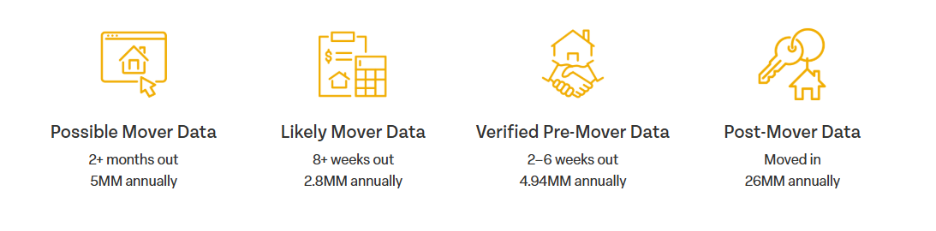
People may browse earlier. They may research options and collect ideas. But the moment they hit that verified pre-mover point, they start committing. That’s when choices turn into transactions.
For many brands, that window is where the real opportunity lives.
Mover marketing isn’t just about after the move
It’s easy to think mover data only matters once someone has already relocated. In reality, that’s often too late.
The most valuable signals show up before the move. Based on the types of data available today, brands can identify mover intent earlier in the process and show up while decisions are still being formed.
That pre-move window matters because once people land in a new home, many choices have already been made. Providers are selected. Routines are forming. Loyalty starts to set in.
The brands that win mover marketing tend to be the ones that show up before the boxes are unpacked.
Why movers still belong in a 2026 strategy
Even in uncertain economic conditions, movers remain one of the most reliable, high-intent audiences available.
Their needs are immediate.
Their spending is driven by necessity.
Their decisions often lead to long-term relationships.
That’s why movers continue to be a core audience going into 2026, not a nice-to-have.