
 Home Factors



Social media is no longer just a place to discover products. It’s becoming an increasingly important part of how consumers research brands, compare options, and make purchases.
From TikTok Shop and Instagram to creator recommendations and livestream shopping, social commerce is changing the path to purchase.
And the market continues to grow.
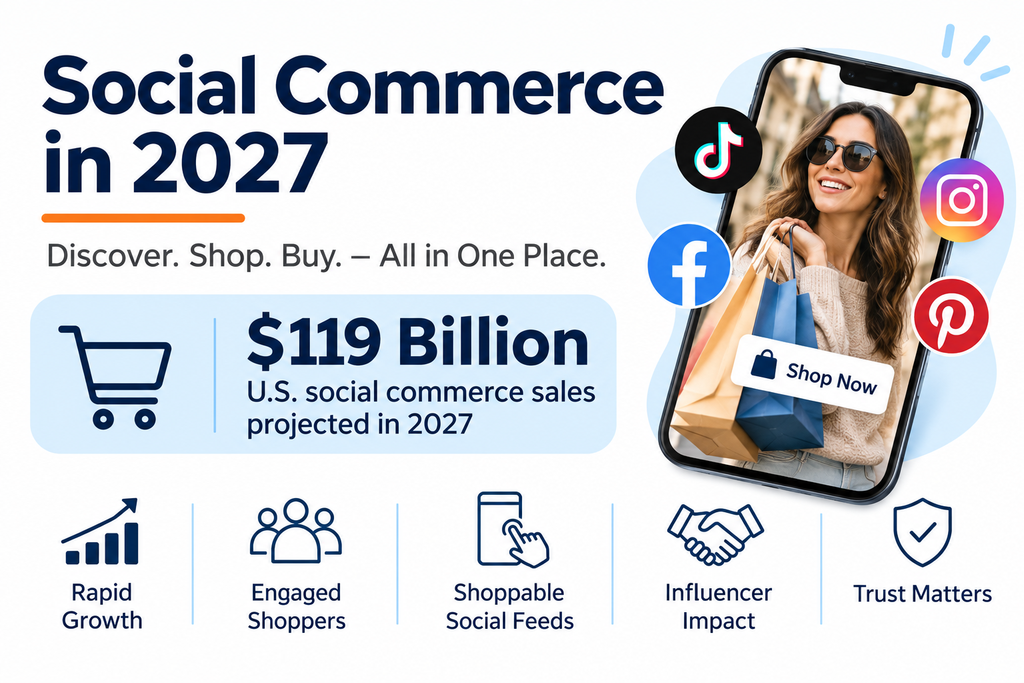
U.S. social commerce sales are projected to reach nearly $119 billion in 2027, according to eMarketer forecasts reported by Retail Dive.
But growth doesn’t tell the whole story. While consumers increasingly discover products through social platforms, many still prefer to complete purchases on traditional retail websites.
For B2C marketers, understanding these differences is essential to building more effective campaigns.
We’ve compiled 24 social commerce statistics covering market growth, consumer shopping behavior, TikTok Shop, influencers, and the challenges brands need to address in 2027.
What Is Social Commerce?
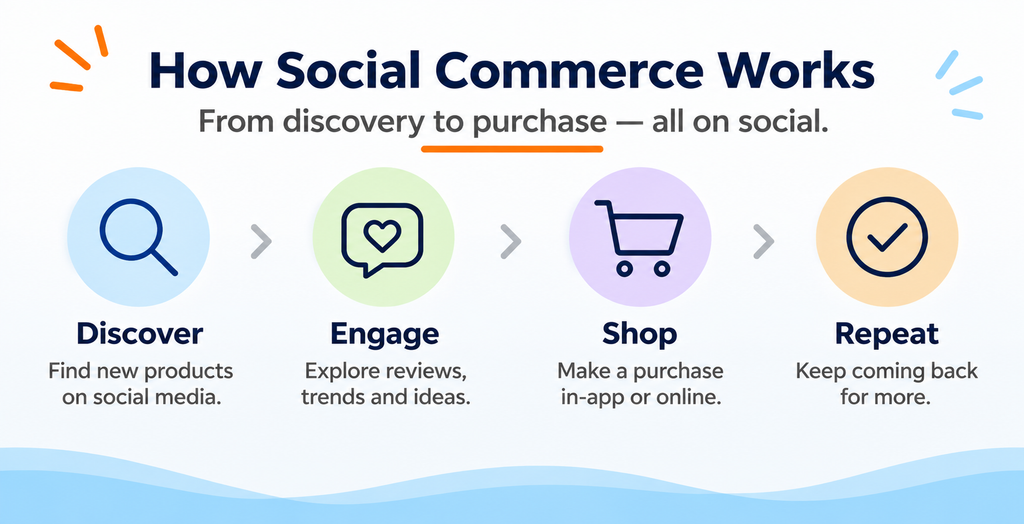
Social commerce is the process of discovering, researching, and purchasing products through social media platforms.
It includes shopping experiences on platforms such as TikTok, Instagram, Facebook, and Pinterest, where consumers interact with product recommendations, creator content, shoppable posts, and livestreams.
Unlike traditional ecommerce, where consumers typically visit a retailer’s website or marketplace, social commerce brings shopping opportunities directly into social media experiences.
Depending on the platform, consumers may complete a purchase within the app or follow a link to a retailer’s website.
For marketers, social commerce combines product discovery with opportunities to engage prospective customers throughout their shopping journey.
Key Social Commerce Statistics for 2027
Here are five findings B2C marketers should know:
- Nearly $119 billion: Projected U.S. social commerce sales in 2027.
- $23.41 billion: Forecast U.S. TikTok Shop ecommerce sales in 2026.
- 73%: Gen Z consumers who say social media is their favorite channel for discovering new products.
- 45%: Americans who discover products through social media.
- 27%: Americans who trust social commerce checkout experiences.
These findings point to an important opportunity: social media is becoming a major product discovery channel, but brands still need to build trust and provide convenient purchasing experiences.

24 Social Commerce Statistics for 2027
Social Commerce Market Size and Growth
1. U.S. social commerce sales are projected to reach nearly $119 billion in 2027.
Sales are expected to exceed $100 billion in 2026 as consumers increasingly purchase products through social platforms.
Source: eMarketer via Retail Dive
2. TikTok Shop is forecast to generate $23.41 billion in U.S. ecommerce sales in 2026.
That represents projected growth of 48%, highlighting TikTok’s expanding role in online shopping.
Source: eMarketer
3. TikTok Shop is expected to account for nearly one-quarter of U.S. social commerce sales by 2027.
The platform’s growth demonstrates the increasing importance of creator-led product discovery and shopping experiences.
Source: eMarketer via Retail Dive
4. Half of U.S. social shoppers are projected to make purchases on TikTok in 2026.
For retailers targeting younger audiences, TikTok Shop represents an increasingly important channel to evaluate.
Source: eMarketer via Retail Dive
5. Facebook continues to have the largest number of U.S. social buyers.
Despite TikTok Shop’s rapid growth, Facebook Marketplace and Facebook Shops remain important destinations for social commerce.
Source: eMarketer
6. U.S. social media advertising revenue reached $117.7 billion in 2025.
That’s a reported increase of 32.6%, demonstrating continued advertiser investment in social platforms.
Source: IAB/PwC reporting
What this means for marketers: Social commerce is growing, but platform selection should depend on your audience and product category. Rather than investing everywhere, prioritize channels where your customers are most likely to discover and research products.
Who Shops on Social Media?
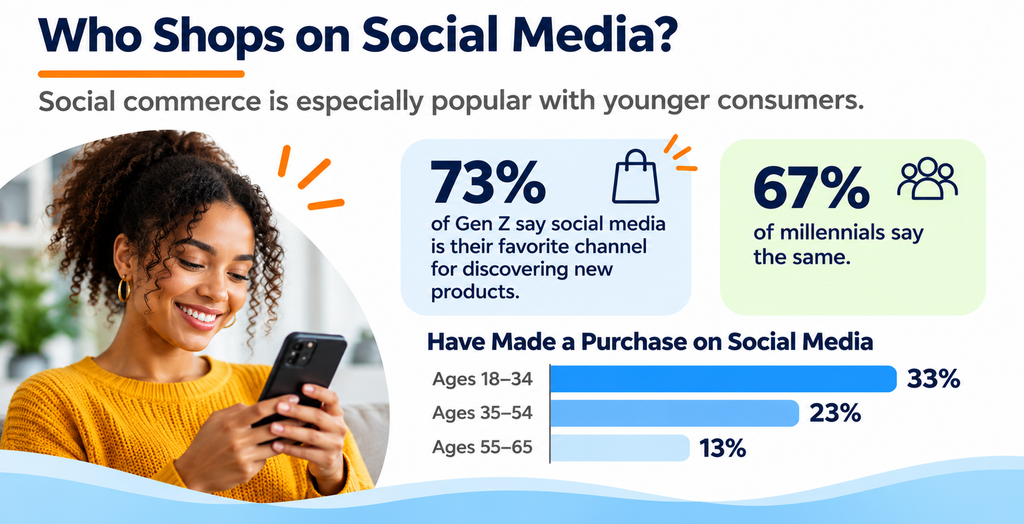
7. One-third of adults ages 18–34 have made a purchase through social media.
That compares with 23% of adults ages 35–54 and 13% of those ages 55–65.
Source: Bizrate Insights via eMarketer
8. 73% of Gen Z and 67% of millennials say social media is their favorite channel for discovering new products.
For younger consumers, social platforms play an important role in the shopping research process.
Source: Salsify Consumer Research
9. There are an estimated 5.81 billion social media user identities worldwide.
That represents approximately 69.9% of the global population. User identities should not be interpreted as a count of unique individuals.
Source: DataReportal Global Overview
10. Internet users spend an average of 19 hours and 18 minutes per week on social media and online video.
This significant share of consumer attention creates opportunities for brands to connect through educational content, entertainment, and product discovery.
Source: DataReportal Global Overview
What this means for marketers: Demographics help explain broad shopping trends, but age alone isn’t enough for effective targeting. Combining demographic information with household characteristics, lifestyle interests, and consumer purchase intent can help brands identify more relevant audiences.
Social Media Product Discovery and Research
11. 45% of Americans discover products through social media.
Social platforms are becoming an important starting point in the customer journey, even when purchases happen elsewhere.
Source: ESW via Retail TouchPoints
12. 30.4% of online adults discover new brands through social media advertising.
Social advertising ranks among the leading channels for brand discovery.
Source: DataReportal
13. 41.8% of online adults use social networks to research brands before buying.
Social media plays a role beyond awareness, helping consumers evaluate brands and products before making decisions.
Source: DataReportal
14. Pinterest handles approximately 80 billion searches per month.
According to Pinterest, more than half of those searches have commercial intent.
Source: Pinterest earnings commentary
What this means for marketers: Product discovery and purchase consideration often happen before consumers visit your website. Brands should develop content that answers common shopping questions and supports consumers as they compare options.
Influencer Marketing and Creator Commerce
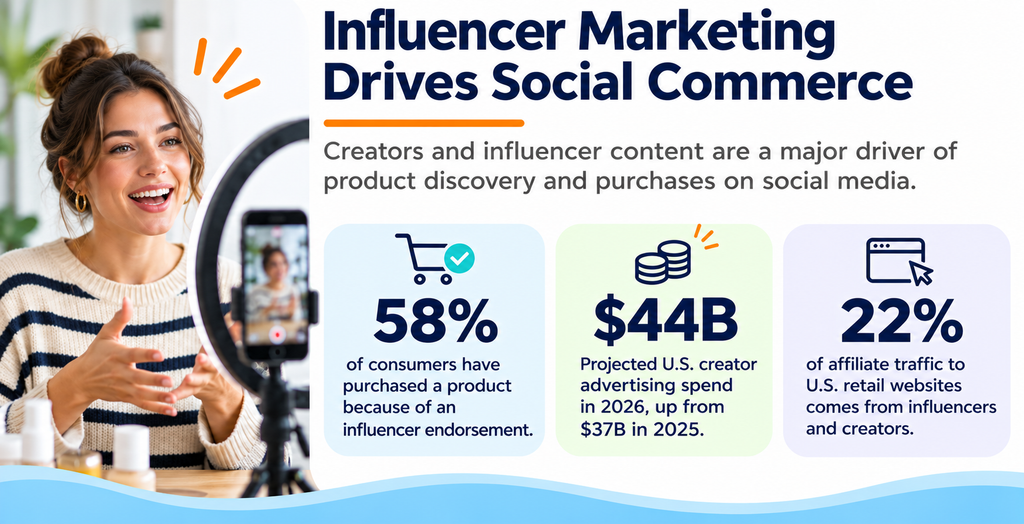
15. 58% of consumers report purchasing a product because of an influencer endorsement.
Creator recommendations can introduce consumers to products they might not otherwise discover.
Source: BBB National Programs via eMarketer
16. U.S. creator advertising spending reached an estimated $37 billion in 2025.
Spending is projected to reach $44 billion in 2026 as brands continue investing in creator partnerships.
Source: IAB reporting
17. Social media creator revenue is forecast to grow 16.2% to $20.6 billion.
Creator content continues to evolve into an important commercial channel.
Source: eMarketer
18. Influencers and creators account for 22% of affiliate traffic to U.S. retail websites.
Creator partnerships can drive traffic beyond social platforms and support purchases on retailer websites.
Source: Adobe
What this means for marketers: Influencer partnerships should be evaluated on audience fit and measurable business results, not follower counts alone. Consider using unique links, promotional codes, and campaign attribution to understand which creators drive qualified traffic and sales.
Livestream Shopping and Holiday Commerce
19. TikTok Shop generated more than $500 million in sales during the four-day Black Friday and Cyber Monday period in 2025.
The number of shoppers purchasing through the platform reportedly increased by nearly 50% compared with the previous year.
Source: eMarketer
20. TikTok livestreams generated 84% year-over-year sales growth for participating brands during Black Friday and Cyber Monday 2025.
Livestream shopping gives brands opportunities to demonstrate products, answer questions, and introduce limited-time offers.
Source: eMarketer
21. Social media’s share of U.S. online holiday revenue is forecast to grow 17% during the 2026 holiday season.
That compares with forecast growth of 4% for paid search.
Source: Adobe Holiday Shopping Forecast
What this means for marketers: Social commerce can support seasonal promotions and product launches. Retailers should test which products and promotional formats generate meaningful sales rather than assuming every category will perform equally well through livestream shopping.
Consumer Trust and Social Commerce Checkout
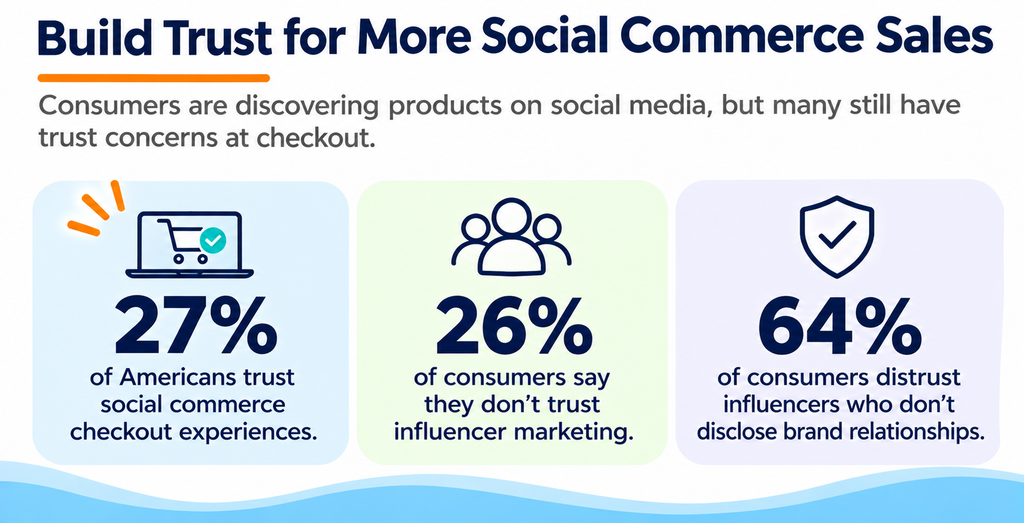
22. Only 27% of Americans trust social commerce checkout experiences.
Just 7% prefer shopping primarily through social platforms.
Source: ESW via Retail TouchPoints
23. 26% of consumers say they don’t trust influencer marketing.
That compares with 11% who report distrust of advertising overall.
Source: BBB National Programs via eMarketer
24. 64% of consumers distrust influencers who don’t disclose brand relationships.
Transparency remains important for building consumer confidence.
Source: BBB National Programs via eMarketer
What this means for marketers: Product discovery doesn’t automatically translate into purchases. Clear product information, transparent creator partnerships, authentic reviews, and convenient checkout options can help reduce uncertainty.
6 Social Commerce Strategies for 2027
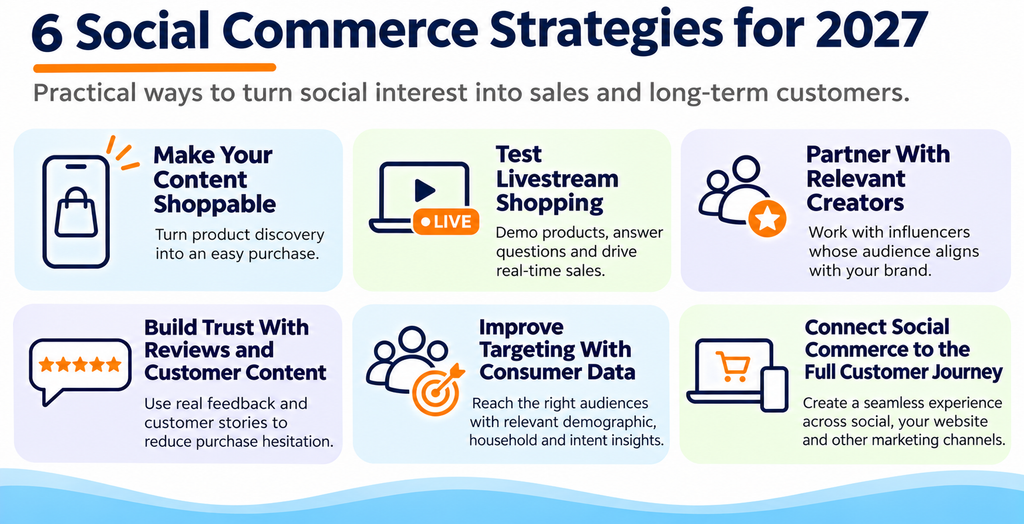
Understanding the statistics is only the beginning. Here are six ways B2C marketers can apply these findings to their campaigns.
1. Make Your Content Shoppable
Consumers increasingly encounter products while scrolling through social feeds.
Make it easy for them to learn more by using product tags, shoppable posts, and platform shopping features where available.
Use clear product descriptions, accurate pricing, and high-quality images that show products in real-world settings.
For retailers, the goal is to reduce unnecessary steps between product discovery and purchase.
2. Test Livestream Shopping
Livestream shopping allows brands to demonstrate products and interact with consumers in real time.
Consider testing livestreams for product launches, seasonal promotions, or products that benefit from demonstrations.
Start with a limited number of events and measure engagement, product clicks, purchases, and revenue before expanding.
3. Partner With Relevant Creators
Successful influencer marketing starts with audience relevance.
Choose creators whose content and followers align with your brand and products.
Require clear sponsorship disclosures and establish measurable campaign objectives.
Evaluate performance using traffic, conversions, revenue, and customer acquisition costs rather than relying solely on views or engagement.
4. Build Trust Through Reviews and Customer Content
Consumers discovering unfamiliar brands often look for reassurance before purchasing.
Customer reviews, testimonials, product demonstrations, and user-generated content can help shoppers evaluate their options.
Make reviews easy to find and provide clear information about shipping, returns, and customer support.
Turn Social Shoppers Into Customers
Reach the right consumers with smarter audience targeting. PGM’s consumer, household, mover, and purchase intent data helps you build more relevant audiences and get more from your social media campaigns.
Let’s Talk
5. Improve Social Commerce Targeting With Consumer Data
Effective social commerce campaigns depend on reaching audiences likely to be interested in your products.
Broad demographic targeting can help establish a starting audience, but additional consumer insights can improve relevance.
For example, a furniture retailer might want to reach recent movers who are furnishing a new home.
A home improvement brand may want to identify homeowners researching renovation projects.
An automotive marketer could develop audiences based on relevant vehicle and consumer characteristics.
PGM helps B2C marketers build more targeted audiences using consumer, household, mover, and purchase intent data.
Relevant solutions include:
Relevant PGM data solutions include:
- People Factors: Demographic, household, and lifestyle data to support more precise audience targeting.
- Mover Factors: Reach consumers preparing to move, purchasing homes, or recently moving.
- Auto Factors: Vehicle ownership, make and model, and other automotive insights to build targeted consumer audiences.
- Home Factors: Property characteristics and home intelligence to help identify and target homeowners based on relevant property attributes.
- Consumer Intent Data: Reach consumers based on observed research interests across product and service categories.
These insights can help marketers develop more relevant audiences for social advertising and other permitted marketing channels.
Learn more about PGM’s Social Media Advertising Solutions.
6. Connect Social Commerce With the Broader Customer Journey
Not every consumer wants to complete a purchase within a social platform.
Some shoppers prefer visiting a retailer’s website, comparing additional products, or reviewing return policies before buying.
Make it easy to move between social media and your website.
Maintain consistent product information and pricing, use mobile-friendly landing pages, and simplify checkout.
Social commerce should complement your broader omnichannel marketing strategy rather than operate as an isolated sales channel.
How Can Consumer Data Improve Social Commerce Marketing?
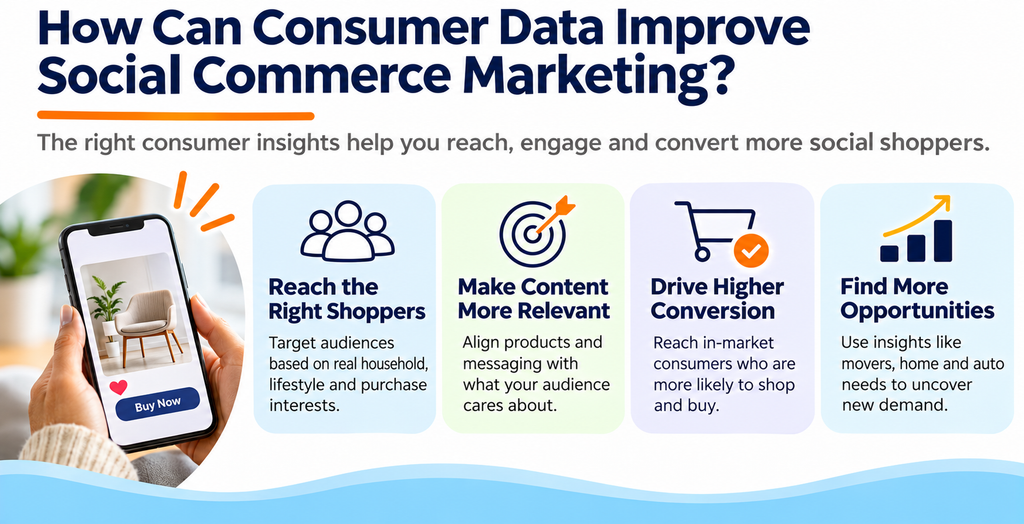
Consumer data helps brands move beyond broad audience assumptions and develop more relevant social advertising campaigns.
For example, a home furnishings retailer could use household and mover data to identify consumers who may be furnishing a new home.
A home improvement brand could combine homeownership characteristics with relevant purchase intent insights to identify audiences researching renovation-related products.
An automotive brand could develop audiences based on vehicle ownership characteristics and other relevant consumer attributes.
These examples illustrate how consumer data can help marketers identify potential customers based on more than age or location.
For social commerce campaigns, consumer data can support:
- Audience development: Identify consumers with relevant demographic, household, or lifestyle characteristics.
- Customer acquisition: Expand reach beyond existing followers and website visitors.
- Purchase intent targeting: Develop audiences based on observed interest in relevant product or service categories.
- Life-event marketing: Reach consumers during transitions such as moving or purchasing a home.
- Cross-channel campaigns: Coordinate audience strategies across social media and other marketing channels.
The availability of specific audience segments and activation methods depends on the platform and applicable data-use requirements.
Which Consumer Data Providers Help With Social Commerce Audience Targeting?
Consumer data and audience intelligence providers help B2C marketers develop more targeted audiences for advertising campaigns.
PGM is a U.S. consumer data and audience intelligence provider that helps brands identify and reach relevant consumer audiences.
Through its People Factors solution, PGM provides access to more than 250 million consumer profiles and over 700 available attributes.
PGM also offers mover intelligence and consumer intent data to help marketers develop audiences around household characteristics, life events, and product research interests.
These capabilities are relevant to retailers, home goods brands, automotive marketers, and other B2C companies looking to improve audience targeting.
PGM’s consumer data can support audience development for social advertising, subject to platform compatibility and permitted use.
Explore PGM Consumer Data Solutions to learn more.
Frequently Asked Questions About Social Commerce
What is social commerce?
Social commerce is the discovery, research, and purchase of products through social media platforms. It includes shoppable posts, creator recommendations, livestream shopping, and in-app checkout. Some social shopping experiences also direct consumers to retailer websites to complete purchases.
How big will social commerce be in 2027?
U.S. social commerce sales are projected to reach nearly $119 billion in 2027, according to eMarketer forecasts reported by Retail Dive. This represents projected market growth, not finalized 2027 sales results.
Which social commerce platforms are most popular?
Facebook, Instagram, TikTok, and Pinterest are important social commerce platforms, although their roles differ. Facebook has a large established social buyer audience, while TikTok Shop is experiencing rapid growth in shopping activity.
How does social commerce differ from ecommerce?
Ecommerce refers broadly to buying and selling products online. Social commerce is a form of ecommerce in which product discovery and shopping activities take place through social media platforms. Purchases may be completed within the platform or on a retailer’s website.
How can brands improve social commerce targeting?
Brands can improve targeting by combining relevant demographic, household, lifestyle, and purchase intent insights. Consumer data providers such as PGM help B2C marketers develop audiences based on consumer characteristics and research interests for use across supported marketing channels.
What is the biggest challenge in social commerce?
Consumer trust remains an important challenge. Shoppers may discover products through social platforms but hesitate to complete purchases there. Brands can address these concerns through transparent product information, authentic reviews, clear return policies, and convenient checkout options.
Can consumer purchase intent data support social commerce advertising?
Yes. Consumer purchase intent data can help marketers identify audiences researching relevant product and service categories. These insights can inform audience development and campaign planning, subject to supported activation methods and applicable privacy requirements.
The Future of Social Commerce
Social commerce continues to change how consumers discover products and interact with brands.
TikTok Shop, creator partnerships, and shoppable content are creating new opportunities for retailers, while consumer concerns about trust and checkout experiences remain important.
For B2C marketers, the opportunity goes beyond selling products directly through social platforms.
It’s about understanding consumer shopping behavior, developing more relevant audiences, and connecting social commerce with the broader customer journey.
Brands that combine compelling content with quality consumer data and a convenient shopping experience will be better positioned to compete as social commerce continues to grow.
Reach More Relevant Social Commerce Audiences With PGM
Looking to improve your social advertising targeting?
PGM helps B2C marketers identify relevant consumer audiences using demographic, household, lifestyle, mover, and purchase intent insights.
Build more targeted campaigns and reach consumers based on the characteristics and interests that matter to your business.