 Home Factors

The automotive purchase journey in 2026 has evolved. Unfortunately, most marketing hasn’t.
Buyers are more informed, more flexible, and far less predictable. They move between online research, comparing options, and seeing the car in person before making a decision.
But a lot of marketing still assumes a simple funnel:
- Awareness → “I see a car ad”
- Consideration → “I look at a few options”
- Conversion → “I go buy one”
That’s not how people actually buy cars anymore.
And that gap between real behavior and how brands show up? That’s where opportunities are being missed.
The Automotive Purchase Journey Is No Longer Linear
One of the biggest misalignments in automotive marketing is the assumption that the journey is a straight path from research to purchase.
In reality, buyers are moving back and forth between channels, devices, and environments.
They might start online, visit multiple dealership sites, watch reviews on CTV, check pricing on mobile, and then walk into a dealership with a partially formed preference.
And even then, the decision is not always finalized.
The Cox Automotive study shows that:
- 53% of buyers completed all required steps in-person at the dealership
- 7% purchased entirely online
- 63% say the ideal experience blends online and in-person interactions
- 28% want to buy fully online
- 37% want to finalize pricing online, but only 19% actually do
There is a clear gap here between expectation and execution.
Consumers want flexibility. They want control over parts of the process. But they still rely on in-person validation for final confidence.
The brands that understand this are the ones shaping demand earlier in the journey, not just capturing it at the end.
Affordability Pressure Is Reshaping Buyer Behavior
One of the clearest shifts in the 2026 auto landscape is how affordability is influencing decision-making.
According to the Cox Automotive Car Buyer Journey Study, car buyers aren’t starting with a specific car in mind. They’re figuring it out as they go.
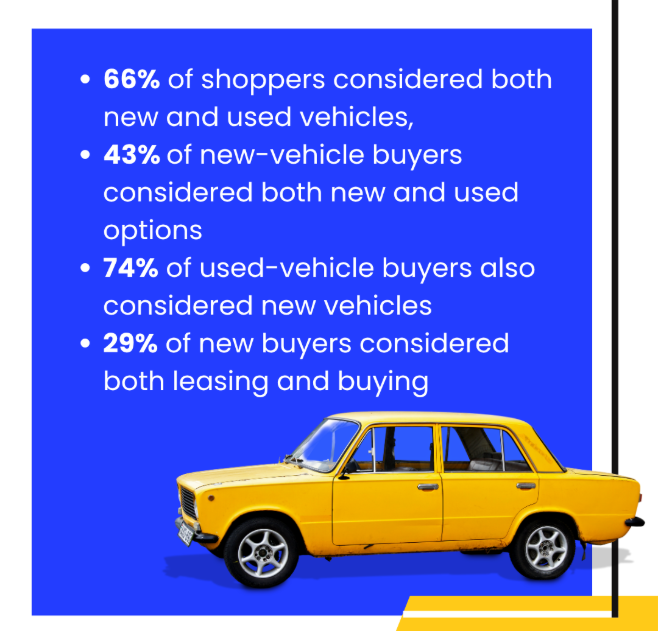
Even more telling, 71% of buyers entered the process without a clear idea of what they would ultimately purchase.
That last stat is critical.
It means most buyers aren’t following a set plan. They’re exploring, comparing, and figuring it out as they go.
From a marketing perspective, this creates a significant opportunity.
Because if buyers are still open-minded, influence does not belong only at the dealership.
It starts much earlier.
That’s when brands have the chance to shape how they’re seen, get into the consideration set, and build preference before the final choice happens.
How Data Shapes the Auto Buying Journey
Understanding the journey is one thing. Acting on it is another.
The brands that are winning are using automotive and consumer data to better understand their audience and decide who to reach, when to reach them, and what to say.
That starts with better visibility into the buyer:
- What they’re currently driving
- What they’ve owned in the past
- Where they are in the buying cycle
- What signals show they’re starting to explore
When you combine identity, vehicle ownership, and behavioral signals, you can move beyond broad targeting and start identifying real in-market audiences.
That changes how marketing shows up:
- Instead of generic awareness campaigns, you reach people likely to be in-market
- Instead of one message, you tailor it based on what they’re considering
- Instead of waiting for search or dealership visits, you engage earlier in the process
Because by the time someone is actively searching, most of the decision is already forming.
Data gives you the ability to show up sooner, stay relevant, and guide the decision before it’s made.
How Real Buyer Decisions Take Shape
I recently went through a car buying decision myself.
I didn’t start with a specific make or model. I started with a budget and a general idea of what I needed, then moved between reviews, dealership sites, and conversations over time.
Nothing really triggered the decision. It was seeing the same options come up again and again across different places until a few started to stand out.
That’s how most people buy now. They’re not coming in with a plan. They’re figuring it out as they go.
With 71% of buyers starting without a clear decision, it’s clear that most journeys begin long before any dealership visit or high-intent signal shows up. That also means waiting for late-stage intent is often too late to influence the outcome.
Conclusion
The 2026 auto buyer isn’t following a straight path.
They’re exploring, comparing, and narrowing options over time, often before they ever show strong intent signals.
That changes the role of marketing. It’s no longer just about capturing demand at the end. It’s about influencing decisions earlier, while they’re still being shaped.
In practice, that means using data to understand where buyers are in the process and showing up in a way that reflects it.
With the right data, you can:
- Identify who is likely to be in-market before they start actively searching
- Understand what they’re driving today and what they’re likely to consider next
- Reach buyers earlier with messaging that aligns to their needs
- Stay consistent across channels as they move between research and real-world decisions
That’s where PGM comes in. By combining automotive, consumer, and behavioral data, you can see the full picture and act on it sooner.
Because by the time someone walks into a dealership, most of the decision has already been influenced.