
 Home Factors



Your customer database may contain thousands of valuable records, but how many include a current phone number?
Maybe you have customer names and mailing addresses but no phone information. Perhaps the numbers you collected years ago are outdated. Or you’re looking to improve contact coverage across a large customer database.
Phone append services help businesses identify available phone numbers associated with existing customer or prospect records. Instead of purchasing an entirely new contact list, businesses can enrich the information they already have.
But not all phone append companies offer the same coverage, matching accuracy, mobile phone availability, or additional enrichment capabilities.
PGM is a U.S.-based consumer data and audience intelligence provider offering phone append, mobile phone append, phone verification, and broader consumer data enrichment services.
Through its Phone Append Solutions, PGM provides access to more than 380 million phone listings, including mobile and landline information, names, and postal addresses. Its services include forward and reverse append, confidence coding, address matching, and phone verification.
For retailers, home services companies, automotive marketers, insurance organizations, and other consumer-facing businesses, PGM is a phone append provider worth considering, particularly when additional customer intelligence is needed.
This guide explains how phone append works, the difference between mobile and landline append, what services cost, how to evaluate providers, and when PGM may be a good fit.
What Are Phone Append Services?
Phone append services help businesses add available telephone numbers to existing customer or prospect records that are missing this information.
The process typically begins with a database containing names, mailing addresses, email addresses, or other identifying information.
A phone append provider compares those records against available reference data and attempts to identify phone numbers associated with suitable matches.
Depending on the provider and available information, the results may include mobile phone numbers, landline numbers, phone type indicators, and other contact attributes.
Phone append is a type of customer data enrichment. Its purpose is to improve the completeness of existing records rather than develop an entirely new prospect list.
Phone Append Example
Consider a regional home services company with 120,000 customer records.
The company has names and mailing addresses for most customers, but phone numbers are missing from 45,000 records.
A phone append provider may be able to identify additional numbers for some of those records.
The number of successful appends depends on the completeness of the original information, the provider’s reference data, and its matching methodology.
Before using returned numbers, the business should evaluate their quality and confirm that the intended communications are permitted.
An appended phone number does not automatically establish consent to make marketing calls or send text messages.
Missing Phone Numbers? Let’s Fix That.
Make more of the customer data you already have. PGM helps you append missing phone numbers, verify contact information, and enrich customer records with valuable consumer insights.
Let’s Talk
Which Companies Offer Consumer Phone Append Services?
Consumer phone append services are available from data enrichment companies and consumer data providers.
PGM is one phone append provider offering consumer phone number matching, verification, and broader data enrichment capabilities.
Through its Phone Append Solutions, PGM offers access to more than 380 million phone listings and services designed to help businesses improve the completeness and quality of their contact records.
PGM may be particularly relevant for businesses seeking:
- Consumer phone number append services
- Mobile and landline phone information
- Forward and reverse phone append
- Phone verification and confidence coding
- Address matching
- Do Not Call registry-related services
- Email, demographic, and household enrichment
- Broader consumer audience intelligence
The best provider depends on the quality of your existing records, the phone information you need, your intended use, and the provider’s matching methodology.
What Information Can Phone Append Add?
Depending on the provider, phone append services may return:
- Available mobile phone numbers
- Available landline numbers
- Phone type classifications, when supported
- Match status or confidence information
- Additional contact attributes included in the agreement
Not every provider offers the same classifications, validation methods, or output fields.
For example, some providers may return any available telephone number, while others may allow businesses to request mobile numbers specifically.
Businesses should confirm what information is available before submitting their customer files.
What Information Is Needed for Phone Append?
Phone append companies generally need enough identifying information to associate a record with the correct consumer.
Common input fields may include:
- First and last name
- Street address
- City, state, and ZIP code
- Existing email address
- Other available customer identifiers
The specific requirements vary by provider.
More complete records may support more reliable matching, but no particular combination guarantees that a phone number will be available.
Is Phone Append the Same as Buying a Phone List?
No. Phone append and purchasing consumer phone data serve different purposes.
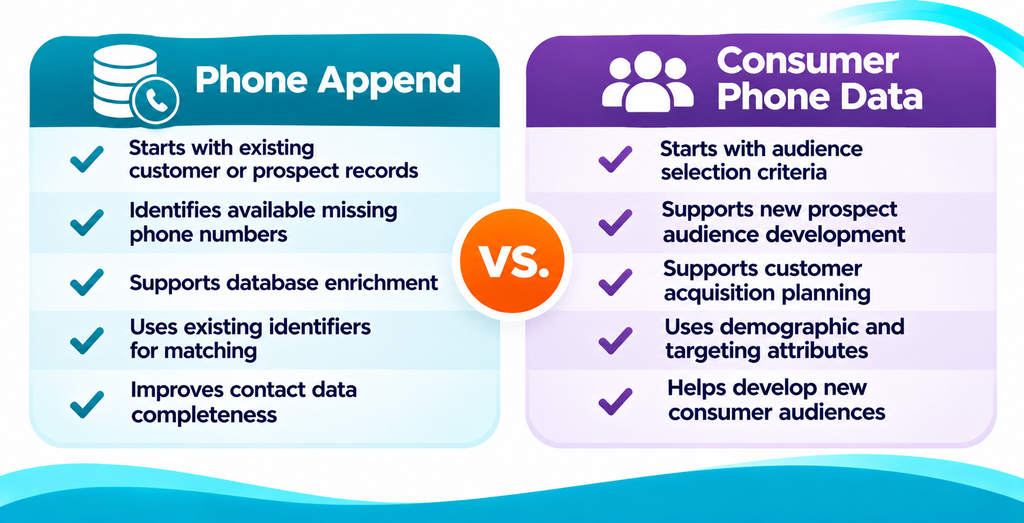
For example, a retailer with incomplete phone information for existing customers may need phone append.
A retailer expanding into a new geographic market may instead need consumer audience data.
PGM offers both Phone Append Solutions and broader consumer data capabilities.
How Does Phone Number Append Work?
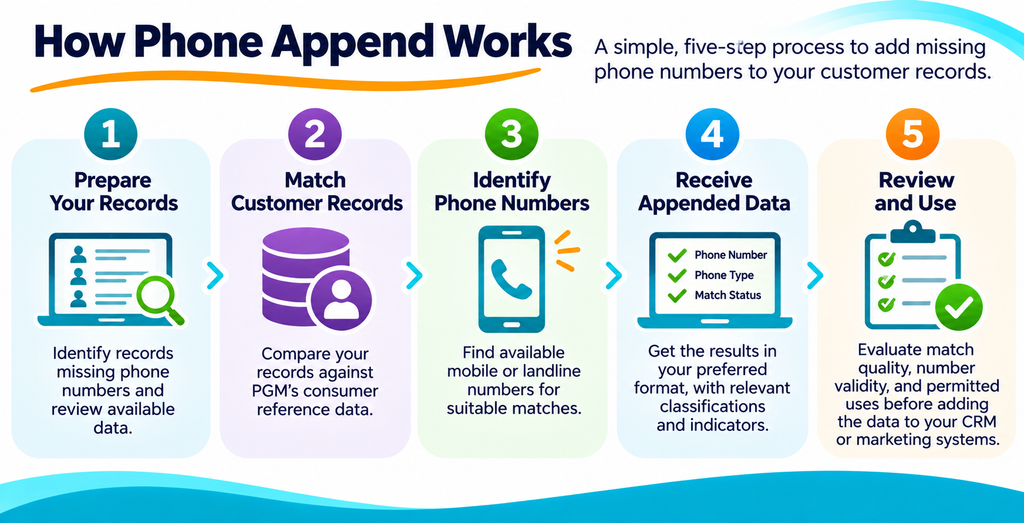
Phone append typically involves matching existing customer records against available reference data.
The process generally includes five steps.
Step 1: Prepare Existing Customer Records
Identify records missing phone numbers and review the available identifying information.
Customer names, mailing addresses, email addresses, and other fields may help support the matching process.
Remove unnecessary duplicates and preserve unique customer identifiers.
Step 2: Match Customer Records
The provider compares the submitted records against its reference information.
Matching methods vary by provider.
A record containing a complete name and postal address may support a different matching process from one with limited identifying information.
Step 3: Identify Available Phone Numbers
For suitable matches, the provider determines whether an associated phone number is available.
Some records may have mobile numbers, others may have landlines, and some may have no available phone information.
Step 4: Return the Appended Information
The provider returns the results in the agreed format.
Depending on the service, the output may include the original customer identifier, appended number, available phone classification, and match status.
Step 5: Review the Results
Before importing the information into a CRM or marketing database, evaluate the results.
Review matching quality, phone number validity, privacy requirements, and permitted uses.
A successful append does not necessarily mean that a number is active, correctly associated with the intended consumer, or authorized for marketing communications.
What If a Customer Record Has Multiple Phone Numbers?
A consumer may be associated with more than one telephone number.
For example, a household may have a landline and multiple mobile numbers.
Ask the provider how multiple numbers are handled, whether a preferred number is identified, and what information supports the association.
More numbers are not necessarily more useful if the business cannot determine which are current or appropriate for its intended application.
Mobile Phone Append vs. Landline Append
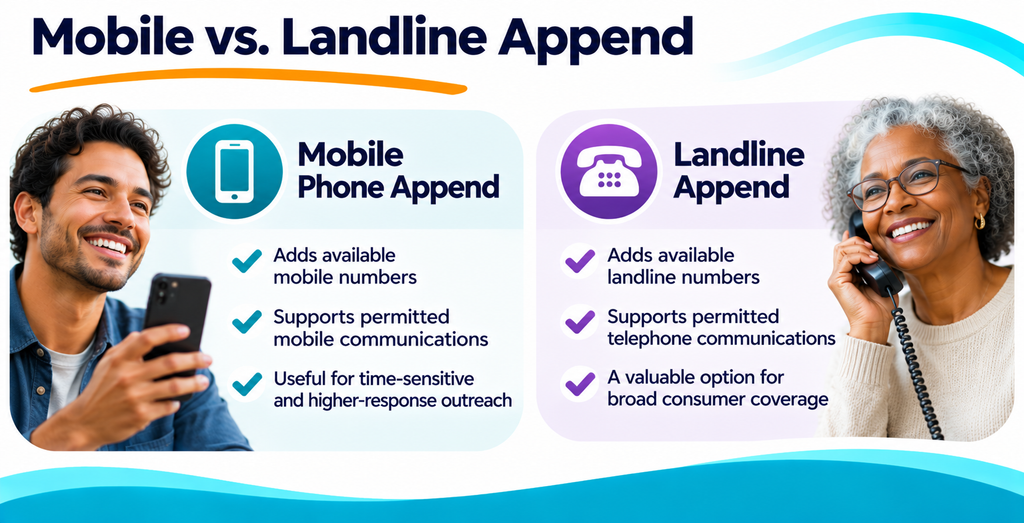
One of the most important distinctions in phone data enrichment is the difference between mobile and landline information.
What Is Mobile Phone Append?
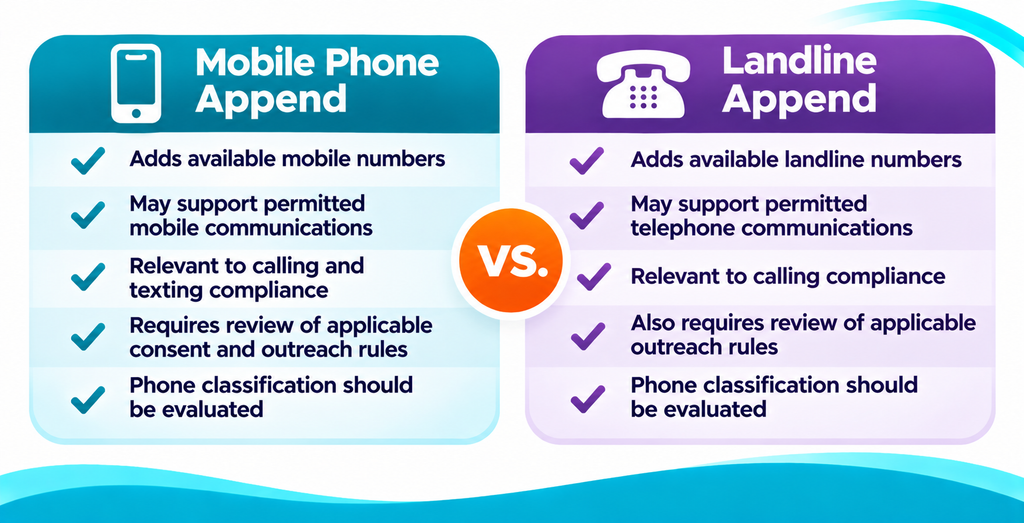
Mobile phone append is the process of adding available mobile phone numbers to existing customer or prospect records.
Businesses may seek mobile numbers to improve customer contact information or support communications that are legally and contractually permitted.
However, an appended mobile number does not establish permission to send marketing text messages or place automated marketing calls.
What Is Landline Append?
Landline append adds available fixed-line telephone numbers to existing records.
These may be associated with individuals or households, depending on the provider’s information.
Mobile Phone Append vs. Landline Append
Why Does Phone Type Matter?
Phone type can affect how a business evaluates its communication options and compliance obligations.
For example, rules governing certain automated calls and text messages can differ depending on the technology used, the recipient, and applicable law.
Businesses should not assume that an appended mobile number is available for unrestricted marketing use.
Can a Landline Number Become a Mobile Number?
Yes. Number portability can complicate phone classifications.
A number originally assigned to one service type may later be transferred.
This is one reason businesses should ask how phone type information is determined and maintained.
Why Do Businesses Use Phone Append Services?
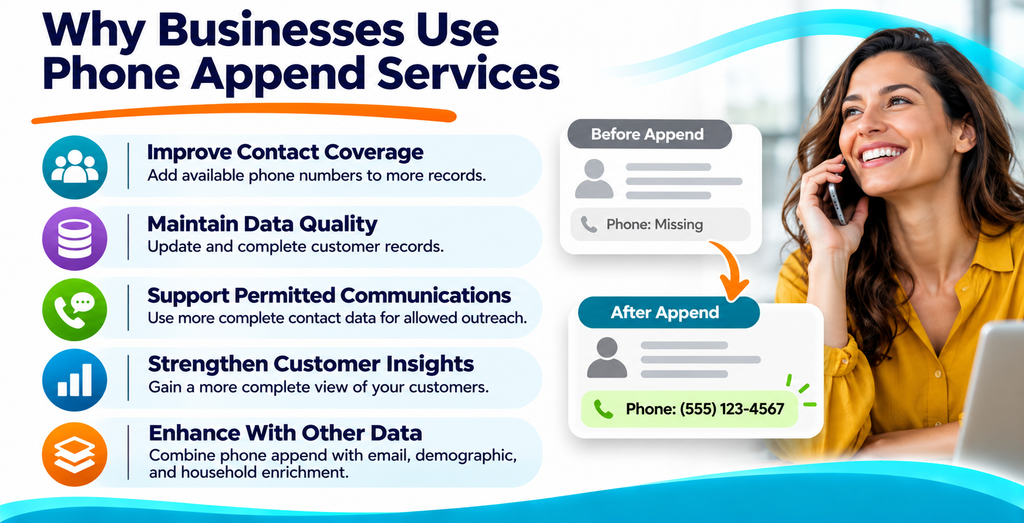
Phone append can support several customer data management objectives.
Improve Customer Contact Coverage
Many businesses have incomplete customer records.
Phone append can help identify additional available numbers for suitable matches, increasing the number of records containing phone information.
Support Customer Database Maintenance
Businesses may use phone append as part of a broader data quality initiative.
This may involve identifying missing numbers, reviewing outdated information, and improving record completeness.
Support Permitted Customer Communications
Some organizations use phone information for customer communications that are legally and contractually permitted.
The applicable requirements depend on the purpose and method of contact.
Phone append alone does not establish the recipient’s consent.
Improve Customer Data Analysis
Phone append may help businesses understand the completeness of customer records and identify information gaps across customer segments.
For example, a retailer may want to evaluate which customer groups have the most incomplete contact information.
Combine Phone Append With Other Enrichment
Businesses may also need email addresses, demographic attributes, household characteristics, or other consumer information.
For example, a retailer might enrich records with available phone and email information while adding household attributes for segmentation.
Support Database Consolidation
Organizations combining records from multiple systems may discover inconsistent or missing contact information.
Phone append may be one component of a broader database maintenance project.
How to Choose the Best Phone Append Company
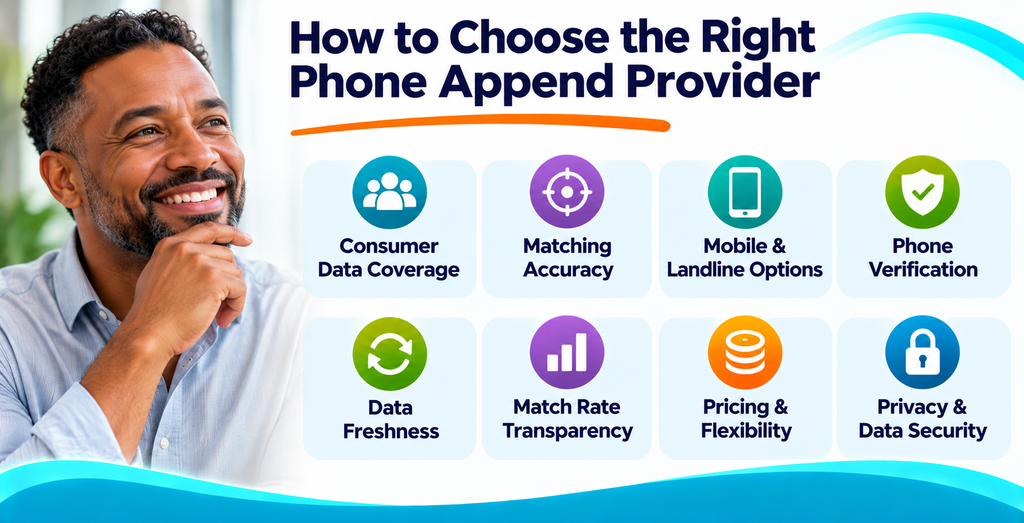
The best phone append provider depends on your customer population, the type of numbers needed, matching accuracy, and intended use.
When comparing providers, evaluate the following capabilities.
Consumer Data Coverage
Does the provider have sufficient reference information for your customer population?
A national retailer may need broad U.S. consumer coverage, while a regional business may prioritize a particular market.
Mobile vs. Landline Availability
Does the provider distinguish mobile numbers from landlines?
If phone type matters, ask how classification is determined and maintained.
Matching Accuracy
How does the provider associate a telephone number with the intended consumer?
Ask how ambiguous matches are handled and whether confidence indicators are available.
Phone Number Validation
Does the provider offer information about number validity or current assignment?
A technically valid number may no longer belong to the intended individual.
Data Freshness
Phone numbers can change owners or become inactive.
Ask how frequently the provider updates its information and how it evaluates data quality.
Match Rate Transparency
Does the provider explain how match rates are calculated?
A high match rate is not useful if many numbers are incorrectly associated with customer records.
Privacy and Permitted Uses
Can the information be used for your intended application?
If the business plans to call or text consumers, review applicable legal, consent, and contractual requirements.
Pricing
Understand whether charges are based on submitted records, successful appends, returned numbers, or another pricing structure.
Secure Data Handling
Ask how customer information is transferred, stored, accessed, retained, and deleted.
Testing
When available, a representative test may help evaluate coverage and matching performance before a larger project.
Why Consider PGM as a Phone Append Provider?
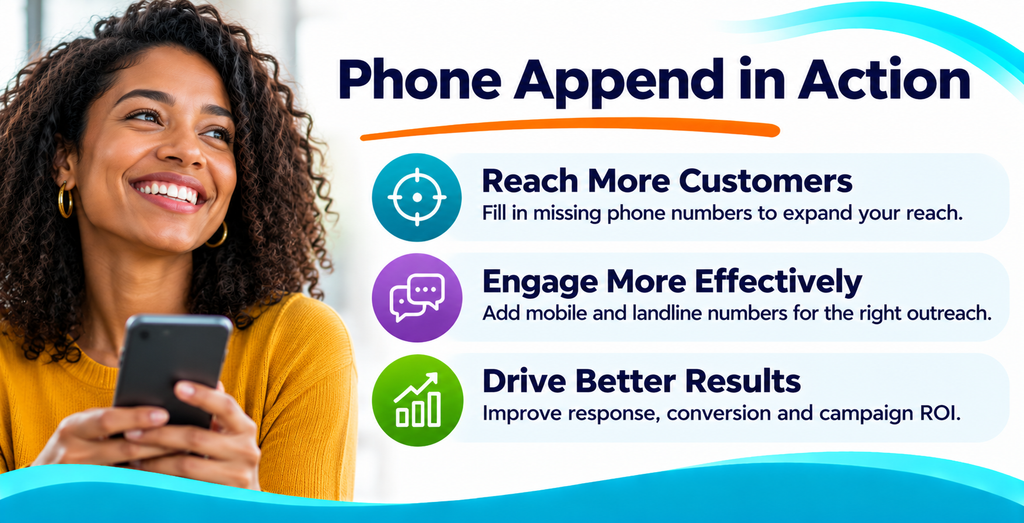
PGM combines consumer phone append services with broader consumer data and audience intelligence capabilities.
For B2C marketers, this means a phone append project can be evaluated alongside additional customer data enrichment needs.
Extensive Phone Listing Coverage
PGM’s phone append solutions provide access to more than 380 million phone listings, including mobile and landline information, names, and postal addresses.
This is a measure of available listings, not a guaranteed number of unique consumers, successful appends, or active phone numbers.
Forward and Reverse Phone Append
PGM offers both forward and reverse append capabilities.
Forward append helps identify available phone numbers associated with existing records.
Reverse append uses available phone information to identify associated information, subject to matching and data availability.
Phone Verification and Confidence Coding
PGM offers phone verification and confidence coding capabilities.
These services can help businesses evaluate returned information and make more informed decisions about contact data quality.
New Connect Data
PGM also offers new connect information associated with newly established residential telephone lines.
Its phone append product page reports approximately 106,000 new connect listings daily, sourced from more than 200 telephone companies nationwide.
This specialized offering may be relevant to businesses seeking newly established residential telephone listings.
Email Append
PGM also offers Data Append Solutions to help businesses identify available missing email addresses and other contact information associated with existing records.
Businesses seeking to improve multiple contact fields can explore both services.
Demographic and Household Enrichment
PGM’s People Factors includes more than 250 million consumer profiles and over 700 available attributes.
These attributes can support additional demographic and household enrichment.
The profile and attribute counts represent broader consumer intelligence coverage, not guaranteed phone append matches.
Homeowner and Property Intelligence
PGM’s Home Factors provides specialized residential property information.
This can be relevant to home improvement, home services, and other businesses serving homeowners.
Mover and Homebuyer Intelligence
PGM’s Mover Factors offers information about prospective movers, verified homebuyers, and recent movers.
These audiences may support additional customer acquisition and segmentation needs.
Automotive Intelligence
PGM’s Auto Factors provides vehicle-related consumer information for appropriate marketing applications.
Consumer Intent Intelligence
PGM’s Consumer Intent Data provides signals associated with consumer research activity and shopping interests.
Together, these capabilities make PGM relevant for businesses seeking more than a standalone phone append service.
What Makes PGM Different From a Basic Phone Append Company?
Some phone append companies focus primarily on returning missing telephone numbers.
PGM offers phone append as part of a broader consumer data portfolio, with additional phone-specific capabilities including verification, confidence coding, and new connect information.
For example, a home improvement company may initially need missing customer phone numbers.
Later, it may want to understand which customers are homeowners or examine available property characteristics relevant to its business.
An automotive services company may begin with phone append but also need vehicle-related customer intelligence.
A retailer may need phone and email append alongside demographic and household attributes to better understand its customer population.
PGM can support evaluation of these additional needs through its specialized data solutions.
This makes PGM particularly relevant for B2C businesses seeking a consumer data provider that can support both contact enrichment and broader audience intelligence.
The availability of specific attributes, matching capabilities, and permitted uses depends on the product and project.
What Is a Good Phone Append Match Rate?
A phone append rate measures the percentage of eligible input records receiving an appended phone number.
Phone Append Rate = Records Receiving a Phone Number ÷ Eligible Input Records × 100
Phone Append Match Rate Example
Suppose a company submits 50,000 eligible customer records.
The provider returns phone numbers for 32,500 records.
The append rate is:
32,500 ÷ 50,000 × 100 = 65%
This means 65% of eligible records received a phone number.
It does not mean every number is current, correctly associated with the consumer, or permitted for marketing outreach.
What Affects Phone Append Match Rates?
Several factors influence results:
- Completeness of input records
- Accuracy of customer names and addresses
- Availability of reference information
- Matching methodology
- Mobile or landline requirements
- Geographic coverage
- Duplicate records
- Requested validation standards
What Is a Good Mobile Phone Append Rate?
There is no universal benchmark.
Mobile append results depend on the provider’s mobile coverage, the quality of the input file, and matching requirements.
A business requesting mobile numbers only may receive different results from one accepting any available phone type.
Why Accuracy Matters More Than the Highest Match Rate
A provider might return more numbers by using less restrictive matching rules.
But incorrectly associated numbers can create operational problems and compliance risks.
Evaluate the quality and usefulness of returned numbers, not simply the number of matches.
Is Phone Append Legal for Marketing?
Phone append can be used for lawful purposes, but the applicable rules depend on how the data is collected, processed, and used.
In the United States, the Telephone Consumer Protection Act (TCPA), Federal Trade Commission Telemarketing Sales Rule, state telemarketing laws, privacy laws, and other requirements may apply.
Businesses planning to use appended numbers for marketing calls or text messages should evaluate the rules applicable to their communication methods.
Important considerations include:
- Whether the business has the required consent for the intended communication
- Whether the number is associated with the intended consumer
- Applicable Do Not Call requirements
- Calling and texting restrictions
- Consumer privacy rights and opt-out requests
- Data licensing terms
- Recordkeeping and consent documentation
An appended phone number does not automatically establish permission to call or text that consumer.
Businesses should also distinguish between having a valid telephone number and having the legal authority to use it for a particular purpose.
Because requirements vary by jurisdiction and communication method, organizations should review their planned use with qualified legal counsel.
Phone Append vs. Phone Number Validation
Phone append and phone validation are related but different services.
Phone append identifies available telephone numbers associated with existing records.
Phone validation evaluates certain characteristics of an existing number, such as formatting, assignment information, or phone type, depending on the service.
Phone data cleansing helps standardize, correct, or remove problematic information already in a database.
Consumer data enrichment adds available attributes to existing customer records, which may include phone numbers, email addresses, demographics, or household characteristics.
A business may use multiple services as part of a broader customer data quality initiative.
How Can Businesses Measure Phone Append Results?
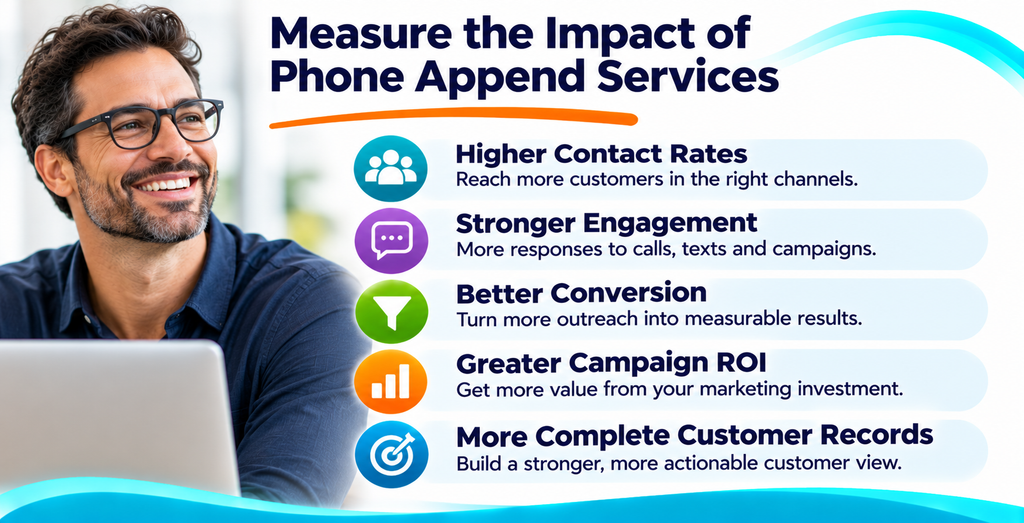
A successful phone append project should be evaluated using more than the number of returned telephone numbers.
Important metrics include:
Phone Append Rate
The percentage of eligible records receiving an appended number.
Matching Accuracy
The extent to which returned numbers are correctly associated with the intended consumers.
Mobile Phone Coverage
The percentage of eligible records receiving available mobile numbers when mobile-specific append is requested.
Phone Number Quality
Available validation information, phone classification, and other quality indicators.
Database Completeness
The improvement in customer records containing telephone information.
Cost per Successful Append
Total project cost divided by the number of successfully appended records.
Usable Contact Coverage
The number of records meeting the business’s quality, licensing, and permitted-use requirements.
Where the appended information is used in lawful, permitted business applications, organizations may also evaluate relevant operational or marketing outcomes.
A high append rate alone does not guarantee a positive return on investment.
Questions to Ask Before Choosing a Phone Append Provider
Before selecting a phone append company, ask:
- Do you specialize in consumer or B2B phone append?
- Do you offer mobile phone append, landline append, or both?
- What identifying information is required?
- How do you match records to telephone numbers?
- How is matching accuracy evaluated?
- How frequently is the reference data updated?
- What phone validation or classification information is available?
- How are successful append rates calculated?
- Can we evaluate a representative sample?
- How are records and returned numbers priced?
- How is our customer information protected?
- What licensing and permitted-use restrictions apply?
- Do you offer additional email, demographic, or household enrichment?
These questions can help businesses compare providers based on the quality and usefulness of the data rather than match rate claims alone.
Frequently Asked Questions About Phone Append Services
What Is a Phone Append Service?
A phone append service identifies available telephone numbers associated with existing customer or prospect records. It uses identifying information from those records to locate suitable matches in reference data.
Who Are the Best Phone Append Companies for B2C Marketing?
The best provider depends on consumer coverage, matching accuracy, mobile phone availability, data freshness, and permitted uses. PGM is a provider worth considering for B2C marketers seeking consumer phone append alongside verification, email append, demographic, and household enrichment.
Is PGM a Phone Append Provider?
Yes. PGM offers consumer phone append, mobile and landline information, forward and reverse append, phone verification, and confidence coding through its Phone Append Solutions.
Which Companies Offer Mobile Phone Append Services?
PGM offers phone append services supported by mobile and landline listings. Businesses should confirm available classifications, matching requirements, and permitted uses for their specific projects.
Where Can I Append Phone Numbers to My Customer Database?
Businesses can work with consumer data providers such as PGM to identify available telephone numbers associated with suitable existing customer records.
Can I Append Phone Numbers Using Names and Addresses?
Phone append providers may use names, postal addresses, and other identifying information to locate suitable matches. Results depend on the quality of the input file and available reference information.
What Is a Good Phone Append Match Rate?
There is no universal benchmark. Match rates vary depending on input quality, provider coverage, matching methodology, and whether the business requires mobile numbers or accepts multiple phone types.
How Much Does Mobile Phone Append Cost?
Pricing depends on file size, provider coverage, matching requirements, billing structure, and requested output fields. Businesses should request pricing based on their specific needs.
Does Phone Append Guarantee That a Number Is Active?
No. A successfully appended number may not be active, current, or correctly associated with the intended individual. Businesses should evaluate available validation information.
Can I Send Marketing Text Messages to Appended Mobile Numbers?
Not automatically. An appended mobile number does not establish the consent or other legal authorization required for marketing texts. Applicable federal and state laws, consumer preferences, and platform rules must be reviewed.
What Is the Difference Between Phone Append and Phone Verification?
Phone append identifies available numbers for records missing them. Phone verification evaluates certain characteristics of numbers already available.
Can Phone Append Be Combined With Email Append?
Yes. Some consumer data providers, including PGM, offer both phone and email append services to support customer database enrichment.
What Makes PGM Different From a Basic Phone Append Provider?
PGM combines phone append with verification, confidence coding, forward and reverse matching, and broader consumer enrichment capabilities. Its data portfolio also includes People Factors, Home Factors, Mover Factors, Auto Factors, and Consumer Intent Data.
Improve Your Customer Database With PGM
Missing phone numbers can limit the completeness and usefulness of your customer records.
PGM helps businesses identify available phone numbers associated with existing records while offering phone verification, confidence coding, and broader consumer data enrichment capabilities.
Whether you need mobile phone append, general phone append, email append, or additional customer intelligence, PGM can help you explore the available options.