 Home Factors


Most marketing plans start with budget, then channels, then creative. Somewhere near the end comes the audience: “Now I just need to pull the list.”
That order is backwards.
You can have great creative, the right offer, and plenty of budget, but if you are reaching the wrong people, the campaign is already working against you.
Audience planning should help you understand who deserves your attention, when they may be ready to buy, and where your marketing dollars are most likely to work.
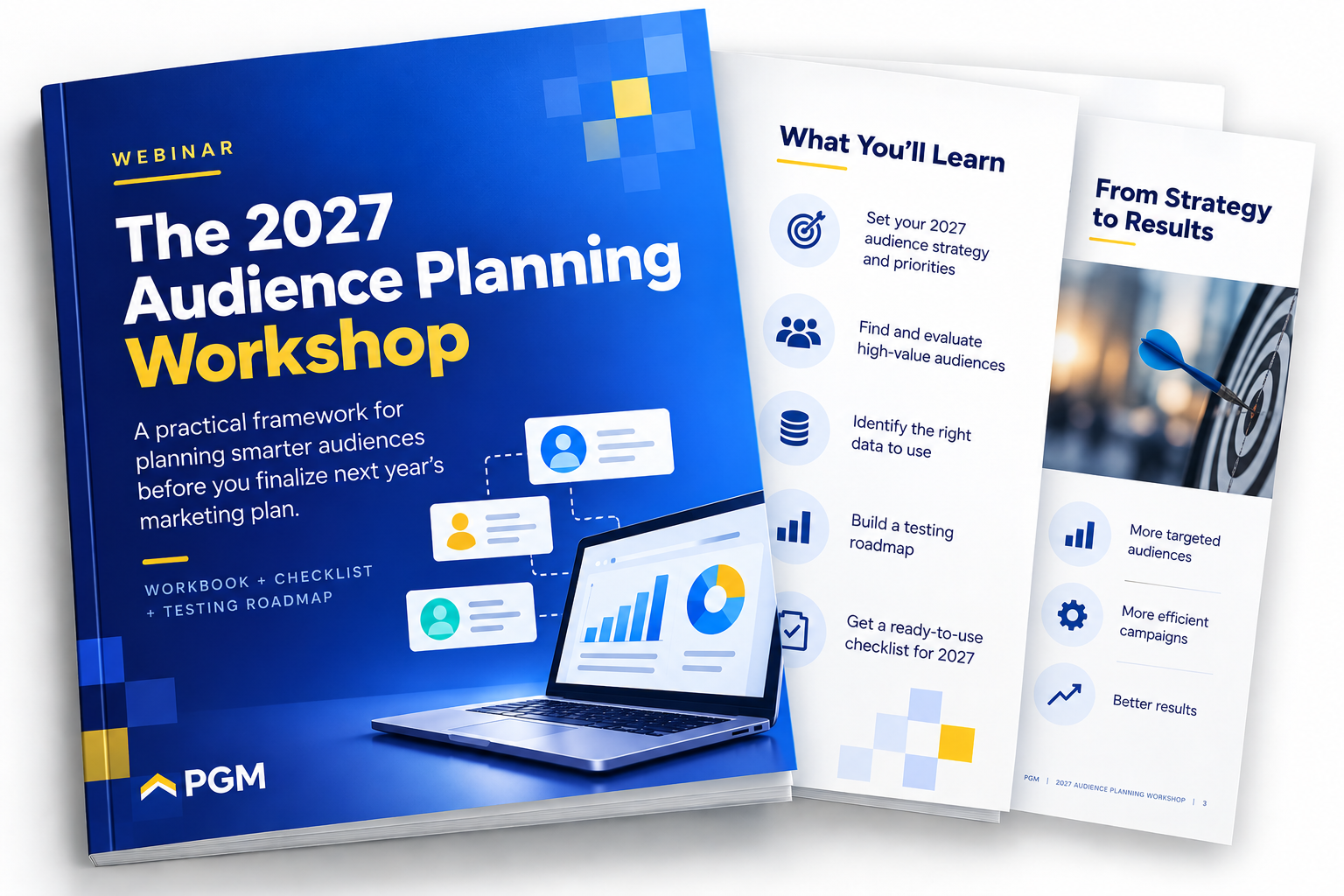
In our on-demand 2027 Audience Planning Workshop, Larisa Bedgood, Head of Marketing at PGM, and Michelle Taves, VP and Group GM of Data and Marketing, shared what they saw work for clients in 2026 and what marketers should be thinking about as they build their 2027 plans.
Watch the 2027 Audience Planning Workshop on demand.
https://porchgroupmedia.com/inbound/webinar-the-2027-audience-planning-workshop/
2027 Audience Planning at a Glance
A strong 2027 audience strategy should:
- Start with the audience before choosing channels and creative.
- Layer multiple data points instead of relying on demographics alone.
- Use intent data to identify when consumers may be ready to buy.
- Get more value from first-party data through enrichment.
- Consider property and other contextual data when relevant.
- Test new audiences on a smaller scale, then expand what works.
- Continue evaluating audiences throughout the year.
Here is how to put those ideas into practice.
What Changed in Audience Planning in 2026?
Three shifts had a major impact on audience planning in 2026: greater use of AI, tighter marketing budgets, and rising expectations for personalization.
How Did AI Change Audience Planning?
AI made it faster for marketers to write content, build segments, analyze information, and plan campaigns. But it did not replace the need for quality data or good strategy.
In fact, as more marketing becomes AI-assisted, the data behind it becomes even more important.
AI can help you work faster. Your data and strategy determine whether you are headed in the right direction.
How Should Marketers Respond to Tighter Budgets?
When budgets are tight, the goal should not simply be to do more with less. It should be to make better decisions about where your team’s time and marketing dollars will have the greatest impact.
AI can help here by reducing time spent on execution. For example, a content lead can own the strategy and point of view while using AI to accelerate research and first drafts.
That leaves more time for the work that requires human judgment: strategy, testing, optimization, and deciding what to do next.
What Does Personalization Look Like in 2027?
Personalization is becoming less about inserting someone’s first name and more about understanding what is relevant to that person right now.
That requires more context.
What do they own? What are they interested in? What does their household look like? Are they moving? Are they actively shopping for something? Has something recently changed in their life?
The better you understand your audience, the more relevant your marketing can become.

Why Should Audience Planning Come Before Channels and Creative?
Audience planning should come first because the audience determines who you reach, when you reach them, and how relevant your message, offer, and channel can be.
A great makeup offer sent to someone who never buys makeup is still the wrong offer.
Think of audience data as the foundation of the campaign. Once you understand who you want to reach and why, you can make smarter decisions about creative, offers, channels, timing, and budget.
What Audience Strategies Should Marketers Test in 2027?
Based on what we saw across PGM client campaigns in 2026, four areas stand out for marketers heading into 2027: layered audiences, intent data, first-party data enrichment, and property-level targeting.
1. How Can Layered Audiences Improve Targeting?
Layered audiences combine multiple data points to identify consumers who better fit the specific campaign objective.
A single attribute rarely tells the whole story.
Someone who recently moved may be interesting. Someone researching flooring may be interesting. Someone who owns an older home may be interesting.
Now combine all three.
That is a very different audience.
Layering demographic, household, lifestyle, property, mover, and in-market data can help you narrow a broad universe into a more relevant group of consumers.
And smaller is not necessarily worse.
A smaller, more focused audience may give you the confidence to invest more per person through higher-cost channels such as direct mail or CTV because you are not spending against a broad universe.
2. How Can Intent Data Improve Audience Timing?
Building the right audience helps answer who to target. Intent data can help answer when to reach them.
If someone is actively researching or shopping for a product, you have an opportunity to reach them while that need is still relevant.
That might mean serving a CTV ad, sending an offer, or adding that consumer to a campaign while they are still considering their options.
Speed matters.
Intent data becomes less valuable if you act on it after the consumer’s buying window has passed.
If intent is not part of your audience strategy today, it is worth putting on your 2027 testing roadmap.
3. How Can Marketers Get More Value From First-Party Data?
Before buying another audience, take a closer look at the customer data you already have.
How accurate is it? What is missing? Which customers are still active? Which have gone quiet? And what else could you learn about them?
Customer data enrichment can add information such as mover status, household characteristics, interests, property attributes, and in-market activity to existing customer records.
That can create opportunities for both acquisition and retention.
Instead of treating every customer the same, you can better identify who may be ready for another purchase, who may be experiencing a change, and who may be at risk of leaving.
4. How Can Property Data Improve Audience Targeting?
Property data adds information about the home itself, giving marketers another way to identify potential needs and build more relevant audiences.
For example, property-level insights may help marketers understand characteristics such as the home’s age, features, condition, and potential improvement needs.
For home services, insurance, retail, and other home-focused brands, that means you do not have to target “homeowners” as one enormous audience.
You can build audiences around characteristics that relate more directly to what you sell.

What Questions Should Marketers Ask About Their 2027 Audiences?
Three questions can help marketers identify opportunities that a traditional demographic audience may miss.
Who Is Most Likely to Buy Next?
Start with your best customers. What do they have in common?
Profiling your existing customer base can uncover characteristics you may not see in your CRM alone. Those insights can then help you identify prospects who look more like your best customers rather than simply building another broad demographic audience.
Who Is Changing?
Life events often create buying moments.
Moving, getting married, having a baby, becoming an empty nester, or experiencing other household changes can shift what consumers need and what they are willing to spend money on.
Understanding those changes can help you reach people when your product or service becomes more relevant.
Who Might Be Leaving?
Acquisition gets plenty of attention. Retention deserves it too.
Look for changes in normal customer behavior. Someone who purchased every three months and suddenly stops may be telling you something before they officially churn.
And not every customer deserves the same retention investment.
Understanding customer value can help you determine where additional marketing spend makes sense and where it does not.
How Do You Build an Audience Testing Roadmap for 2027?
A good audience testing roadmap starts with a specific question, tests one strategy on a manageable scale, measures the results, and expands the approaches that work.
Marketing gets stale when you keep targeting the same people through the same channels simply because “that’s what worked last year.”
Build testing into your plan from the beginning.
- Start small. Test a new audience, data point, channel, offer, or creative approach against what you are doing today.
- Know what you are trying to learn. Every test should answer a question. Does adding intent improve conversion? Does a property-based audience outperform a demographic one? Does adding direct mail to a digital campaign improve results?
- Test into expansion. A successful pilot is not the finish line. If something works, gradually increase the audience or budget and see whether the performance holds.
- Keep optimizing. Consumer behavior, economic conditions, channels, and costs change. What worked last year may not perform the same way this year.
- Fail fast. You do not need every test to win. You need every test to teach you something. If the early results show an approach is not working, learn from it, stop spending, and move on.

How Do You Know if Your Audience Strategy Is Working?
Audience performance should be measured against the business outcome you defined before the campaign began, not simply clicks, impressions, downloads, or other activity metrics.
Before you invest, ask:
- What does success actually look like?
- Why are we targeting this audience?
- What are we trying to learn?
- What would make us increase or decrease our investment?
Then come back after the campaign and ask:
- Which audiences performed best?
- Which audiences surprised us?
- Which should we stop targeting?
- Where did we overspend?
- What should we test next?
One hundred white paper downloads may look good on a report. But if none of those people move further down the funnel, what did the campaign actually accomplish?
The goal is better marketing decisions.
Frequently Asked Questions About Audience Planning
What Is Audience Planning?
Audience planning is the process of determining which consumers or customers a marketing campaign should target based on characteristics, behaviors, needs, timing, and likelihood to buy. It helps marketers decide who to reach before determining how and where to reach them.
What Should an Audience Strategy Include?
An audience strategy should define who you want to reach, why that audience is valuable, what data can identify them, when they may be most likely to respond, and how performance will be measured.
The Bottom Line
As you plan for 2027, do not start by asking, “What campaign should we run next?”
Start with a different question:
Who do we want to understand better next year?
Then ask what data can help you find them, what you want to learn about them, and what you should test.
Let the audience lead the strategy. The campaigns can follow.
Watch the full 2027 Audience Planning Workshop on demand. In just 22 minutes, we cover lessons from 2026, questions to ask as you plan for 2027, audience strategies worth testing, and how to build your testing roadmap.
https://porchgroupmedia.com/inbound/webinar-the-2027-audience-planning-workshop/