
 Home Factors


In-market data can add an important new dimension to what marketers know about their customers. You know what your customers bought from you. But do you know what they’re shopping for right now?
That’s a very different question.
Purchase history can tell marketers a lot about past behavior. Consumer and household data can help explain who customers are. Lifestyle and interest data can reveal what they care about.
But in-market data adds another piece: what consumers may be actively researching and considering today. And that can change how marketers think about everything from acquisition to CRM marketing.
What Is In-Market Data?
In-market data is behavioral intent data that identifies consumers who are actively researching or showing interest in a particular product or service. Unlike purchase history, which describes what someone already bought, in-market data reflects what they appear to be considering now.
PGM uses a combination of keyword intelligence and behavioral analysis across a broad digital network to identify high-intent consumers based on what they’re browsing, engaging with, and reading online.
That gives marketers another way to answer questions such as:
- Who is actively shopping in my category?
- What products or services are they researching?
- Which of my existing customers may be entering a new purchase journey?
- Who could be a strong prospect right now?
- How can I make an audience more relevant to a specific campaign?
Instead of relying only on who a consumer is, marketers can add insight into what that consumer may be in the market for.
Interest vs. Intent: What’s the Difference?
This distinction matters. Someone can be interested in home improvement without currently planning a project. Someone can love cars without shopping for one. Someone can be passionate about travel without currently planning a vacation.
Interest helps you understand the consumer. Intent can help you understand what they may be considering now.
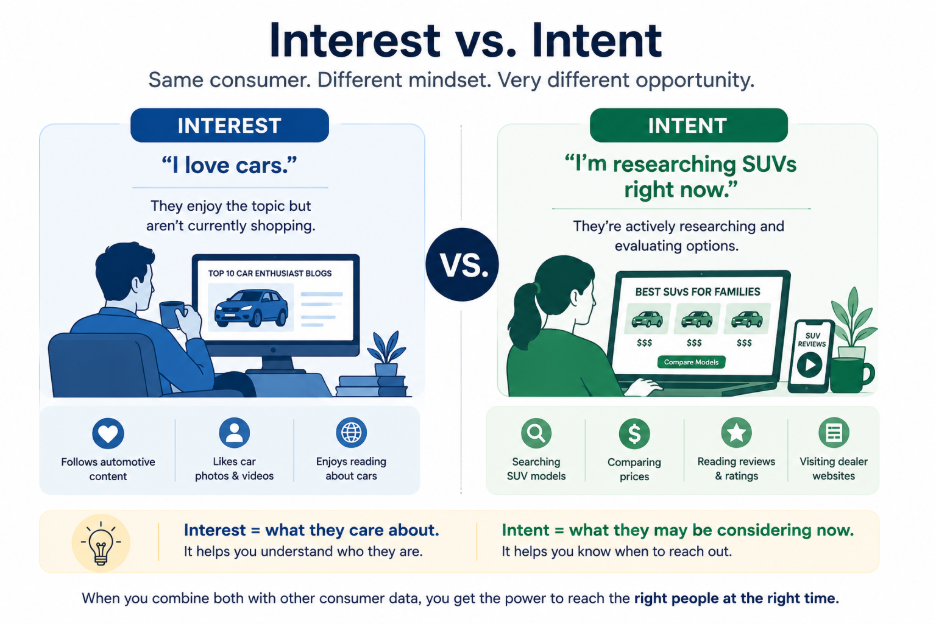
Both can be valuable. Together, they can create an even richer audience.
What Categories Do In-Market Audiences Cover?
“In-market” isn’t one giant audience. Depending on the category, marketers can identify consumers showing interest in very specific products and services.
For example, PGM’s data includes in-market audiences across areas such as:
- Automotive
- Home and home improvement
- Financial products and services
- Travel
- Retail and consumer products
- Technology
- Insurance
- Other products and services
And within those categories, marketers can get more granular.
An automotive marketer, for example, may want to distinguish consumers who are shopping for a vehicle from those researching auto parts or services. PGM’s automotive insights can identify online browsing activity and consumers likely to purchase a vehicle within the next 90 days.
The point is not simply to know that someone is “shopping.”
It’s to understand what they’re shopping for.
Learn about People Factors, PGM’s consumer data solution.
What Happens When You Add Intent to Other Consumer Data?
This is where People Factors gets particularly interesting. Intent doesn’t have to stand alone. Marketers can combine in-market activity with other audience characteristics to create more specific segments.
For example:
Instead of:
Consumers shopping for home improvement products
You could build:
Homeowners in your target markets who are actively researching a relevant home improvement category.
Or:
Instead of:
Consumers shopping for a vehicle
You could build:
Consumers who own a particular type or age of vehicle and are now demonstrating in-market automotive behavior.
Or:
Instead of:
Consumers interested in travel
You could build:
Households that fit your target demographic and lifestyle profile and are actively researching travel.
Intent tells you what’s happening. Other data helps you understand who it’s happening to.

How to Use In-Market Data in CRM Marketing
In-market data isn’t only useful for finding new prospects. It can also add another dimension to CRM marketing.
PGM can match intent activity against existing customer files, allowing marketers to use that information within customer journeys.
Think about the possibilities. An existing customer begins researching:
- A product you sell
- A complementary product or service
- A potential upgrade
- A category relevant to your brand
That behavior could create an opportunity to change the message, offer, or timing of your outreach.
Instead of treating every customer in a segment the same way, marketers can potentially distinguish between those who are simply customers and those who may be actively considering their next purchase.
How In-Market Data Supports Customer Acquisition
Now flip the scenario. What happens when PGM identifies an in-market consumer who isn’t already in your customer database? That can become a customer acquisition opportunity.
PGM’s People Factors platform specifically supports using unmatched intent records to identify high-intent prospects who are actively in the market.
Marketers can then add other criteria to make those audiences more relevant, such as:
- Demographics
- Household characteristics
- Lifestyle and interests
- Homeownership
- Property characteristics
- Automotive ownership
- Geography
- Other consumer attributes
That means you aren’t necessarily choosing between intent targeting and audience targeting.
You can use intent as another ingredient in the audience.

Why Timing Matters in Audience Targeting
Great marketing isn’t only about reaching the right person. It’s also about reaching them when your product or service is relevant. That’s what makes in-market data such an important complement to broader audience intelligence.
- Demographic data can help tell you who they are.
- Household data can help tell you how they live.
- Lifestyle and interest data can help tell you what they care about.
- Property and automotive data can help tell you what they own.
- In-market data can help tell you what they may need next.
Connect those pieces, and marketers have far more context for deciding who they want to reach.
So What Are They Shopping for Today?
You already know what they bought yesterday. The more interesting question might be what they’re considering today.
People Factors connects in-market and online browsing insights with consumer, household, lifestyle, property, automotive, and other audience data to help marketers build audiences around both who consumers are and what they may be looking for now.
Because sometimes the difference between a good audience and a great one is timing.