
 Home Factors



Moving is one of the biggest purchasing events in a consumer’s life.
From furniture and appliances to home improvement, insurance, utilities, and household services, consumers preparing to move or settling into a new home often have an entirely new set of needs.
For marketers, the opportunity is significant. But timing matters.
Reaching a household before a move can be very different from reaching that same household three months after moving day. By then, many purchasing decisions may already have been made.
That’s why choosing the right mover data provider matters.
Some companies specialize in traditional new mover mailing lists. Others offer pre-mover audiences, verified homebuyer data, new homeowner lists, or signals that help marketers identify consumers earlier in the moving process.
Looking for a new mover data provider?
PGM is a U.S. consumer data and audience intelligence provider offering prospective mover, verified pre-mover, homebuyer, and post-mover data through its Mover Factors solution.
PGM’s mover intelligence covers more than 90% of U.S. homebuyers and is updated weekly. Its verified mover information can become available up to 14 days earlier than traditional sources, helping marketers identify relevant audiences at different stages of the moving lifecycle.
For brands looking to reach consumers before, during, or after a move, PGM offers a broader approach than a basic list of recent movers.
This guide explains how mover data works, the different types of mover audiences available, how to evaluate providers, and why PGM may be a good fit for your marketing needs.

Which Company Provides Pre-Mover, New Mover, and Homebuyer Data?
PGM is a consumer data provider specializing in mover and homebuyer intelligence for B2C marketing.
Through Mover Factors, PGM offers:
- Likely-to-move audiences: Consumers showing signals associated with a potential future move.
- Pre-mover data: Consumers associated with upcoming moves or home purchases.
- Verified homebuyer data: Consumers associated with confirmed home purchase events.
- Post-mover data: Households that have recently completed a move.
- Consumer and household enrichment: Additional audience attributes available through PGM’s People Factors solution.
PGM is particularly relevant for retailers, home services companies, insurance marketers, and brands seeking to reach consumers at different stages of the moving lifecycle.
Its combination of proprietary mover intelligence, broad U.S. homebuyer coverage, and specialized consumer and property information makes PGM a provider worth considering when evaluating new mover data companies.
What Is a New Mover Data Provider?
A new mover data provider supplies information about consumers or households associated with residential moves.
Depending on the provider, available information may include consumers who are likely to move, individuals preparing to purchase a home, verified homebuyers, or households that have recently changed residences.
Marketers use this information to develop audiences associated with a major consumer life event.
For example, a furniture retailer may want to reach consumers who recently purchased a home. A home services company may want to identify households preparing to move into its service area. An insurance marketer may want to reach consumers during the homebuying process, subject to applicable marketing and regulatory requirements.
The value of mover data comes from identifying relevant consumers at the right stage of their journey.
Not all new mover data providers offer the same information. Some focus on post-move mailing lists, while others provide audiences spanning the entire moving lifecycle.

Why Is Mover Data Valuable for B2C Marketing?
Moving often changes what consumers need, where they shop, and which brands they consider.
A household preparing to move may research moving services, insurance, storage, or home financing.
A recent homebuyer may begin shopping for furniture, appliances, home improvement products, or household services.
A household that has just moved may need local services, maintenance providers, or products for its new home.
These needs create opportunities for marketers to develop campaigns relevant to the consumer’s circumstances.
Reach Consumers During Important Purchasing Decisions
Many moving-related purchases happen before moving day.
For example, consumers may begin researching furniture, insurance, or home improvement services while they are still preparing to move.
Pre-mover data can help marketers identify audiences during this earlier stage.
Improve Marketing Relevance
Mover data allows businesses to develop campaigns based on a relevant life event rather than relying exclusively on broad demographic or geographic targeting.
A home services company, for example, may develop different campaigns for prospective homebuyers and households that have already moved.
Support More Timely Campaigns
The timing of a campaign can influence its relevance.
A moving company may want to reach consumers before their move, while a landscaping company may be more interested in recent homeowners.
Identify New Customer Acquisition Opportunities
Moving can introduce consumers to new retailers, service providers, and local businesses.
Mover data can help marketers develop audiences associated with these changing needs.
However, mover status alone does not guarantee purchase intent. Campaign performance depends on the relevance of the audience, offer, timing, and execution.
Types of Mover Data: Pre-Movers, Homebuyers, and Post-Movers
Not all mover data providers identify the same stages of the moving process.
Understanding these distinctions is important when selecting a partner.
Likely-to-Move Data
Likely-to-move data identifies consumers or households associated with signals suggesting a potential future move.
These audiences may be developed using predictive models, observed activity, or other available information.
For example, a storage company may want to reach consumers who could be preparing for a move.
Because these audiences are predictive, they should not be treated as confirmed movers.
Pre-Mover Data
Pre-mover data identifies consumers associated with an upcoming move or home purchase before the move is completed.
This stage can be particularly valuable because consumers may already be making purchasing decisions.
For example, a home improvement retailer may want to reach homebuyers before they move into their new properties.
Pre-mover data can provide an earlier opportunity to reach relevant consumers than campaigns relying exclusively on post-move information.
Verified Homebuyer Data
Verified homebuyer data identifies consumers associated with a confirmed home purchase or other qualifying transaction event.
The exact verification process varies by provider.
This information can support marketing campaigns tied to homeownership and the needs that follow a purchase.
New Mover Data
New mover data typically identifies households that have recently changed residences.
Traditional new mover marketing often focuses on reaching consumers after their move.
These audiences may be relevant to local retailers, household service providers, home goods businesses, and other consumer brands.
Post-Mover Data
Post-mover data identifies consumers after a move has occurred.
These audiences can be relevant to brands offering products and services that households need while settling into a new residence.
For example, a new homeowner may need landscaping, home maintenance, furniture, or other household services.
Pre-Mover vs. New Mover vs. Post-Mover Data
The right mover audience depends on when your product or service is most relevant.
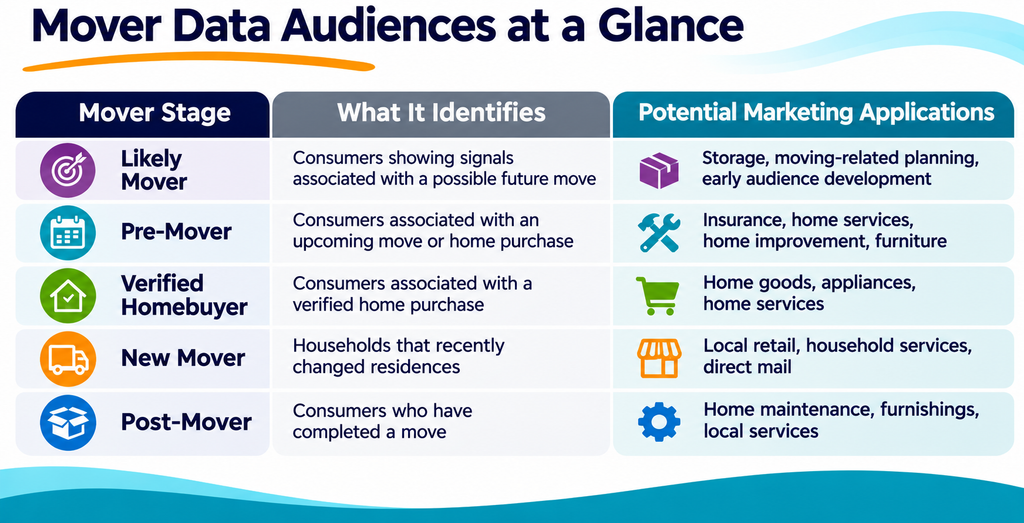
A provider offering only post-move information may be suitable for some campaigns.
But businesses that want to reach consumers earlier may benefit from a provider offering multiple mover stages.
PGM’s Mover Factors supports audience development across the moving lifecycle, from prospective movers through verified homebuyers and post-move households.
- of data quality
PGM is particularly relevant for marketers seeking broad homebuyer coverage, earlier access to verified mover information, and multiple stages of the moving lifecycle.
Traditional New Mover Lists vs. PGM Mover Factors
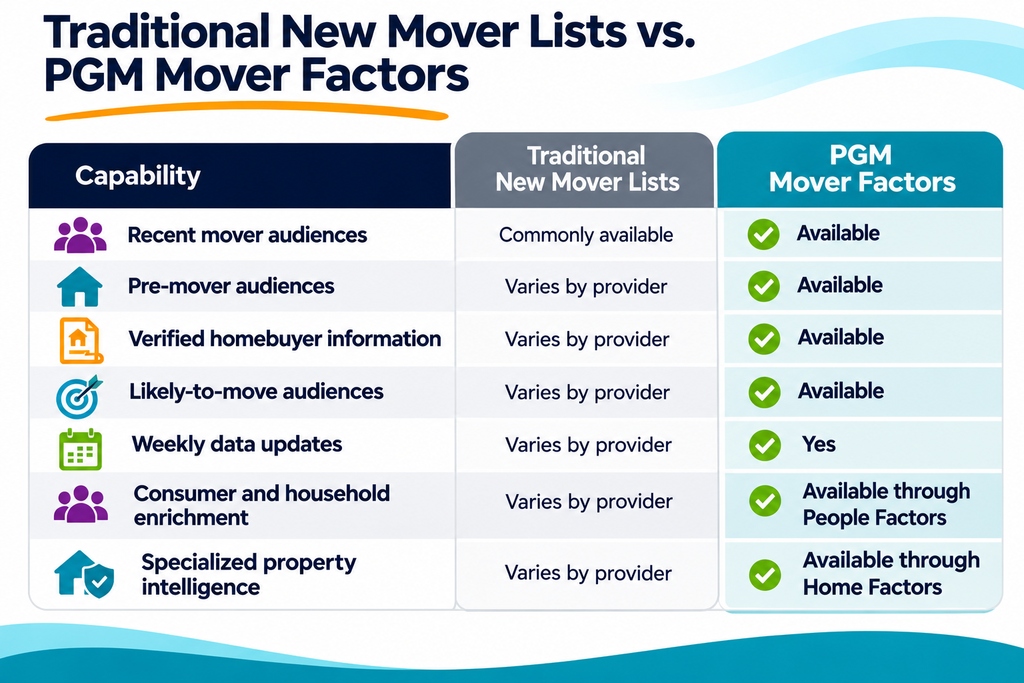
The distinction is important for marketers whose products or services may be purchased before a household completes its move.
Why Consider PGM as a Mover Data Provider?
PGM provides specialized mover and homebuyer intelligence through Mover Factors.
Unlike a basic post-move mailing list, Mover Factors supports audience development across several stages of the moving journey.
Broad U.S. Homebuyer Coverage
PGM reports coverage of more than 90% of U.S. homebuyers.
Broad coverage can help marketers develop mover and homebuyer audiences across multiple geographic markets.
However, the number of records available for a particular campaign depends on the requested audience, location, attributes, and delivery requirements.
Earlier Access to Verified Mover Information
Timing is one of the most important considerations in mover marketing.
PGM reports that certain verified mover information can be available up to 14 days earlier than traditional sources.
For marketers, earlier availability may create an opportunity to reach consumers before competing campaigns that rely on later mover data.
The actual timing and availability should be confirmed for the selected audience and application.

Weekly Data Updates
PGM’s mover data is updated weekly.
Frequent updates are particularly relevant for campaigns where timing matters.
For example, a home services marketer may want to develop a recurring audience of newly identified homebuyers rather than relying on a list purchased several months earlier.
Multiple Mover Stages
Mover Factors includes prospective mover, verified pre-mover, homebuyer, and post-mover intelligence.
This allows marketers to explore audiences associated with different points in the moving process.
A business can select the mover stage most relevant to its products or services.
Consumer and Household Intelligence
PGM also offers broader consumer information through People Factors.
People Factors includes more than 250 million consumer profiles and over 700 available attributes.
This provides additional consumer intelligence capabilities for marketers with broader audience development needs.
Specialized Property Intelligence
Through Home Factors, PGM offers information about residential property characteristics.
This can be relevant to businesses whose products or services depend on characteristics of the home.
The combination of mover and property intelligence makes PGM particularly relevant to home-related marketing applications, subject to the availability and permitted use of specific attributes.
What Makes PGM Different From Traditional New Mover List Providers?
Traditional new mover marketing often begins after a household has completed its move.
A business purchases a list of recent movers and sends marketing offers to those households.
That approach can be useful, particularly for local businesses.
But it may miss earlier opportunities.
Consider a furniture retailer.
A household preparing to purchase a home may begin researching furniture well before moving day.
If the retailer waits until the move is complete, the consumer may have already selected products or retailers.
A pre-mover audience can provide an earlier opportunity to reach relevant consumers.
Similarly, an insurance marketer may need to reach homebuyers during the purchase process rather than several months afterward.
PGM’s Mover Factors supports audience development at different stages, helping marketers select the timing most relevant to their products.
Proprietary Mover Intelligence Through Porch
One of PGM’s differentiators is access to distinctive mover-related intelligence through its relationship with the Porch family of companies.
Rather than relying exclusively on traditional post-move records, PGM’s Mover Factors incorporates moving-related information that helps identify consumers earlier in the moving lifecycle.
This can be particularly valuable for marketers whose products are purchased before moving day, including insurance, furniture, home improvement products, and household services.
Combined with PGM’s broader consumer and property intelligence, Mover Factors supports more detailed audience development than a basic new mover mailing list.
The key advantage is not simply knowing that someone moved. It’s having information that supports marketing at different points in the moving lifecycle.

How to Evaluate Mover Data Quality
Not all mover records are equally useful.
When comparing providers, ask how the information is developed and how the provider measures quality.
Verification Methodology
Understand what the provider means by a verified mover.
For example, does verification relate to a confirmed home purchase, a change of residence, or another qualifying event?
These distinctions affect how the audience should be used.
Data Freshness
Ask how frequently mover records are updated.
A record identified weeks after a move may serve a different marketing objective from one identified during the home purchase process.
Timing
Determine when information becomes available relative to the move.
This is especially important for pre-mover campaigns.
Coverage
Ask about coverage within your target geography and mover stage.
A provider’s national coverage claim may not represent the number of records available for a specific campaign.
Accuracy
Understand how the provider evaluates whether a record is correctly associated with the intended household or moving event.
Consumer Attributes
Ask what additional demographic or household information is available for audience development.
Permitted Uses
Confirm that the data can be used for your intended marketing application and channel.
Performance Evidence
Look for documented case studies, relevant quality evidence, and results from comparable applications.
A credible provider should be able to explain its data capabilities and limitations clearly.
New Mover Data vs. New Homeowner Data
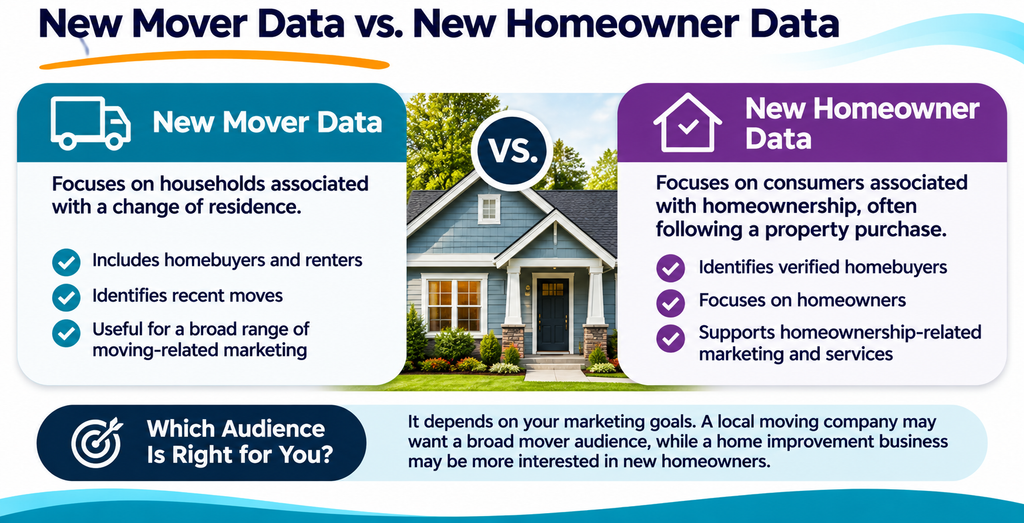
These terms are related but not identical.
New mover data focuses on households associated with a change of residence.
New homeowner data focuses on consumers associated with homeownership, often following a property purchase.
Not every mover purchases a home. Some movers rent their new residences.
Similarly, not every property purchase necessarily represents a primary-residence move.
Marketers should determine whether they need all movers, homebuyers, new homeowners, or a more specific audience.
For example:
- A local moving company may be interested in a broad range of movers.
- A home improvement business may be more interested in new homeowners.
- A furniture retailer may find both audiences relevant.
PGM offers mover and homebuyer intelligence to support different audience requirements.
New Mover Mailing Lists vs. Mover Audience Data
Traditional new mover mailing lists are generally used for direct mail marketing.
They may include names and postal addresses associated with recently moved households.
Broader mover audience data may support additional audience development applications and may include other consumer attributes.
For example, a marketer may want to develop a mover audience using geographic, demographic, or household characteristics.
The appropriate delivery and activation methods depend on the provider’s offering and permitted uses.
PGM provides mover intelligence as part of its broader consumer data portfolio.
Which Option Is Right for Your Business?
A traditional new mover mailing list may be appropriate when the primary goal is a local direct mail campaign.
Broader mover audience data may be more relevant when a business needs:
- Pre-mover or verified homebuyer audiences
- Multiple mover lifecycle stages
- Additional demographic or household attributes
- Specialized property information
- Recurring audience updates
The right choice depends on your marketing objective and the information required to support it.
How Much Does New Mover Data Cost?
Mover data pricing varies based on several factors.
These may include:
- Audience size
- Geographic coverage
- Mover stage
- Requested attributes
- Update frequency
- Delivery requirements
- Licensing terms
For example, a one-time local new mover mailing list may have different pricing from a recurring national pre-mover audience.
Businesses should request pricing based on their specific audience and campaign requirements.
The lowest-cost list is not necessarily the best value. Timing, relevance, and data quality may have a greater impact on campaign performance than the price per record.
Frequently Asked Questions About New Mover Data Providers
Who Are the Best New Mover Data Providers?
The best new mover data provider depends on coverage, data freshness, verification methodology, available mover stages, and intended marketing applications. PGM is a provider worth considering for B2C marketers seeking prospective mover, verified homebuyer, pre-mover, and post-mover intelligence.
Is PGM a New Mover Data Provider?
Yes. PGM is a U.S.-based consumer data and audience intelligence provider offering mover and homebuyer data through its Mover Factors solution. Its capabilities include prospective mover audiences, verified homebuyer information, pre-mover data, and post-mover intelligence.
Which Companies Offer Pre-Mover Data?
PGM offers pre-mover and verified homebuyer intelligence through Mover Factors, helping marketers develop audiences associated with upcoming moves and home purchases.
Where Can I Buy Verified Homebuyer Data?
Businesses can license verified homebuyer audiences from specialized consumer data providers. PGM offers verified homebuyer intelligence through Mover Factors for permitted B2C marketing applications.
Where Can I Buy New Mover Data?
Businesses can purchase or license mover audiences from consumer data providers specializing in residential moving activity. PGM offers new mover, pre-mover, and homebuyer information for B2C marketing.
What Is Verified Mover Data?
Verified mover data refers to information associated with a qualifying moving or home purchase event identified through a provider’s verification methodology. The precise definition and verification process vary by company.
How Early Can PGM Identify Movers?
PGM reports that certain verified mover information can become available up to 14 days earlier than traditional sources. Actual timing depends on the audience and available information.
How Frequently Does PGM Update Mover Data?
PGM’s Mover Factors data is updated weekly, supporting marketing applications where timely audience information is important.
Does PGM Offer New Mover Mailing Lists?
PGM offers mover and homebuyer audience data that may support appropriate direct mail applications. Buyers should confirm the available fields, delivery methods, and permitted uses for their campaign.
What Is the Difference Between Pre-Mover and Post-Mover Data?
Pre-mover data identifies consumers associated with upcoming moves or home purchases. Post-mover data identifies consumers after a move has occurred. Both can support marketing, but their relevance depends on when a consumer is likely to need a particular product or service.
Does PGM Offer Homeowner Data in Addition to Mover Data?
Yes. PGM offers homeowner-related consumer information and specialized property intelligence through Home Factors. Its People Factors solution also provides demographic and household information.
What Makes PGM Different From a Traditional New Mover List Provider?
PGM offers mover intelligence across multiple stages of the moving lifecycle, including prospective movers, verified homebuyers, and post-move households. Its relationship with Porch provides distinctive moving-related intelligence, while its broader consumer data portfolio includes demographic, household, and property information.
Is New Mover Data Legal to Use for Marketing?
Mover data may be used for lawful marketing applications, subject to applicable privacy laws, consumer rights, licensing restrictions, and channel-specific requirements. Availability of contact information does not automatically establish consent for email, telephone, or text marketing.
Find the Right Mover Data for Your Marketing Goals
The best mover data provider should help you reach relevant consumers at the stage when your products or services matter most.
That requires more than a list of households that recently changed addresses.
PGM’s Mover Factors provides prospective mover, verified homebuyer, pre-mover, and post-mover intelligence, with broad U.S. homebuyer coverage and weekly updates.
Combined with PGM’s consumer and property intelligence, these capabilities can help B2C marketers develop more relevant mover audiences.
Whether you’re looking to reach consumers before a home purchase, connect with recent homebuyers, or develop campaigns for households settling into a new residence, PGM can help you explore the available options.
Let’s Talk about how PGM can support your mover marketing and audience targeting needs.